QUESTION IMAGE
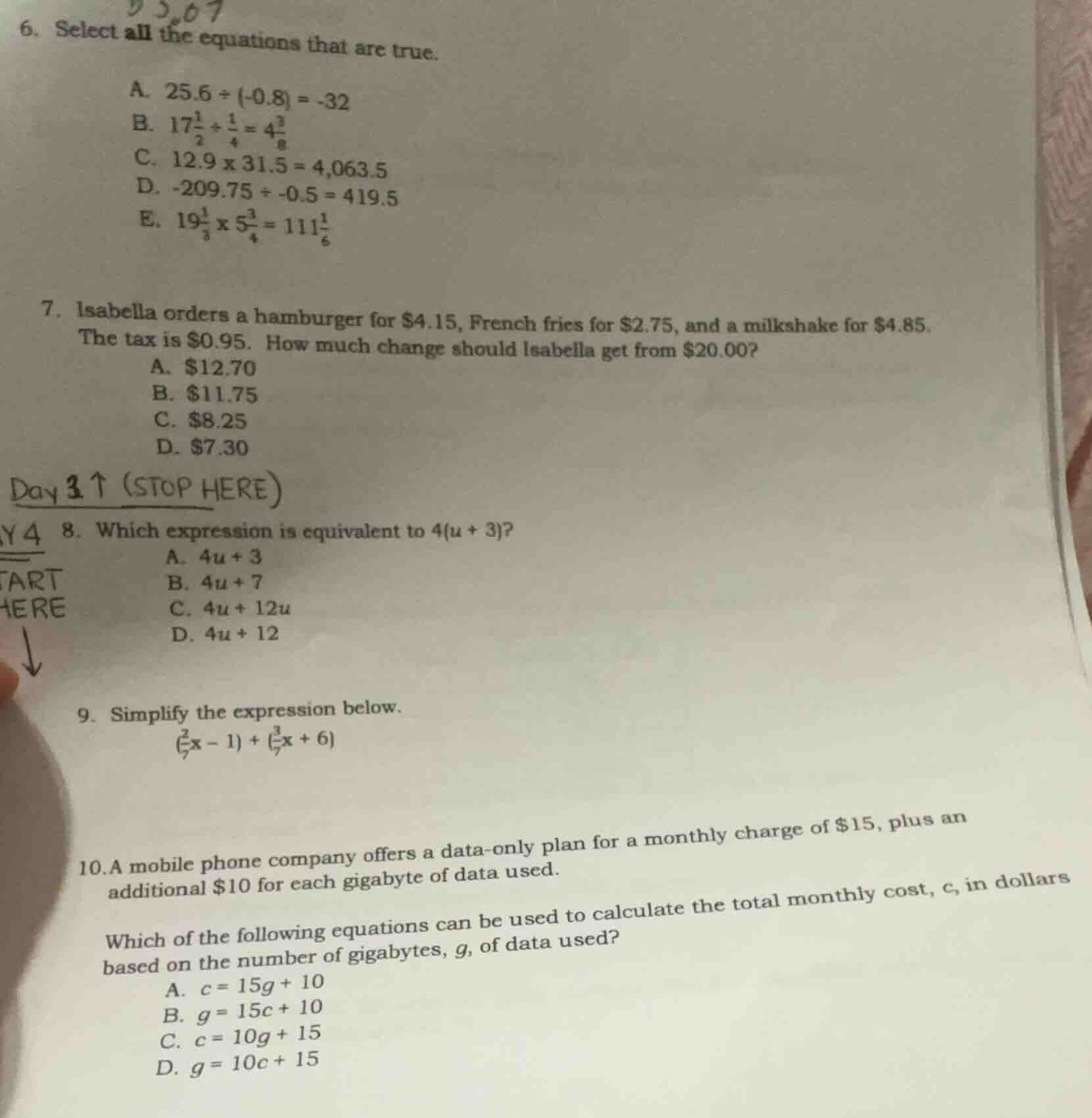
Question
- select all the equations that are true.
a. $25.6 \div (-0.8) = -32$
b. $17\frac{1}{2} \div \frac{1}{4} = 4\frac{3}{8}$
c. $12.9 \times 31.5 = 4,063.5$
d. $-209.75 \div -0.5 = 419.5$
e. $19\frac{1}{3} \times 5\frac{3}{4} = 111\frac{1}{6}$
- isabella orders a hamburger for $4.15, french fries for $2.75, and a milkshake for $4.85. the tax is $0.95. how much change should isabella get from $20.00?
a. $12.70
b. $11.75
c. $8.25
d. $7.30
- which expression is equivalent to $4(u + 3)$?
a. $4u + 3$
b. $4u + 7$
c. $4u + 12u$
d. $4u + 12$
- simplify the expression below.
$left(\frac{2}{7}x - 1\
ight) + \left(\frac{3}{7}x + 6\
ight)$
- a mobile phone company offers a data - only plan for a monthly charge of $15, plus an additional $10 for each gigabyte of data used.
which of the following equations can be used to calculate the total monthly cost, $c$, in dollars based on the number of gigabytes, $g$, of data used?
a. $c = 15g + 10$
b. $g = 15c + 10$
c. $c = 10g + 15$
d. $g = 10c + 15$
Question 6
Step 1: Check Option A
Calculate \(25.6\div(-0.8)\). Dividing a positive by a negative gives a negative. \(25.6\div0.8 = 32\), so \(25.6\div(-0.8)=-32\). So A is true.
Step 2: Check Option B
Convert \(17\frac{1}{2}\) to improper fraction: \(17\frac{1}{2}=\frac{35}{2}\). Then \(\frac{35}{2}\div\frac{1}{4}=\frac{35}{2}\times4 = 70\), which is not \(4\frac{3}{8}\). So B is false.
Step 3: Check Option C
Calculate \(12.9\times31.5\). \(13\times31.5 = 409.5\), and \(12.9\) is less than \(13\), so \(12.9\times31.5\) should be less than \(409.5\), not \(4063.5\). So C is false.
Step 4: Check Option D
Dividing two negatives gives a positive. \(-209.75\div(-0.5)=209.75\div0.5 = 419.5\). So D is true.
Step 5: Check Option E
Convert \(19\frac{1}{3}\) to \(\frac{58}{3}\) and \(5\frac{3}{4}\) to \(\frac{23}{4}\). Multiply: \(\frac{58}{3}\times\frac{23}{4}=\frac{1334}{12}=\frac{667}{6}=111\frac{1}{6}\). So E is true.
Step 1: Calculate total cost
Add the cost of hamburger, fries, milkshake and tax. \(4.15 + 2.75+4.85 + 0.95\). First, \(4.15+4.85 = 9\), \(2.75 + 0.95=3.7\), then total is \(9 + 2.75+0.95=9 + 3.7 = 12.7\)? Wait, no, wait: \(4.15+2.75 = 6.9\), \(6.9+4.85 = 11.75\), \(11.75+0.95 = 12.7\)? Wait, no, the total cost is \(4.15+2.75 + 4.85+0.95\). Let's add step by step: \(4.15+2.75 = 6.9\); \(6.9+4.85 = 11.75\); \(11.75 + 0.95=12.7\). Then change is \(20 - 12.7 = 7.3\)? Wait, no, wait, maybe I miscalculated. Wait, \(4.15+2.75 = 6.9\), \(6.9+4.85 = 11.75\), \(11.75+0.95 = 12.7\). Then \(20 - 12.7 = 7.3\). So the change is \$7.30.
Step 2: Verify
Total cost: \(4.15+2.75 = 6.9\); \(6.9+4.85 = 11.75\); \(11.75 + 0.95=12.7\). Change: \(20 - 12.7 = 7.3\). So option D.
Step 1: Apply distributive property
The distributive property is \(a(b + c)=ab+ac\). So \(4(u + 3)=4\times u+4\times3 = 4u + 12\).

Snap & solve any problem in the app
Get step-by-step solutions on Sovi AI
Photo-based solutions with guided steps
Explore more problems and detailed explanations
A, D, E