QUESTION IMAGE
Question
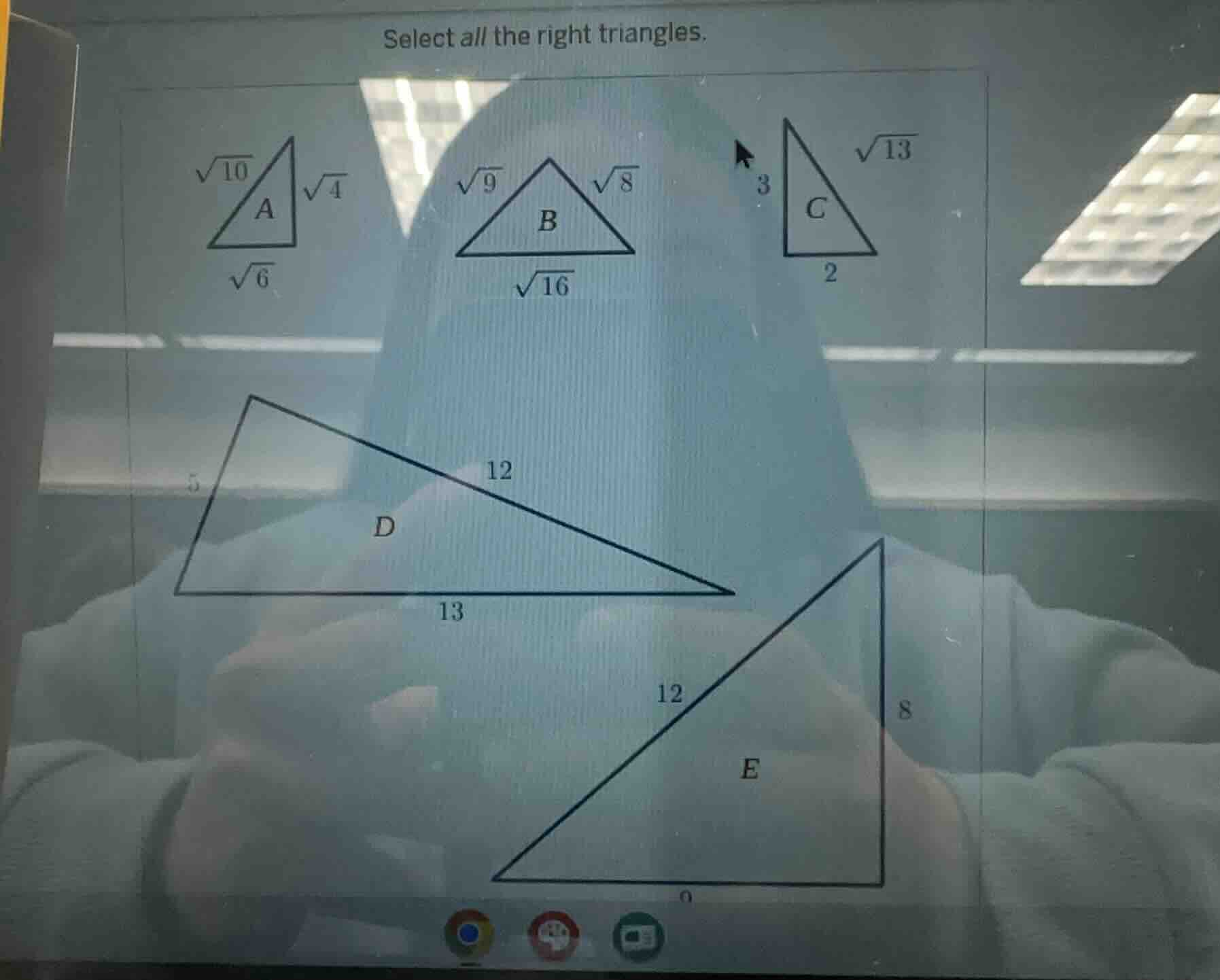
select all the right triangles.
To determine if a triangle is a right triangle, we use the Pythagorean theorem, which states that for a right triangle with legs \(a\) and \(b\) and hypotenuse \(c\), \(a^{2}+b^{2}=c^{2}\) (where the hypotenuse is the longest side). We will check each triangle:
Step 1: Check Triangle A
The sides of triangle A are \(\sqrt{10}\), \(\sqrt{4}\), and \(\sqrt{6}\). First, identify the longest side. \(\sqrt{10}\approx3.16\), \(\sqrt{4} = 2\), \(\sqrt{6}\approx2.45\). The longest side is \(\sqrt{10}\). Now check the Pythagorean theorem:
\((\sqrt{6})^{2}+(\sqrt{4})^{2}=6 + 4=10\)
\((\sqrt{10})^{2}=10\)
Since \((\sqrt{6})^{2}+(\sqrt{4})^{2}=(\sqrt{10})^{2}\), triangle A is a right triangle.
Step 2: Check Triangle B
The sides of triangle B are \(\sqrt{9}=3\), \(\sqrt{8}\approx2.83\), and \(\sqrt{16}=4\). The longest side is \(\sqrt{16} = 4\). Check the Pythagorean theorem:
\((\sqrt{9})^{2}+(\sqrt{8})^{2}=9 + 8 = 17\)
\((\sqrt{16})^{2}=16\)
Since \(17
eq16\), triangle B is not a right triangle.
Step 3: Check Triangle C
The sides of triangle C are \(3\), \(2\), and \(\sqrt{13}\approx3.61\). The longest side is \(\sqrt{13}\). Check the Pythagorean theorem:
\(3^{2}+2^{2}=9 + 4 = 13\)
\((\sqrt{13})^{2}=13\)
Since \(3^{2}+2^{2}=(\sqrt{13})^{2}\), triangle C is a right triangle.
Step 4: Check Triangle D
The sides of triangle D are \(5\), \(12\), and \(13\). The longest side is \(13\). Check the Pythagorean theorem:
\(5^{2}+12^{2}=25 + 144 = 169\)
\(13^{2}=169\)
Since \(5^{2}+12^{2}=13^{2}\), triangle D is a right triangle.
Step 5: Check Triangle E
The sides of triangle E are \(9\) (wait, the base seems to be \(9\)? Wait, the sides are \(12\), \(8\), and \(9\)? Wait, no, looking at the diagram, the legs are \(8\) and \(9\)? Wait, no, the sides are \(12\), \(8\), and \(9\)? Wait, no, let's re - check. Wait, the triangle E has sides \(12\), \(8\), and \(9\)? Wait, no, the horizontal side is \(9\), vertical side is \(8\), and the hypotenuse - like side is \(12\). Wait, no, the longest side is \(12\). Check the Pythagorean theorem:
\(8^{2}+9^{2}=64 + 81=145\)
\(12^{2}=144\)
Since \(145
eq144\), triangle E is not a right triangle. Wait, maybe I misread the sides. Wait, no, the user's diagram: triangle E has sides \(12\), \(8\), and \(9\)? Wait, no, maybe the base is \(9\), vertical is \(8\), and the other side is \(12\). So \(8^{2}+9^{2}=64 + 81 = 145\), \(12^{2}=144\), so not a right triangle.

Snap & solve any problem in the app
Get step-by-step solutions on Sovi AI
Photo-based solutions with guided steps
Explore more problems and detailed explanations
The right triangles are A, C, D.