QUESTION IMAGE
Question
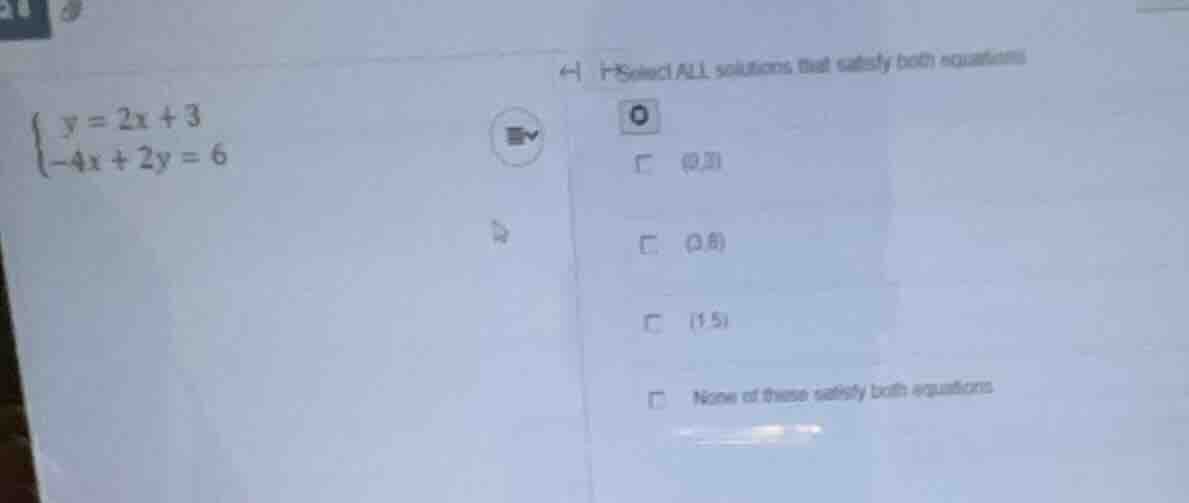
select all solutions that satisfy both equations
\
options:
- (0,3)
- (0,6)
- (1,5)
- none of these satisfy both equations
Step1: Substitute \( y = 2x + 3 \) into \( -4x + 2y = 6 \)
Substitute \( y \) in the second equation: \( -4x + 2(2x + 3) = 6 \)
Step2: Simplify the equation
Expand and simplify: \( -4x + 4x + 6 = 6 \)
\( 0x + 6 = 6 \)
\( 6 = 6 \)
This means the two equations are dependent (represent the same line), so we can check the points in the first equation \( y = 2x + 3 \).
Check (0,3):
Substitute \( x = 0 \), \( y = 2(0) + 3 = 3 \). So (0,3) satisfies \( y = 2x + 3 \). Let's check in the second equation: \( -4(0) + 2(3) = 6 \), \( 6 = 6 \). So (0,3) works.
Check (0,6):
Substitute \( x = 0 \) in \( y = 2x + 3 \), \( y = 3
eq 6 \). So (0,6) does not satisfy the first equation.
Check (1,5):
Substitute \( x = 1 \) in \( y = 2x + 3 \), \( y = 2(1) + 3 = 5 \). So (1,5) satisfies \( y = 2x + 3 \). Check in the second equation: \( -4(1) + 2(5) = -4 + 10 = 6 \). So (1,5) also works. Wait, but let's re - check the substitution in the second equation for (1,5):
For the second equation \( -4x+2y = 6 \), when \( x = 1 \) and \( y = 5 \):
\( -4(1)+2(5)=-4 + 10=6 \), which is equal to the right - hand side. And for the first equation \( y = 2x+3 \), when \( x = 1 \), \( y=2(1)+3 = 5 \), which matches the \( y \) - value of the point (1,5).
Wait, but initially, when we substituted, we got an identity, which means all points on the line \( y = 2x + 3 \) are solutions. So both (0,3) and (1,5) are solutions? But let's check the options again. The options given are (0,3), (0,6), (1,5), and "None of these satisfy both equations".
Wait, maybe there was a typo in the problem's option for (0,3) (the first option is marked with a circle, maybe it's (0,3)). Let's re - evaluate:
For (0,3):
First equation: \( y=2x + 3\), when \( x = 0 \), \( y=3 \), so (0,3) is on the line.
Second equation: \( -4x+2y=6\), when \( x = 0 \), \( 2y=6\), \( y = 3 \), so (0,3) satisfies the second equation.
For (1,5):
First equation: \( y=2(1)+3 = 5 \), so (1,5) is on the line.
Second equation: \( -4(1)+2(5)=-4 + 10 = 6 \), so (1,5) satisfies the second equation.
But looking at the options, if (0,3) and (1,5) are options (assuming the first option is (0,3) and the third is (1,5)):
Wait, maybe the original problem's first option is (0,3) (the circle is on the first option, maybe the text of the first option is (0,3)). Let's check the options again as per the user's image:
The options are:
- (0,3) (the first checkbox with a circle, maybe pre - selected)
- (0,6)
- (1,5)
- None of these satisfy both equations
So let's check each point:
- For (0,3):
- In \( y = 2x+3 \): \( y=2(0)+3 = 3 \), so it satisfies the first equation.
- In \( -4x + 2y=6 \): \( -4(0)+2(3)=6 \), so it satisfies the second equation.
- For (0,6):
- In \( y = 2x + 3 \), when \( x = 0 \), \( y = 3
eq6 \), so it does not satisfy the first equation.
- For (1,5):
- In \( y = 2x+3 \), when \( x = 1 \), \( y=2(1)+3 = 5 \), so it satisfies the first equation.
- In \( -4x + 2y=6 \), when \( x = 1 \), \( -4(1)+2(5)=-4 + 10 = 6 \), so it satisfies the second equation.
So both (0,3) and (1,5) are solutions. But looking at the options, if (0,3) is the first option (with the circle) and (1,5) is the third option, then both (0,3) and (1,5) satisfy both equations. But maybe there is a mistake in the problem's option presentation. However, based on the calculation:
For (0,3):
Satisfies \( y = 2x+3 \) (0,3: \( 3=2(0)+3 \)) and \( -4(0)+2(3)=6 \) (6 = 6).
For (1,5):
Satisfies \( y = 2x + 3 \) (5=2(1)+3) and \( -4(1)+2(5)=6 \) ( - 4 + 10 = 6).
But if we have to choose from…

Snap & solve any problem in the app
Get step-by-step solutions on Sovi AI
Photo-based solutions with guided steps
Explore more problems and detailed explanations
A. (0,3), C. (1,5)