QUESTION IMAGE
Question
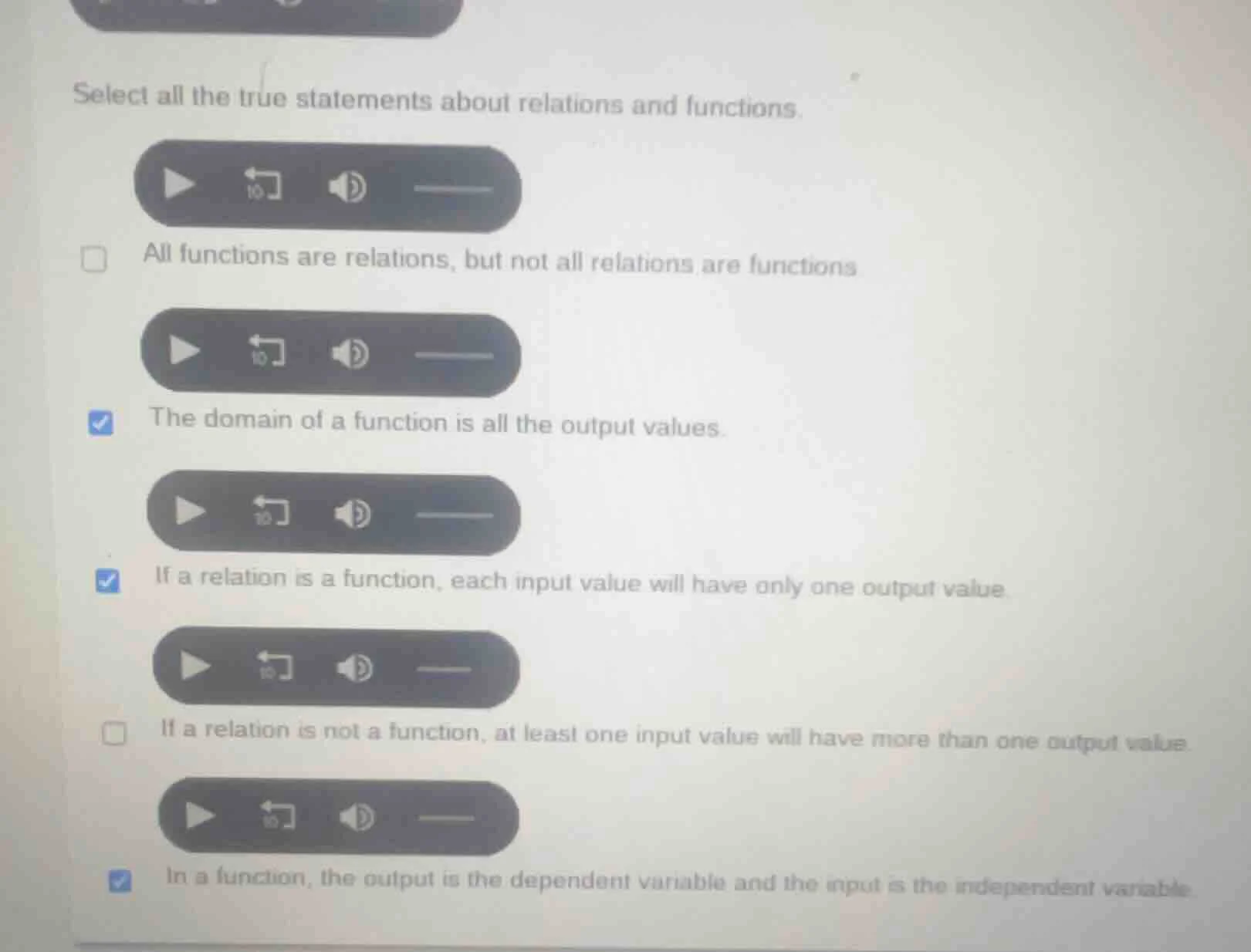
select all the true statements about relations and functions. all functions are relations, but not all relations are functions the domain of a function is all the output values. if a relation is a function, each input value will have only one output value. if a relation is not a function, at least one input value will have more than one output value. in a function, the output is the dependent variable and the input is the independent variable.
To determine the true statements about relations and functions, we analyze each option:
- "All functions are relations, but not all relations are functions"
A relation is a set of ordered pairs. A function is a special type of relation where each input (from the domain) has exactly one output (in the range). So all functions are relations (since they are sets of ordered pairs), but some relations (where an input has multiple outputs) are not functions. This is true.
- "The domain of a function is all the output values"
The domain of a function is the set of all input values (independent variable values), while the range is the set of all output values (dependent variable values). This statement confuses domain and range. It is false.
- "If a relation is a function, each input value will have only one output value"
By definition, a function requires that each input (from the domain) maps to exactly one output (in the range). This is the core definition of a function. This is true.
- "If a relation is not a function, at least one input value will have more than one output value"
A relation fails to be a function precisely because at least one input value is associated with multiple output values (violating the "one input → one output" rule for functions). This is true.
- "In a function, the output is the dependent variable and the input is the independent variable"
In a function, the input (domain) is the independent variable (its value does not depend on other variables), and the output (range) is the dependent variable (its value depends on the input). This is true.
Correct Statements:
- All functions are relations, but not all relations are functions
- If a relation is a function, each input value will have only one output value
- If a relation is not a function, at least one input value will have more than one output value
- In a function, the output is the dependent variable and the input is the independent variable
(Note: The second statement ("The domain of a function is all the output values") is incorrect and should not be selected.)

Snap & solve any problem in the app
Get step-by-step solutions on Sovi AI
Photo-based solutions with guided steps
Explore more problems and detailed explanations
- All functions are relations, but not all relations are functions
- If a relation is a function, each input value will have only one output value
- If a relation is not a function, at least one input value will have more than one output value
- In a function, the output is the dependent variable and the input is the independent variable