QUESTION IMAGE
Question
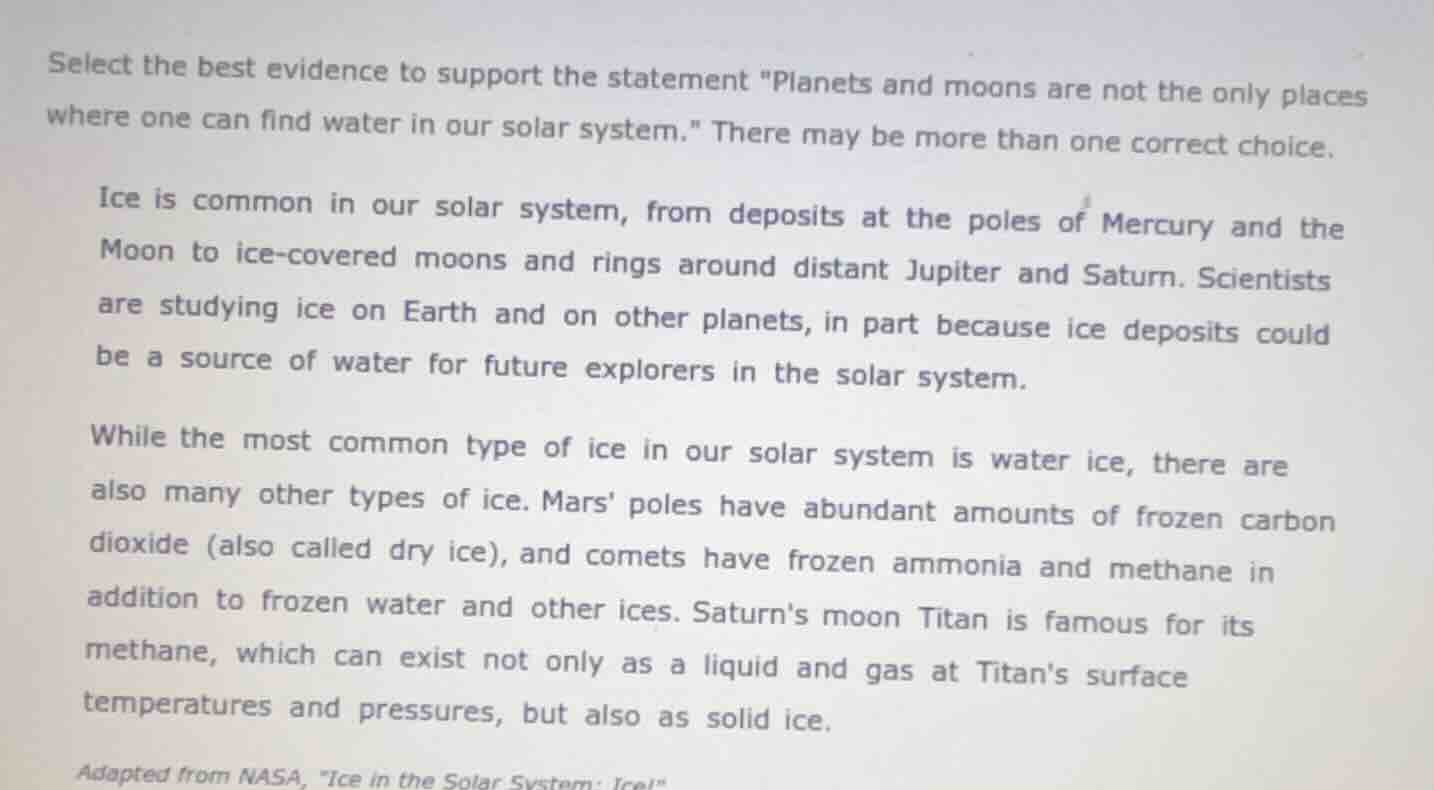
select the best evidence to support the statement \planets and moons are not the only places where one can find water in our solar system.\ there may be more than one correct choice.
ice is common in our solar system, from deposits at the poles of mercury and the moon to ice - covered moons and rings around distant jupiter and saturn. scientists are studying ice on earth and on other planets, in part because ice deposits could be a source of water for future explorers in the solar system.
while the most common type of ice in our solar system is water ice, there are also many other types of ice. mars poles have abundant amounts of frozen carbon dioxide (also called dry ice), and comets have frozen ammonia and methane in addition to frozen water and other ices. saturns moon titan is famous for its methane, which can exist not only as a liquid and gas at titans surface temperatures and pressures, but also as solid ice.
adapted from nasa, \ice in the solar system: ice!\
To support the statement, we need evidence showing water (in ice form) exists outside planets and moons. The sentence "Comets have frozen ammonia and methane in addition to frozen water and other ices" shows comets (not planets or moons) have water ice, proving water exists beyond planets and moons. Also, "Ice is common... from deposits at the poles of Mercury and the Moon to ice - covered moons and rings around distant Jupiter and Saturn" shows rings (not planets/moons) have ice (water - based), but the comet part directly shows non - planet/moon water. The best evidence is "Comets have frozen ammonia and methane in addition to frozen water and other ices" as comets are not planets or moons, so this shows water exists outside planets and moons.

Snap & solve any problem in the app
Get step-by-step solutions on Sovi AI
Photo-based solutions with guided steps
Explore more problems and detailed explanations
Comets have frozen ammonia and methane in addition to frozen water and other ices.