QUESTION IMAGE
Question
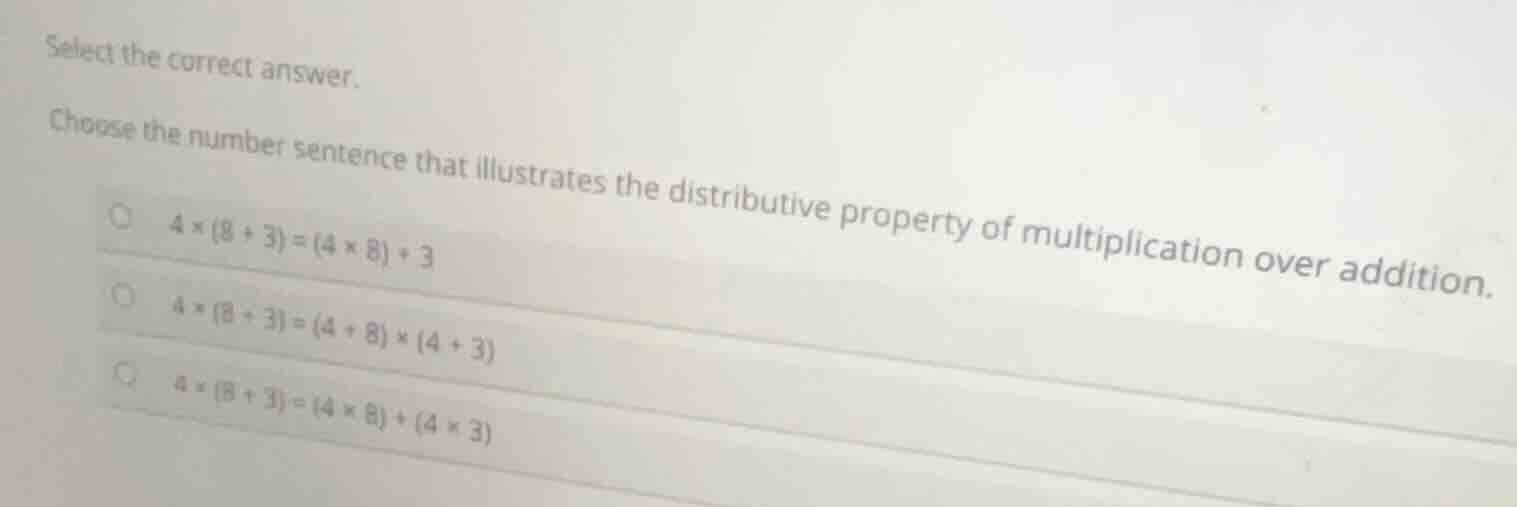
select the correct answer. choose the number sentence that illustrates the distributive property of multiplication over addition. 4×(8 + 3) = (4×8) + 3; 4×(8 + 3) = (4 + 8)×(4 + 3); 4×(8 + 3) = (4×8) + (4×3)
Step1: Recall the distributive property
The distributive property of multiplication over addition states that for any real numbers \(a\), \(b\), and \(c\), \(a\times(b + c)=(a\times b)+(a\times c)\).
Step2: Analyze each option
- First option: \(4\times(8 + 3)=(4\times8)+3\)
Here, we only multiply \(4\) with \(8\) and then add \(3\), but according to the distributive property, we should multiply \(4\) with both \(8\) and \(3\) and then add the results. So this is incorrect.
- Second option: \(4\times(8 + 3)=(4 + 8)\times(4 + 3)\)
This is not the distributive property. The right - hand side is the product of two sums, which is not related to the distributive property of multiplication over addition.
- Third option: \(4\times(8 + 3)=(4\times8)+(4\times3)\)
Here, \(a = 4\), \(b = 8\), and \(c = 3\). We can see that \(4\) is multiplied with both \(8\) and \(3\) and then the products are added, which follows the distributive property \(a\times(b + c)=(a\times b)+(a\times c)\).

Snap & solve any problem in the app
Get step-by-step solutions on Sovi AI
Photo-based solutions with guided steps
Explore more problems and detailed explanations
\(4\times(8 + 3)=(4\times8)+(4\times3)\) (the third option)