QUESTION IMAGE
Question
3
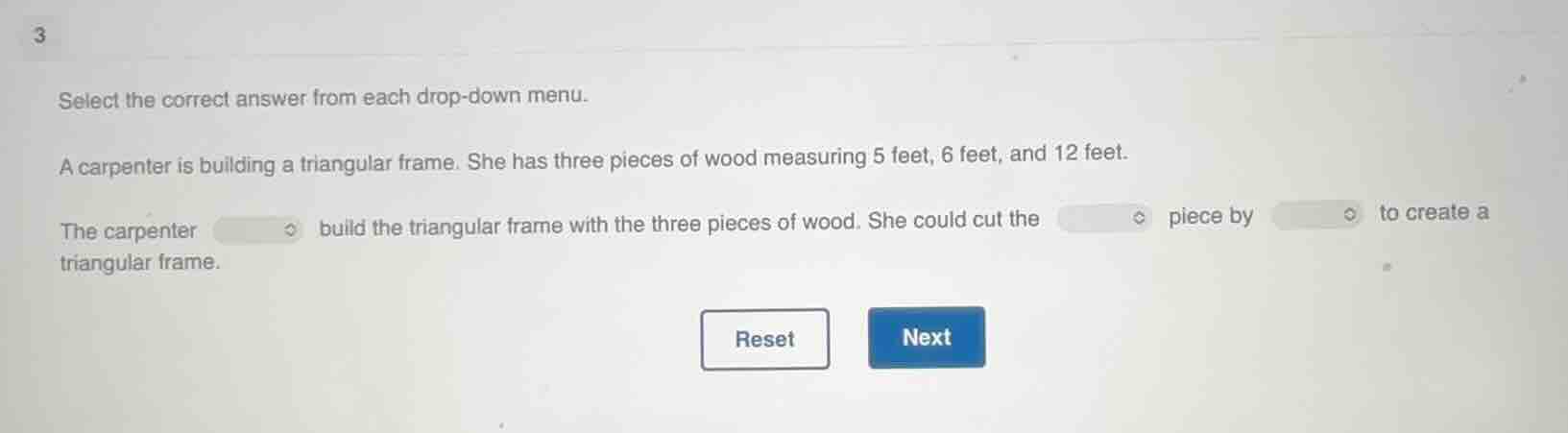
select the correct answer from each drop - down menu.
a carpenter is building a triangular frame. she has three pieces of wood measuring 5 feet, 6 feet, and 12 feet.
the carpenter build the triangular frame with the three pieces of wood. she could cut the piece by to create a triangular frame.
reset next
To solve this, we use the triangle inequality theorem, which states that the sum of the lengths of any two sides of a triangle must be greater than the length of the remaining side.
Step 1: Check the triangle inequality for the given sides
We have side lengths \( a = 5 \) feet, \( b = 6 \) feet, and \( c = 12 \) feet.
- Check \( a + b \) vs \( c \): \( 5 + 6 = 11 \), and \( 11 < 12 \). So the triangle inequality is not satisfied with these lengths. Thus, the carpenter cannot build the triangular frame with the three pieces as they are.
Step 2: Determine which piece to cut
Since the longest side (12 feet) is the one causing the inequality to fail (because \( 5 + 6 < 12 \)), we need to cut the 12 - foot piece. We need to make it shorter so that \( 5 + 6 > \) (new length of the 12 - foot piece). Let the new length be \( x \). We need \( 5+6>x \), so \( x < 11 \). So we need to cut the 12 - foot piece by at least \( 12 - 10 = 2 \) feet (or any amount such that the new length is less than 11 feet). A common way is to cut it to make the sum of the other two sides greater than the new length. For example, if we cut the 12 - foot piece to 10 feet (cutting it by \( 12 - 10 = 2 \) feet), then \( 5+6 = 11>10 \), \( 5 + 10=15>6 \), and \( 6 + 10 = 16>5 \), which satisfies the triangle inequality.
Final Answers (for the drop - down menus):
- The first drop - down: cannot
- The second drop - down: 12 - foot
- The third drop - down: (an amount such that the new length is less than 11 feet, e.g.,) 2 feet (or other valid amounts like 3 feet, 4 feet, etc., as long as the new length is less than 11)
(Note: The exact amount for the third drop - down can vary as long as it makes the new length of the 12 - foot piece satisfy the triangle inequality with 5 and 6. A typical answer could be cutting the 12 - foot piece by at least 1 foot (but more precisely, at least \( 12 - 10 = 2 \) feet to make it 10 feet, but any amount that makes the new length \( < 11 \) is correct).)
So filling in the blanks:
The carpenter \(\boldsymbol{\text{cannot}}\) build the triangular frame with the three pieces of wood. She could cut the \(\boldsymbol{\text{12 - foot}}\) piece by \(\boldsymbol{\text{2 feet (or more, such that new length}<11\text{ feet)}}\) to create a triangular frame.

Snap & solve any problem in the app
Get step-by-step solutions on Sovi AI
Photo-based solutions with guided steps
Explore more problems and detailed explanations
To solve this, we use the triangle inequality theorem, which states that the sum of the lengths of any two sides of a triangle must be greater than the length of the remaining side.
Step 1: Check the triangle inequality for the given sides
We have side lengths \( a = 5 \) feet, \( b = 6 \) feet, and \( c = 12 \) feet.
- Check \( a + b \) vs \( c \): \( 5 + 6 = 11 \), and \( 11 < 12 \). So the triangle inequality is not satisfied with these lengths. Thus, the carpenter cannot build the triangular frame with the three pieces as they are.
Step 2: Determine which piece to cut
Since the longest side (12 feet) is the one causing the inequality to fail (because \( 5 + 6 < 12 \)), we need to cut the 12 - foot piece. We need to make it shorter so that \( 5 + 6 > \) (new length of the 12 - foot piece). Let the new length be \( x \). We need \( 5+6>x \), so \( x < 11 \). So we need to cut the 12 - foot piece by at least \( 12 - 10 = 2 \) feet (or any amount such that the new length is less than 11 feet). A common way is to cut it to make the sum of the other two sides greater than the new length. For example, if we cut the 12 - foot piece to 10 feet (cutting it by \( 12 - 10 = 2 \) feet), then \( 5+6 = 11>10 \), \( 5 + 10=15>6 \), and \( 6 + 10 = 16>5 \), which satisfies the triangle inequality.
Final Answers (for the drop - down menus):
- The first drop - down: cannot
- The second drop - down: 12 - foot
- The third drop - down: (an amount such that the new length is less than 11 feet, e.g.,) 2 feet (or other valid amounts like 3 feet, 4 feet, etc., as long as the new length is less than 11)
(Note: The exact amount for the third drop - down can vary as long as it makes the new length of the 12 - foot piece satisfy the triangle inequality with 5 and 6. A typical answer could be cutting the 12 - foot piece by at least 1 foot (but more precisely, at least \( 12 - 10 = 2 \) feet to make it 10 feet, but any amount that makes the new length \( < 11 \) is correct).)
So filling in the blanks:
The carpenter \(\boldsymbol{\text{cannot}}\) build the triangular frame with the three pieces of wood. She could cut the \(\boldsymbol{\text{12 - foot}}\) piece by \(\boldsymbol{\text{2 feet (or more, such that new length}<11\text{ feet)}}\) to create a triangular frame.