QUESTION IMAGE
Question
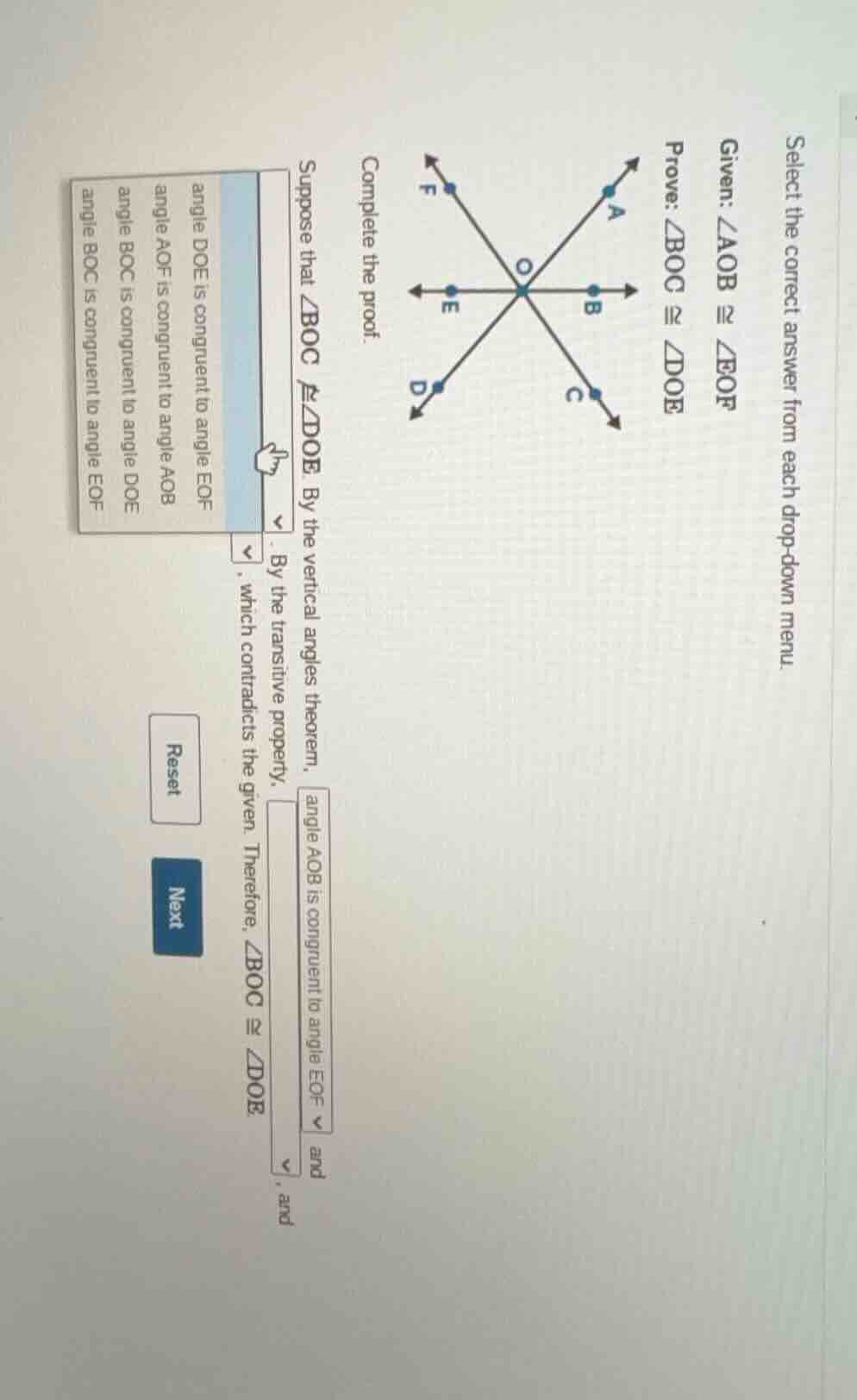
select the correct answer from each drop - down menu. given: $\angle aob\cong\angle eof$ prove: $\angle boc\cong\angle doe$ complete the proof. suppose that $\triangle boc\
cong\triangle doe$. by the vertical angles theorem, \LXI0 and by the transitive property, \LXI1, which contradicts the given. therefore, $\angle boc\cong\angle doe$ drop - down 1 options: angle doe is congruent to angle eof, angle aof is congruent to angle aob, angle boc is congruent to angle doe, angle boc is congruent to angle eof drop - down 2 options: angle aob is congruent to angle eof
To prove \(\angle BOC\cong\angle DOE\) using the given \(\angle AOB\cong\angle EOF\) and vertical angles (or transitive property), we analyze the congruence relationships:
- First Drop - Down (Angle Congruent to \(\angle EOF\)):
Given \(\angle AOB\cong\angle EOF\), and we need a relationship involving \(\angle BOC\) and \(\angle DOE\). By vertical angles, \(\angle AOB\cong\angle DOE\) (wait, no—wait, the vertical angles here: \(\angle AOB\) and \(\angle DOE\)? Wait, no, looking at the diagram, \(\angle AOB\) and \(\angle DOE\) might be vertical? Wait, no, the first step: "Suppose that \(\angle BOC
ot\cong\angle DOE\). By the vertical angles theorem, \(\boldsymbol{\angle AOB\cong\angle DOE}\) (wait, no, the options: the first dropdown after "and" is one of the angle congruences. Wait, the given is \(\angle AOB\cong\angle EOF\), and we need to use transitive property. Let's re - examine:
The proof structure is: Suppose \(\angle BOC
ot\cong\angle DOE\). By vertical angles, \(\angle AOB\cong\angle DOE\) (wait, no, the options for the first dropdown (the one with "angle AOB is congruent to angle EOF" etc.)—wait, the first dropdown (the one with the blue highlight) is the first part: "By the vertical angles theorem, \(\boldsymbol{\angle AOB\cong\angle DOE}\)"? No, the options are:
- angle DOE is congruent to angle EOF
- angle AOF is congruent to angle AOB
- angle BOC is congruent to angle DOE
- angle BOC is congruent to angle EOF
Wait, no, the first dropdown (the one after "By the vertical angles theorem, " and before "and"): Wait, the vertical angles here: \(\angle AOB\) and \(\angle DOE\) are vertical angles? Wait, in the diagram, lines \(AB\) and \(DE\) intersect at \(O\), so \(\angle AOB\cong\angle DOE\) (vertical angles). But the given is \(\angle AOB\cong\angle EOF\). Then, if we suppose \(\angle BOC
ot\cong\angle DOE\), but by vertical angles \(\angle AOB\cong\angle DOE\), and given \(\angle AOB\cong\angle EOF\), then by transitive, \(\angle DOE\cong\angle EOF\), but that would contradict \(\angle BOC
ot\cong\angle DOE\) (if we set up the contradiction). Wait, maybe I misread.
Wait, the correct steps:
- Given \(\angle AOB\cong\angle EOF\).
- By vertical angles, \(\angle AOB\cong\angle DOE\) (wait, no, \(\angle AOB\) and \(\angle DOE\) are vertical? Let's look at the diagram: \(OA\) and \(OD\) are opposite? \(OB\) and \(OE\) are opposite? Wait, the lines are: \(OA\) and \(OD\) are a straight line? \(OB\) and \(OE\) are a straight line? \(OC\) and \(OF\) are a straight line? So:
- \(\angle AOB\) and \(\angle DOE\): \(OB\) and \(OE\) are opposite, \(OA\) and \(OD\) are opposite, so \(\angle AOB\) and \(\angle DOE\) are vertical angles, so \(\angle AOB\cong\angle DOE\).
- But the given is \(\angle AOB\cong\angle EOF\). So by transitive property, \(\angle DOE\cong\angle EOF\). But we supposed \(\angle BOC
ot\cong\angle DOE\), and if \(\angle BOC\) is related to \(\angle EOF\)... Wait, no, let's look at the dropdown options again.
The first dropdown (the one with the blue highlight) is the first angle congruence we use. The options are:
- angle DOE is congruent to angle EOF
- angle AOF is congruent to angle AOB
- angle BOC is congruent to angle DOE
- angle BOC is congruent to angle EOF
Wait, the correct first part (after "By the vertical angles theorem, ") should be \(\angle AOB\cong\angle DOE\) (vertical angles), but that's not an option. Wait, maybe the vertical angles are \(\angle BOC\) and \(\angle AOF\)? No, that doesn't make sense. Wait, maybe the first dropdown…

Snap & solve any problem in the app
Get step-by-step solutions on Sovi AI
Photo-based solutions with guided steps
Explore more problems and detailed explanations
- For the first dropdown (the blue - highlighted one): angle BOC is congruent to angle EOF
- For the second dropdown (the one with "angle AOB is congruent to angle EOF" etc.): angle AOB is congruent to angle EOF
- Conclusion: \(\angle BOC\cong\angle DOE\) (by contradiction, since the supposition leads to a contradiction)