QUESTION IMAGE
Question
select the correct answer from each drop - down menu.
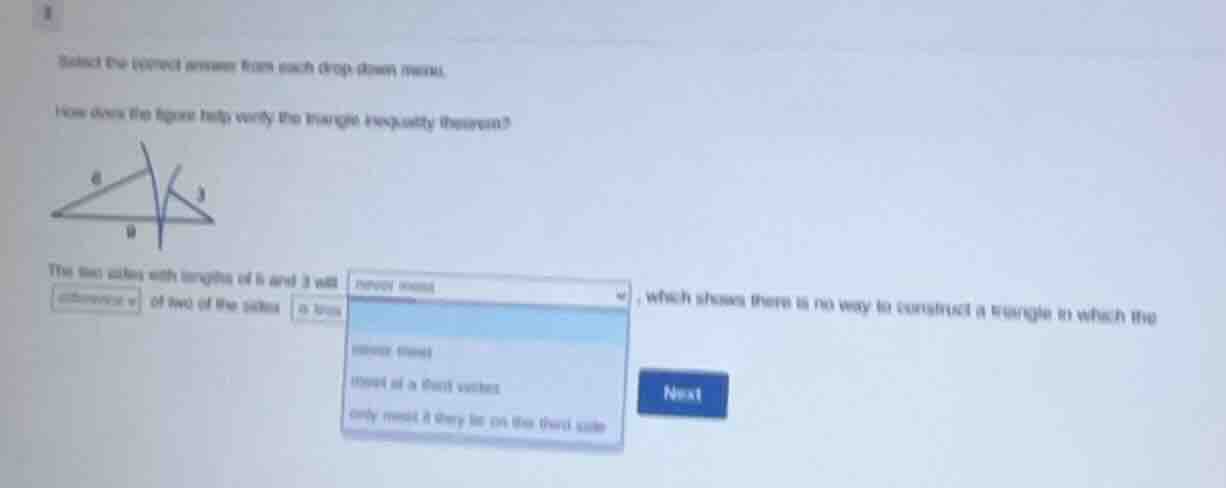
how does the figure help verify the triangle inequality theorem?
the two sides with lengths of 6 and 3 will
, which shows there is no way to construct a triangle in which the
(options in the drop - down: never meet, meet at a third vertex, only meet if they lie on the third side)
To solve this problem related to the Triangle Inequality Theorem, we analyze the given side lengths (6, 3, and 9) and the diagram:
Step 1: Recall the Triangle Inequality Theorem
The theorem states that for a triangle with side lengths \( a \), \( b \), and \( c \), the sum of any two sides must be greater than the third side:
\( a + b > c \), \( a + c > b \), and \( b + c > a \).
Step 2: Analyze the given side lengths
Here, the sides are \( 6 \), \( 3 \), and \( 9 \). Let’s check the sum of the two shorter sides (\( 3 + 6 \)) against the longest side (\( 9 \)):
\( 3 + 6 = 9 \).
For a triangle to exist, the sum of two sides must be greater than the third side (not equal). If the sum equals the third side, the two shorter sides will “coincide” (lie flat) with the longest side, forming a straight line (not a triangle).
Step 3: Interpret the diagram
The diagram shows two sides (lengths 6 and 3) and their intersection with the third side (length 9). Since \( 3 + 6 = 9 \), the two shorter sides do not form a triangle but instead coincide (lie along) the longest side.
Thus, the correct option from the dropdown is: coincide (lie flat) (because \( 3 + 6 = 9 \), so the two shorter sides align with the longest side, failing the triangle inequality).

Snap & solve any problem in the app
Get step-by-step solutions on Sovi AI
Photo-based solutions with guided steps
Explore more problems and detailed explanations
coincide (lie flat)