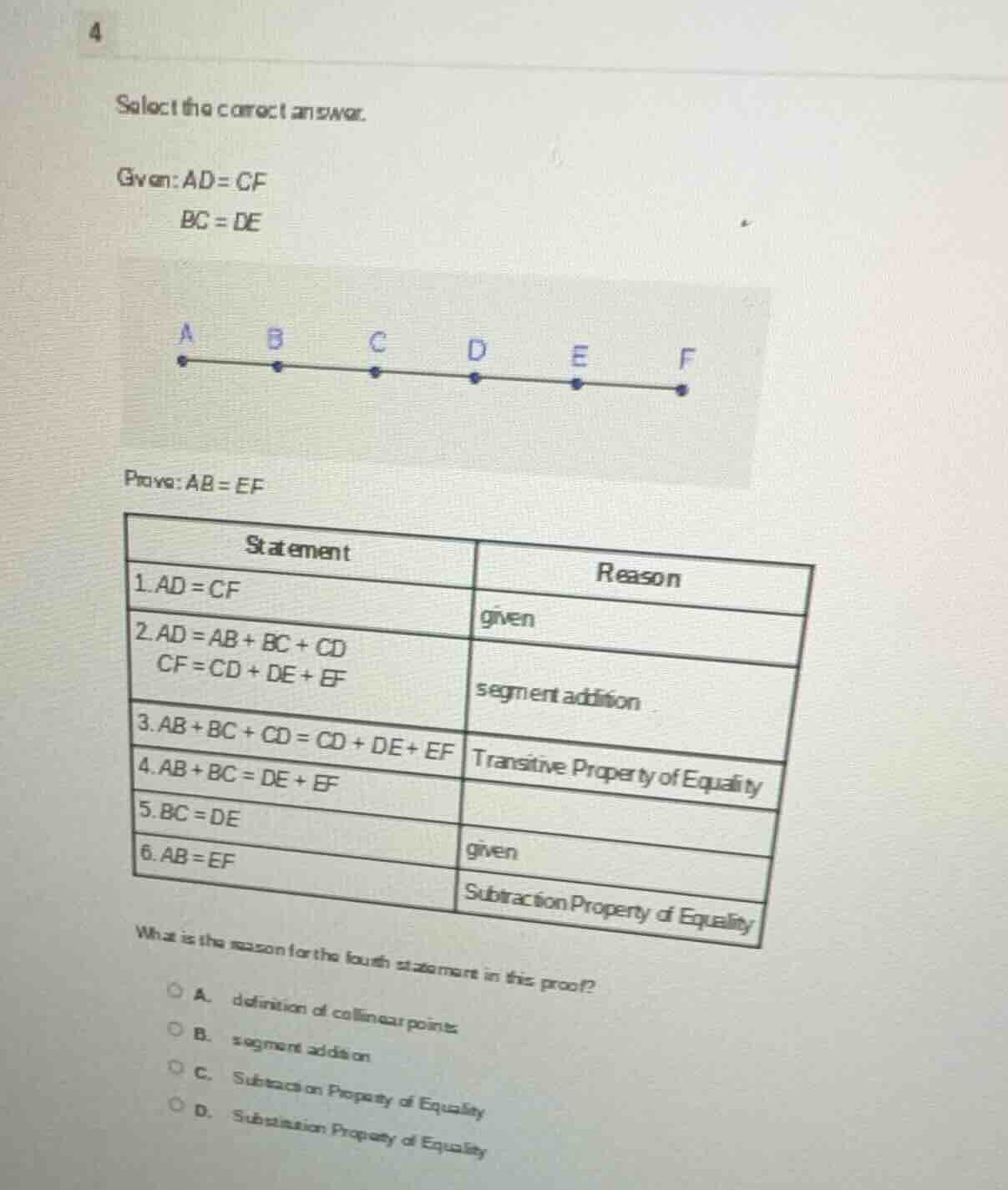
QUESTION IMAGE
Question
4
select the correct answer.
given: ( ad = cf )
( bc = de )
image of a number line with points a, b, c, d, e, f
prove: ( ab = ef )
| statement | reason |
|---|
| 2. ( ad = ab + bc + cd )
( cf = cd + de + ef ) | segment addition |
| 3. ( ab + bc + cd = cd + de + ef ) | transitive property of equality |
| 4. ( ab + bc = de + ef ) | |
| 5. ( bc = de ) | given |
| 6. ( ab = ef ) | subtraction property of equality |
what is the reason for the fourth statement in this proof?
a. definition of collinear points
b. segment addition
c. subtraction property of equality
d. substitution property of equality
To determine the reason for the fourth statement (\(AB + BC = DE + EF\)), we analyze the previous steps. Step 3 gives \(AB + BC + CD = CD + DE + EF\). To get to step 4, we subtract \(CD\) from both sides of the equation. The Subtraction Property of Equality states that if \(a + b = c + b\), then \(a = c\) (subtracting \(b\) from both sides). Here, we subtract \(CD\) from both sides of \(AB + BC + CD = CD + DE + EF\), resulting in \(AB + BC = DE + EF\). This matches the Subtraction Property of Equality.
- Option A (definition of collinear points) is irrelevant as collinearity defines points on a line, not equation manipulation.
- Option B (segment addition) is used for step 2, not step 4.
- Option D (Substitution Property) involves replacing a value with an equal value, but step 4 is about subtracting a common term, not substituting.
So the correct reason is the Subtraction Property of Equality.

Snap & solve any problem in the app
Get step-by-step solutions on Sovi AI
Photo-based solutions with guided steps
Explore more problems and detailed explanations
C. Subtraction Property of Equality