QUESTION IMAGE
Question
select the correct answer.
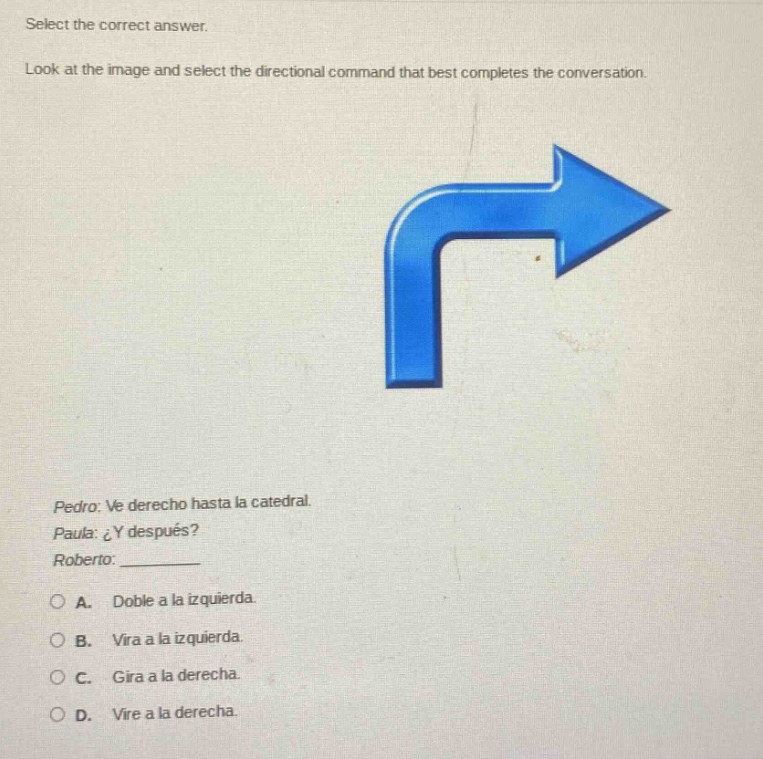
look at the image and select the directional command that best completes the conversation.
pedro: ve derecho hasta la catedral.
paula: ¿y después?
roberto: ______
a. doble a la izquierda.
b. vira a la izquierda.
c. gira a la derecha.
d. vire a la derecha.
The image shows a blue arrow indicating a right turn. We need to find the correct directional command in Spanish. Let's analyze each option:
- Option A: "Doble a la izquierda" means "Turn left" (formal command), which doesn't match the right - turn arrow.
- Option B: "Vira a la izquierda" means "Turn left" (informal command), also doesn't match.
- Option C: "Gira a la derecha" means "Turn right" (informal command, "gira" is the informal imperative of "girar"). But in the context of giving directions, the formal imperative is more appropriate when speaking to someone in a polite or formal way. However, let's check the arrow again. The arrow is a right - turn.
- Option D: "Vire a la derecha" means "Turn right" (formal imperative of "virar"). But wait, the arrow is a right - turn. Wait, maybe we made a mistake. Wait, the arrow is a right - angle turn to the right. Let's re - evaluate. The verb "girar" is more common for "to turn" in the context of directions. "Gira a la derecha" is the informal command (tú form) for "turn right". But let's check the options again. Wait, the arrow is a right turn. Let's check the options:
Option A: Left turn (wrong). Option B: Left turn (wrong). Option C: "Gira a la derecha" (turn right, informal). Option D: "Vire a la derecha" (turn right, formal). But in the context of the conversation, Pedro says "Ve derecho..." (informal, "ve" is the informal imperative of "ir"). So the response should also be informal. "Gira a la derecha" is the informal command for "turn right", which matches the right - turn arrow. Wait, but let's check the arrow again. The arrow is a right - turn. So the correct option should be C? Wait, no, wait. Wait, the arrow is a blue arrow that makes a right - angle turn to the right. So the correct directional command is to turn right. Now, between option C and D. "Gira" is the tú form (informal) of "girar", "vire" is the usted form (formal) of "virar". Since Pedro used "ve" (tú form of "ir"), the response should also be in the tú form. So "Gira a la derecha" (option C) is correct? Wait, but let's check the options again. Wait, the arrow is a right turn. So option C: "Gira a la derecha" means "Turn right" (informal), which matches the arrow. Option D: "Vire a la derecha" is formal. Since the first part of the conversation uses informal language ("ve"), the response should also be informal. So the correct answer is C? Wait, no, wait. Wait, maybe I made a mistake. Wait, the arrow is a right - turn. Let's check the options again. Option C: "Gira a la derecha" – "gira" is the imperative (tú) of "girar", which means "turn". So "Gira a la derecha" is "Turn right". The arrow is a right - turn, so this matches. Option A and B are left turns, so they are out. Option D is formal, but since the previous command was informal ("ve"), the response should be informal. So the correct answer is C. Wait, but let's check the original problem again. The arrow is a blue arrow that is a right - turn. So the correct option is C: Gira a la derecha.

Snap & solve any problem in the app
Get step-by-step solutions on Sovi AI
Photo-based solutions with guided steps
Explore more problems and detailed explanations
C. Gira a la derecha.