QUESTION IMAGE
Question
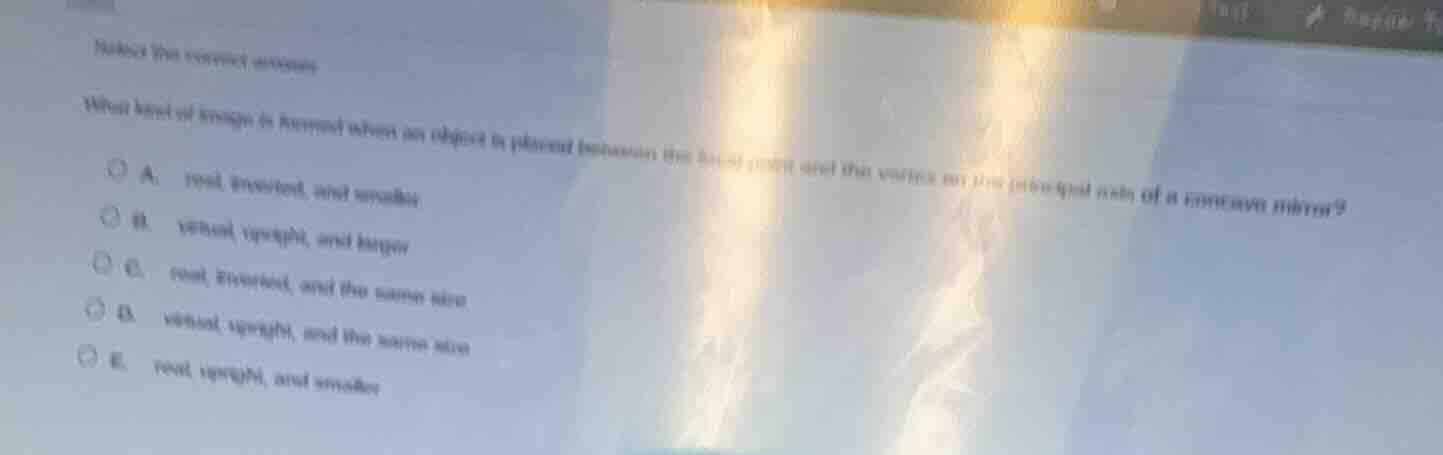
select the correct answer
what kind of image is formed when an object is placed between the focal point and the vertex on the principal axis of a concave mirror?
a. real, inverted, and smaller
b. virtual, upright, and larger
c. real, inverted, and the same size
d. virtual, upright, and the same size
e. real, upright, and smaller
Response
To solve this, we recall the properties of images formed by a concave mirror when the object is between the focal point (\(F\)) and the vertex (pole, \(P\)) of the mirror:
Key Concepts:
- For a concave mirror, when the object is placed between the focal point (\(F\)) and the vertex (\(P\)) (i.e., \(u < f\), where \(u\) = object distance, \(f\) = focal length), the image formed is:
- Virtual (cannot be projected on a screen, formed behind the mirror).
- Upright (erect, same orientation as the object).
- Magnified (larger) than the object.
Now, let’s analyze the options:
- Option A: “real, inverted, and smaller” → Incorrect. Real/inverted images form when \(u > f\) (beyond focal point), not when \(u < f\).
- Option B: “virtual, upright, and larger” → Correct. Matches the properties of the image for \(u < f\) in a concave mirror.
- Option C: “real, inverted, and the same size” → Incorrect. Real/inverted images with same size form at \(u = 2f\), not between \(F\) and \(P\).
- Option D: “virtual, upright, and the same size” → Incorrect. Virtual/upright images here are magnified (larger), not same size.
- Option E: “real, upright, and smaller” → Incorrect. Real images are inverted, and upright/real is impossible for mirrors.

Snap & solve any problem in the app
Get step-by-step solutions on Sovi AI
Photo-based solutions with guided steps
Explore more problems and detailed explanations
B. virtual, upright, and larger