QUESTION IMAGE
Question
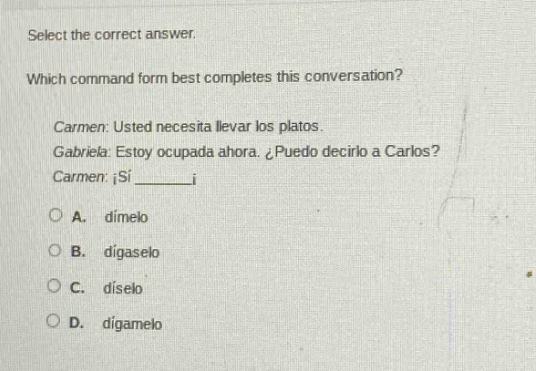
select the correct answer.
which command form best completes this conversation?
carmen: usted necesita llevar los platos.
gabriela: estoy ocupada ahora. ¿puedo decirlo a carlos?
carmen: ¡sí ______!
a. dímelo
b. digaselo
c. díselo
d. dígamelo
To solve this, we analyze the context and Spanish command forms. The situation is Carmen allowing Gabriela to tell Carlos to carry the plates. We need the correct imperative (command) form for "tú" (informal, since Carmen is likely speaking informally to Gabriela here) with the pronoun "se" (for "decirle a Carlos", indirect object) and "lo" (direct object, "los platos"). The verb "decir" has the imperative form "dile" for "tú", but with pronouns, it's "díselo" (for "tú" in the familiar imperative, with "se" (indirect) and "lo" (direct)). Wait, let's recall: the structure for "decirle algo a alguien" with pronouns: the indirect object pronoun (le/les) becomes se, and the direct object (lo/la/los/las) comes after. For the "tú" imperative of "decir", the base is "dile", but with pronouns, we combine "dile" + "se" + "lo" → but the correct form for "tú" imperative with "decir" and pronouns is "díselo" (note: in some dialects, the "tú" imperative of "decir" is "di" (irregular), so "di" + "se" + "lo" → "díselo". Let's check the options:
- A. dímelo: "dímelo" is "dileme lo" which would be "tell me it", not correct.
- B. digaselo: "digaselo" is the subjunctive form, not imperative.
- C. díselo: correct, "tú" imperative: "di" (imperative of decir for tú) + "se" (le → se) + "lo" → díselo (tell him it (the task)).
- D. dígamelo: "dígamelo" is the formal (usted) imperative, but here the context is between Carmen and Gabriela, likely informal, and also "dígamelo" would be "tell me it" formally, which is not the case.
So the correct option is C.

Snap & solve any problem in the app
Get step-by-step solutions on Sovi AI
Photo-based solutions with guided steps
Explore more problems and detailed explanations
C. díselo