QUESTION IMAGE
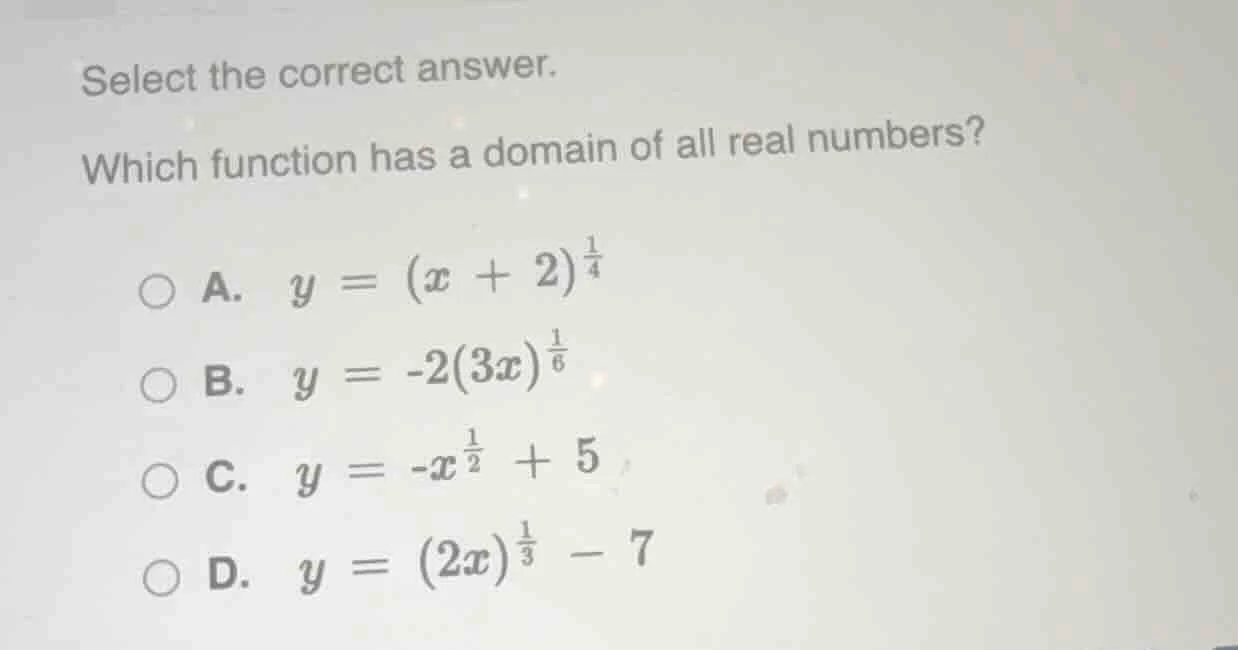
Question
select the correct answer.
which function has a domain of all real numbers?
a. $y = (x + 2)^{\frac{1}{4}}$
b. $y = -2(3x)^{\frac{1}{6}}$
c. $y = -x^{\frac{1}{2}} + 5$
d. $y = (2x)^{\frac{1}{3}} - 7$
Step1: Rewrite roots from exponents
Recall that $x^{\frac{1}{n}} = \sqrt[n]{x}$.
- A: $y = \sqrt[4]{x+2}$
- B: $y = -2\sqrt[6]{3x}$
- C: $y = -\sqrt{x} + 5$
- D: $y = \sqrt[3]{2x} - 7$
Step2: Analyze domain of each root
- Even roots ($n=2,4,6$): Radicand ≥ 0.
- A: $x+2 \geq 0 \implies x \geq -2$ (not all reals)
- B: $3x \geq 0 \implies x \geq 0$ (not all reals)
- C: $x \geq 0$ (not all reals)
- Odd roots ($n=3$): Radicand can be any real number (positive, negative, 0), so $2x$ can be all reals, meaning $x$ is all reals.

Snap & solve any problem in the app
Get step-by-step solutions on Sovi AI
Photo-based solutions with guided steps
Explore more problems and detailed explanations
D. $y = (2x)^{\frac{1}{3}} - 7$