QUESTION IMAGE
Question
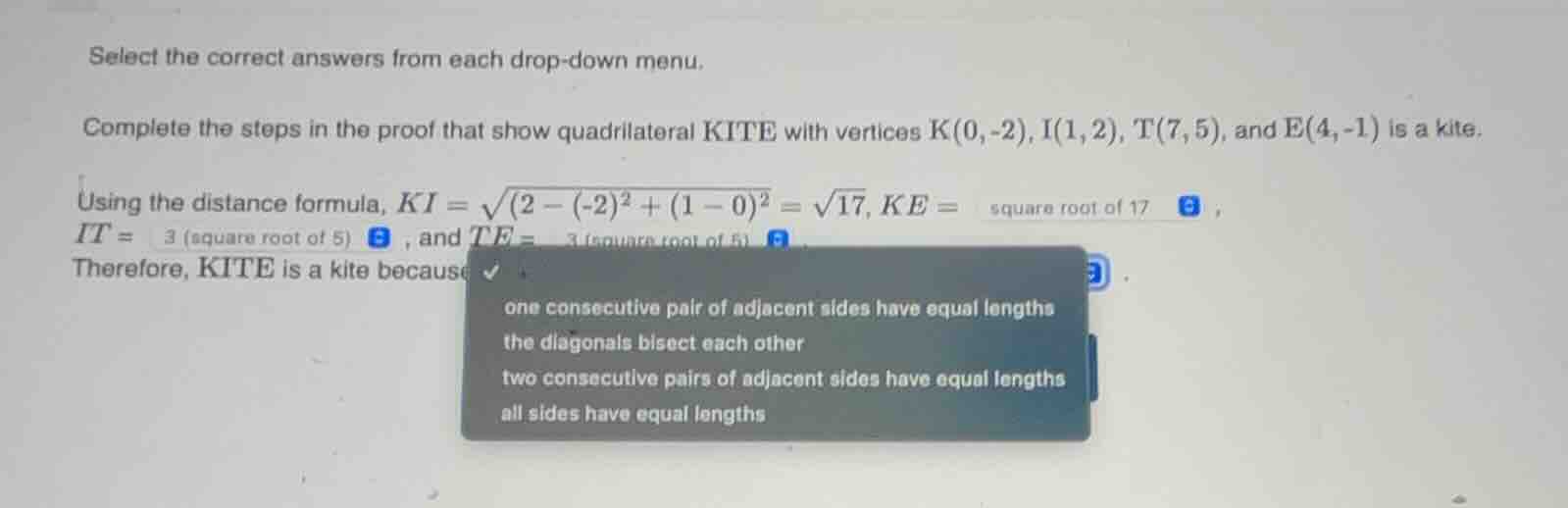
select the correct answers from each drop - down menu. complete the steps in the proof that show quadrilateral kite with vertices k(0, - 2), i(1, 2), t(7, 5), and e(4, - 1) is a kite. using the distance formula, (ki=sqrt{(2 - (-2))^{2}+(1 - 0)^{2}}=sqrt{17}), (ke=) square root of 17, (it = 3) (square root of 5), and (te = 3) (square root of 5). therefore, kite is a kite because one consecutive pair of adjacent sides have equal lengths the diagonals bisect each other two consecutive pairs of adjacent sides have equal lengths all sides have equal lengths
Step1: Calculate $KE$ with distance formula
The distance formula between two points $(x_1,y_1)$ and $(x_2,y_2)$ is $d=\sqrt{(x_2-x_1)^2+(y_2-y_1)^2}$. For $K(0,-2)$ and $E(4,-1)$:
$$KE=\sqrt{(4-0)^2+(-1-(-2))^2}=\sqrt{16+1}=\sqrt{17}$$
Step2: Calculate $IT$ with distance formula
For $I(1,2)$ and $T(7,5)$:
$$IT=\sqrt{(7-1)^2+(5-2)^2}=\sqrt{36+9}=\sqrt{45}=3\sqrt{5}$$
Step3: Calculate $TE$ with distance formula
For $T(7,5)$ and $E(4,-1)$:
$$TE=\sqrt{(4-7)^2+(-1-5)^2}=\sqrt{9+36}=\sqrt{45}=3\sqrt{5}$$
Step4: Verify kite definition
A kite is defined as a quadrilateral with two consecutive pairs of adjacent sides of equal length. Here, $KI=KE=\sqrt{17}$ and $IT=TE=3\sqrt{5}$, which are two consecutive pairs of equal adjacent sides.

Snap & solve any problem in the app
Get step-by-step solutions on Sovi AI
Photo-based solutions with guided steps
Explore more problems and detailed explanations
$KE = \boldsymbol{\sqrt{17}}$
$IT = \boldsymbol{3\sqrt{5}}$
$TE = \boldsymbol{3\sqrt{5}}$
Therefore, KITE is a kite because: two consecutive pairs of adjacent sides have equal lengths