QUESTION IMAGE
Question
select one:
a. $f(x) = \frac{4(x - 3)}{(x + 2)(x - 4)}$
b. $f(x) = \frac{9(x - 3)^2}{2(x + 2)(x - 4)}$
c. $f(x) = \frac{(x + 2)(x - 4)}{-9(x - 3)}$
d. $f(x) = \frac{-9(x - 3)}{(x + 2)(x - 4)}$
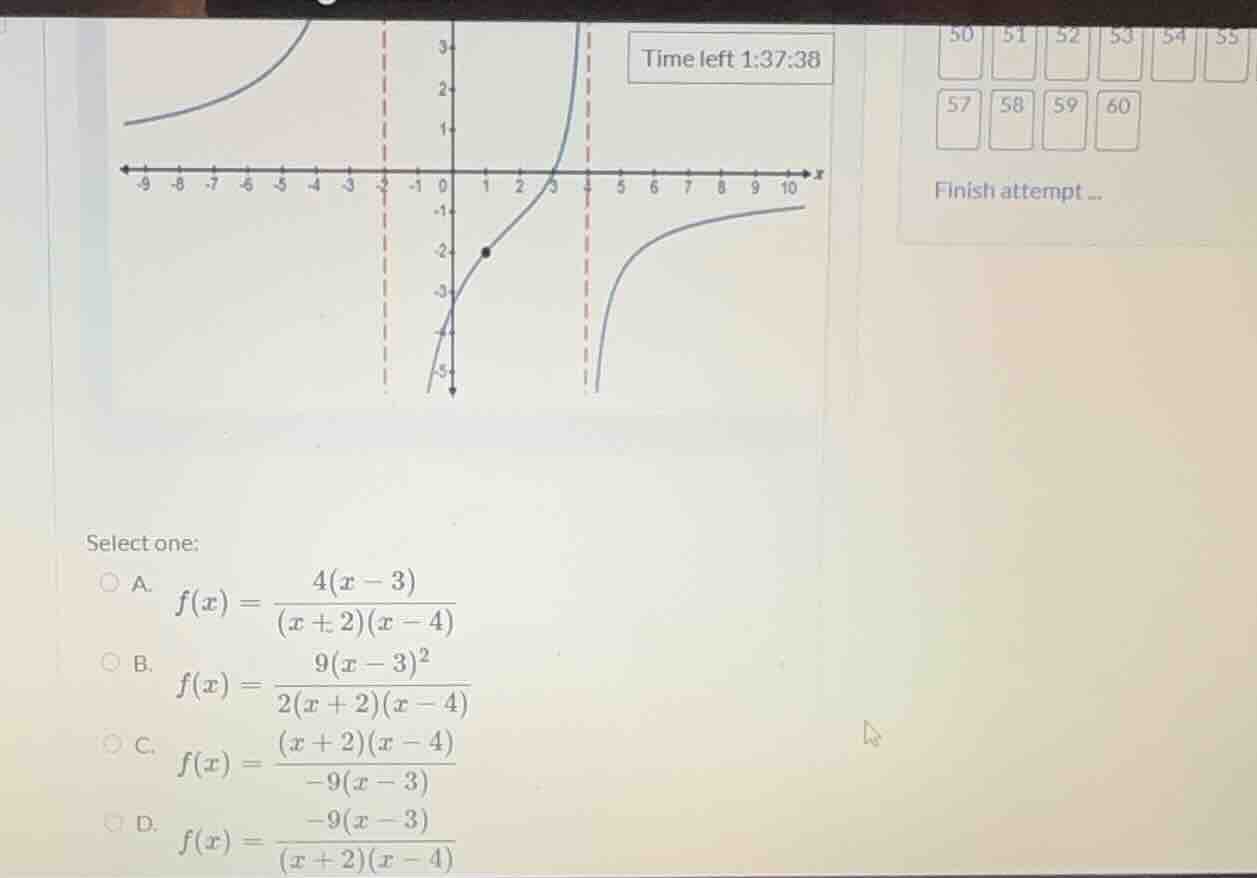
Step1: Identify vertical asymptotes
Vertical asymptotes occur where the denominator is zero (and numerator is non-zero). From the graph, asymptotes are at $x=-2$ and $x=4$, so denominator is $(x+2)(x-4)$. All options match this, so move to next step.
Step2: Identify x-intercept
The x-intercept is where $f(x)=0$, i.e., numerator is zero. The graph crosses the x-axis at $x=3$, so numerator has a factor of $(x-3)$. Option B has $(x-3)^2$ (which would touch, not cross, the x-axis), so eliminate B. Option C has numerator $(x+2)(x-4)$, which would give intercepts at $x=-2,4$ (asymptotes, not intercepts), eliminate C. Remaining: A and D.
Step3: Test the given point
The graph has a point at $x=1$, $f(1)\approx-2$.
For option A: $f(1)=\frac{4(1-3)}{(1+2)(1-4)}=\frac{4(-2)}{(3)(-3)}=\frac{-8}{-9}=\frac{8}{9}\approx0.89$, which does not match.
For option D: $f(1)=\frac{-9(1-3)}{(1+2)(1-4)}=\frac{-9(-2)}{(3)(-3)}=\frac{18}{-9}=-2$, which matches the point.

Snap & solve any problem in the app
Get step-by-step solutions on Sovi AI
Photo-based solutions with guided steps
Explore more problems and detailed explanations
D. $f(x)=\frac{-9(x-3)}{(x+2)(x-4)}$