QUESTION IMAGE
Question
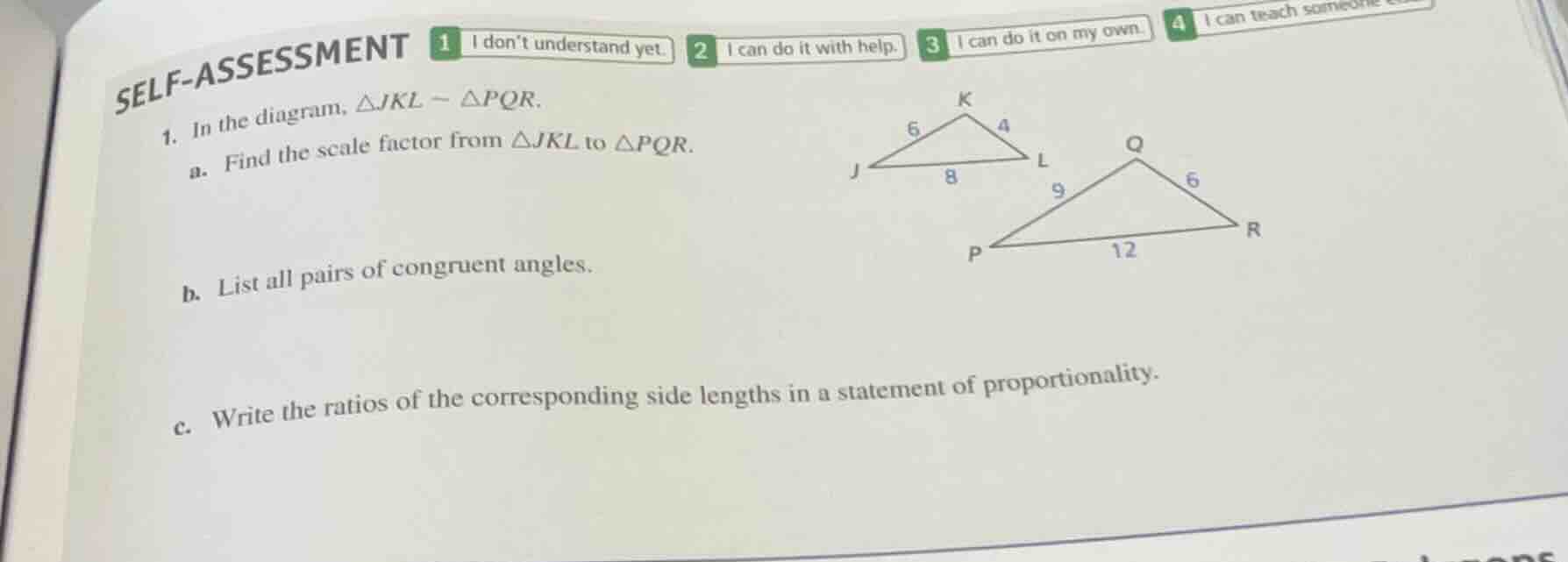
self - assessment 1 i dont understand yet. 2 i can do it with help. 3 i can do it on my own. 4 i can teach someone 1. in the diagram, $\triangle jkl\sim\triangle pqr$. a. find the scale factor from $\triangle jkl$ to $\triangle pqr$. b. list all pairs of congruent angles. c. write the ratios of the corresponding side lengths in a statement of proportionality.
Part (a)
Step 1: Identify corresponding sides
Since \(\triangle JKL \sim \triangle PQR\), the corresponding sides are \(JK\) and \(PQ\), \(KL\) and \(QR\), \(JL\) and \(PR\). From the diagram, \(JK = 6\), \(PQ=9\); \(KL = 4\), \(QR=6\); \(JL = 8\), \(PR = 12\).
Step 2: Calculate scale factor
The scale factor from \(\triangle JKL\) to \(\triangle PQR\) is the ratio of the length of a side in \(\triangle PQR\) to the corresponding side in \(\triangle JKL\). Let's use \(JL\) and \(PR\): \(\frac{PR}{JL}=\frac{12}{8}=\frac{3}{2}\), or using \(JK\) and \(PQ\): \(\frac{PQ}{JK}=\frac{9}{6}=\frac{3}{2}\), or using \(KL\) and \(QR\): \(\frac{QR}{KL}=\frac{6}{4}=\frac{3}{2}\).
For similar triangles, corresponding angles are congruent. In \(\triangle JKL \sim \triangle PQR\), the order of the letters gives the corresponding angles. So \(\angle J\) corresponds to \(\angle P\), \(\angle K\) corresponds to \(\angle Q\), and \(\angle L\) corresponds to \(\angle R\).
Step 1: Identify corresponding sides
From the similar triangles \(\triangle JKL \sim \triangle PQR\), the corresponding sides are \(JK\) and \(PQ\), \(KL\) and \(QR\), \(JL\) and \(PR\) with lengths \(JK = 6\), \(PQ = 9\); \(KL=4\), \(QR = 6\); \(JL = 8\), \(PR=12\).
Step 2: Write the proportionality statement
The ratios of corresponding sides are equal. So \(\frac{JK}{PQ}=\frac{KL}{QR}=\frac{JL}{PR}\), substituting the values we get \(\frac{6}{9}=\frac{4}{6}=\frac{8}{12}\) (or simplifying each ratio, \(\frac{2}{3}=\frac{2}{3}=\frac{2}{3}\), but the statement with original lengths is also correct as \(\frac{6}{9}=\frac{4}{6}=\frac{8}{12}\)).

Snap & solve any problem in the app
Get step-by-step solutions on Sovi AI
Photo-based solutions with guided steps
Explore more problems and detailed explanations
The scale factor from \(\triangle JKL\) to \(\triangle PQR\) is \(\frac{3}{2}\).