QUESTION IMAGE
Question
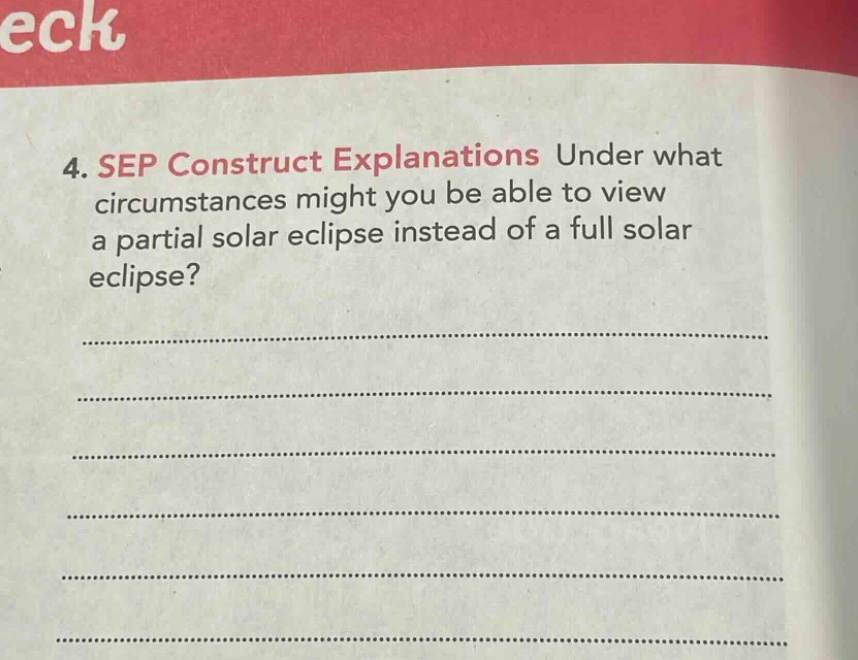
- sep construct explanations under what circumstances might you be able to view a partial solar eclipse instead of a full solar eclipse?
A solar eclipse occurs when the Moon comes between the Sun and Earth, casting a shadow on Earth. A full solar eclipse (total or annular) is visible only from the Moon’s umbra (total) or antumbra (annular) path. A partial solar eclipse happens when an observer is in the Moon’s penumbra, or when the alignment is imperfect (e.g., the Moon is too far (apogee) to fully cover the Sun, or the observer is outside the central umbral/antumbral path but still in the penumbra, so only part of the Sun is obscured.

Snap & solve any problem in the app
Get step-by-step solutions on Sovi AI
Photo-based solutions with guided steps
Explore more problems and detailed explanations
You can view a partial solar eclipse instead of a full solar eclipse if you are located in the Moon’s penumbral shadow (where only part of the Sun is blocked by the Moon), or if the Moon is at an orbital position (e.g., apogee) that prevents it from fully covering the Sun’s disk, or if your location is outside the narrow central path of the Moon’s umbral/antumbral shadow (where a total/annular eclipse would be visible) but still within the broader penumbral region.