QUESTION IMAGE
Question
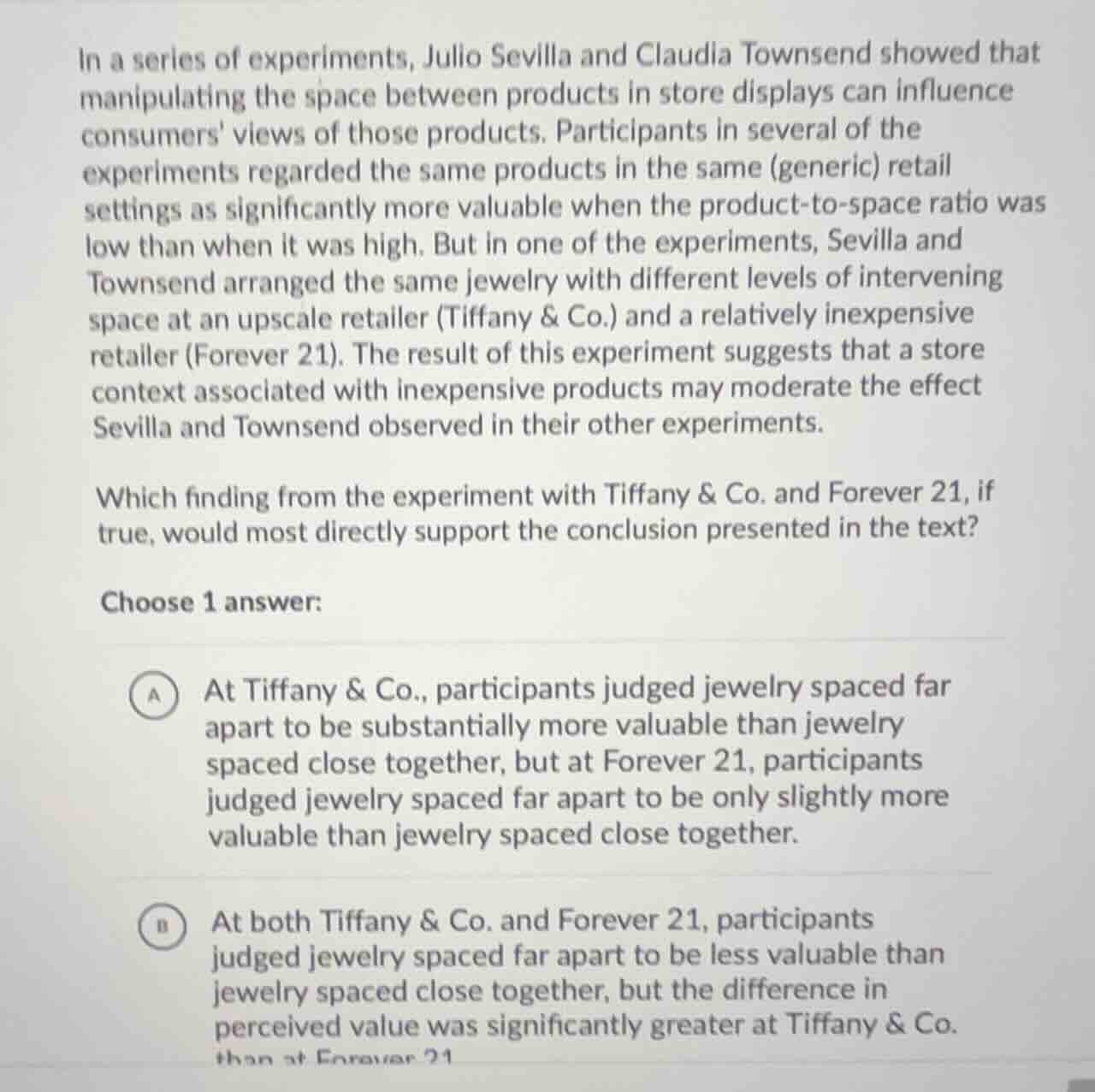
in a series of experiments, julio sevilla and claudia townsend showed that manipulating the space between products in store displays can influence consumers views of those products. participants in several of the experiments regarded the same products in the same (generic) retail settings as significantly more valuable when the product - to - space ratio was low than when it was high. but in one of the experiments, sevilla and townsend arranged the same jewelry with different levels of intervening space at an upscale retailer (tiffany & co.) and a relatively inexpensive retailer (forever 21). the result of this experiment suggests that a store context associated with inexpensive products may moderate the effect sevilla and townsend observed in their other experiments.
which finding from the experiment with tiffany & co. and forever 21, if true, would most directly support the conclusion presented in the text?
choose 1 answer:
a at tiffany & co., participants judged jewelry spaced far apart to be substantially more valuable than jewelry spaced close together, but at forever 21, participants judged jewelry spaced far apart to be only slightly more valuable than jewelry spaced close together.
b at both tiffany & co. and forever 21, participants judged jewelry spaced far apart to be less valuable than jewelry spaced close together, but the difference in perceived value was significantly greater at tiffany & co. than at forever 21
The conclusion is that a store context associated with inexpensive products (like Forever 21) may moderate the effect seen in other experiments (where low product - to - space ratio made products seem more valuable).
For option A: At Tiffany (upscale, expensive context), the usual effect (low product - to - space ratio, i.e., close together, should make products more valuable? Wait, no, in other experiments low product - to - space ratio (more products, less space) made products more valuable? Wait, the first experiments: same products, same retail settings, low product - to - space ratio (so more products, less space between them) made them more valuable. But in the Tiffany and Forever 21 experiment, we are looking at the moderation by store context.
Wait, in option A: At Tiffany (expensive store), jewelry spaced far apart (high product - to - space ratio) is judged more valuable than close together (low product - to - space ratio) – this is the opposite of the first experiments? No, maybe I got the ratio wrong. Product - to - space ratio: if products are spaced far apart, product - to - space ratio is low (fewer products per unit space) or high? Wait, product - to - space ratio: number of products divided by the space. So if products are spaced far apart, number of products per unit space is low, so product - to - space ratio is low. Wait, the first experiments: same products, same retail settings, low product - to - space ratio (so more space between products? No, wait, "product - to - space ratio was low" – so if product - to - space ratio is low, that means for a given space, there are fewer products (more space per product). Wait, no, ratio of product to space: if you have more space between products, the space is larger, so product (count) to space (area) ratio is lower. So in the first experiments, low product - to - space ratio (more space between products) made products more valuable? Wait, the first experiments: "participants regarded the same products in the same (generic) retail settings as significantly more valuable when the product - to - space ratio was low than when it was high". So low product - to - space ratio (more space between products, fewer products per unit space) → more valuable. High product - to - space ratio (less space between products, more products per unit space) → less valuable.
Now, in the Tiffany (expensive) and Forever 21 (inexpensive) experiment, we want to see that the store context (inexpensive) moderates the effect. So in the expensive store (Tiffany), the effect should be similar to the first experiments, and in the inexpensive store (Forever 21), the effect is reduced.
Wait, option A: At Tiffany (expensive), jewelry spaced far apart (low product - to - space ratio) is substantially more valuable than close together (high product - to - space ratio) – this is in line with the first experiments (low product - to - space ratio → more valuable). At Forever 21 (inexpensive), jewelry spaced far apart (low product - to - space ratio) is only slightly more valuable than close together (high product - to - space ratio) – so the effect (difference in value between low and high product - to - space ratio) is reduced in the inexpensive store, which supports the conclusion that the inexpensive store context moderates the effect.
For option B: At both stores, jewelry spaced far apart (low product - to - space ratio) is less valuable than close together (high product - to - space ratio) – this is the opposite of the first experiments, so it doesn't support the conclusion. Also, the difference is gre…

Snap & solve any problem in the app
Get step-by-step solutions on Sovi AI
Photo-based solutions with guided steps
Explore more problems and detailed explanations
A. At Tiffany & Co., participants judged jewelry spaced far apart to be substantially more valuable than jewelry spaced close together, but at Forever 21, participants judged jewelry spaced far apart to be only slightly more valuable than jewelry spaced close together.