QUESTION IMAGE
Question
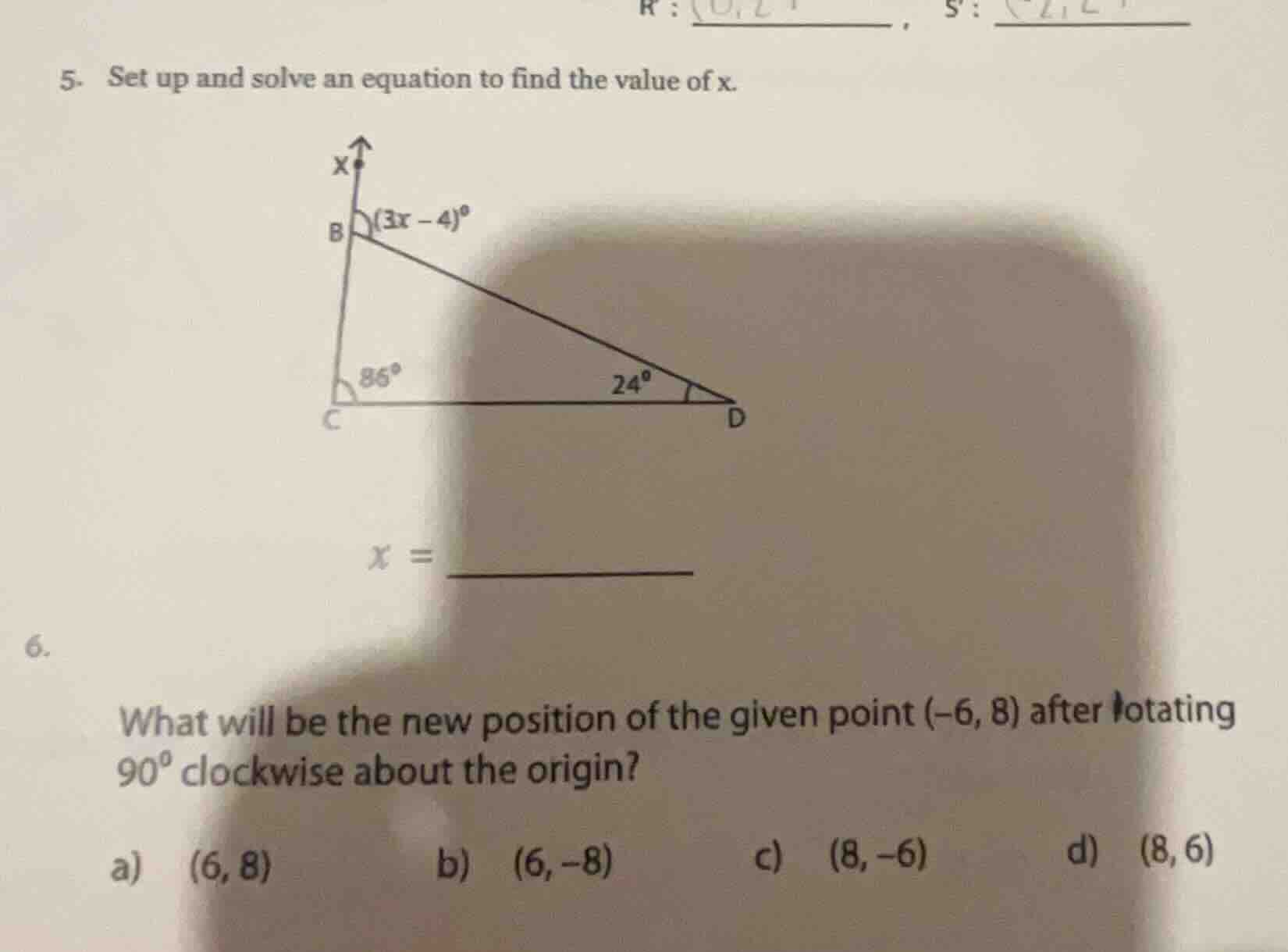
- set up and solve an equation to find the value of x.
x =
- what will be the new position of the given point (-6, 8) after rotating 90° clockwise about the origin?
a) (6, 8) b) (6, -8) c) (8, -6) d) (8, 6)
Question 5
Step1: Find the interior angle at B
The sum of interior angles in a triangle is \(180^\circ\). So, the interior angle at B is \(180^\circ - (3x - 4)^\circ\) (since it's supplementary to \((3x - 4)^\circ\)).
Step2: Sum the interior angles
Sum of angles in \(\triangle BCD\): \(86^\circ + 24^\circ + (180 - (3x - 4))^\circ = 180^\circ\)
Simplify: \(86 + 24 + 180 - 3x + 4 = 180\)
\(294 - 3x = 180\)
Step3: Solve for x
\(-3x = 180 - 294\)
\(-3x = -114\)
\(x = \frac{-114}{-3} = 38\)
To rotate a point \((x, y)\) \(90^\circ\) clockwise about the origin, the transformation rule is \((x, y) \to (y, -x)\). For the point \((-6, 8)\), applying the rule: \(x = -6\), \(y = 8\), so new point is \((8, -(-6)) = (8, 6)\)? Wait, no—wait, the correct rule for \(90^\circ\) clockwise is \((x, y) \to (y, -x)\). So for \((-6, 8)\): \(y = 8\), \(-x = -(-6) = 6\)? Wait, no, wait: Let's recheck. The standard \(90^\circ\) clockwise rotation matrix is \(
\), so \(
=
\), so \(x' = y\), \(y' = -x\). So for \((x, y) = (-6, 8)\), \(x' = 8\), \(y' = -(-6) = 6\)? Wait, no, \(y' = -x\), so \(x = -6\), so \(y' = -(-6) = 6\). Wait, but let's check the options. Wait, maybe I made a mistake. Wait, the rule is: \(90^\circ\) clockwise: \((x, y) \to (y, -x)\). So \((-6, 8)\) becomes \((8, -(-6)) = (8, 6)\)? But option d is \((8, 6)\)? Wait, no, wait: Wait, \(x = -6\), so \(-x = 6\)? Wait, no, \(y' = -x\), so \(x = -6\), so \(y' = -(-6) = 6\), and \(x' = y = 8\). So the new point is \((8, 6)\)? But wait, let's check again. Wait, maybe I confused clockwise and counterclockwise. Wait, \(90^\circ\) counterclockwise is \((x, y) \to (-y, x)\), and \(90^\circ\) clockwise is \((x, y) \to (y, -x)\). So for \((-6, 8)\): \(y = 8\), \(-x = -(-6) = 6\), so \((8, 6)\)? But option d is \((8, 6)\)? Wait, but let's check the options again. Wait, the options are: a) (6,8), b) (6,-8), c) (8,-6), d) (8,6). Wait, maybe my rule was wrong. Wait, let's take a simple point, say (1,0). Rotating 90 degrees clockwise should go to (0, -1)? No, wait, (1,0) rotated 90 degrees clockwise around origin: moves to (0, -1)? Wait, no, visualizing: (1,0) is on x-axis, rotating 90 degrees clockwise (towards negative y-axis) would be (0, -1). Using the rule \((x,y) \to (y, -x)\): (1,0) becomes (0, -1), which is correct. So for (-6,8): (8, -(-6)) = (8,6). So the answer is d? Wait, but let's check with another example: (0,1) rotated 90 degrees clockwise: (1, 0). Using the rule: (1, -0) = (1,0), correct. So yes, the rule is correct. So for (-6,8), it's (8, 6), which is option d? Wait, no, wait: Wait, \(-x\) when \(x = -6\) is \(-(-6) = 6\), so \(y' = 6\), \(x' = y = 8\), so (8,6), which is option d.

Snap & solve any problem in the app
Get step-by-step solutions on Sovi AI
Photo-based solutions with guided steps
Explore more problems and detailed explanations
\(x = 38\)