QUESTION IMAGE
Question
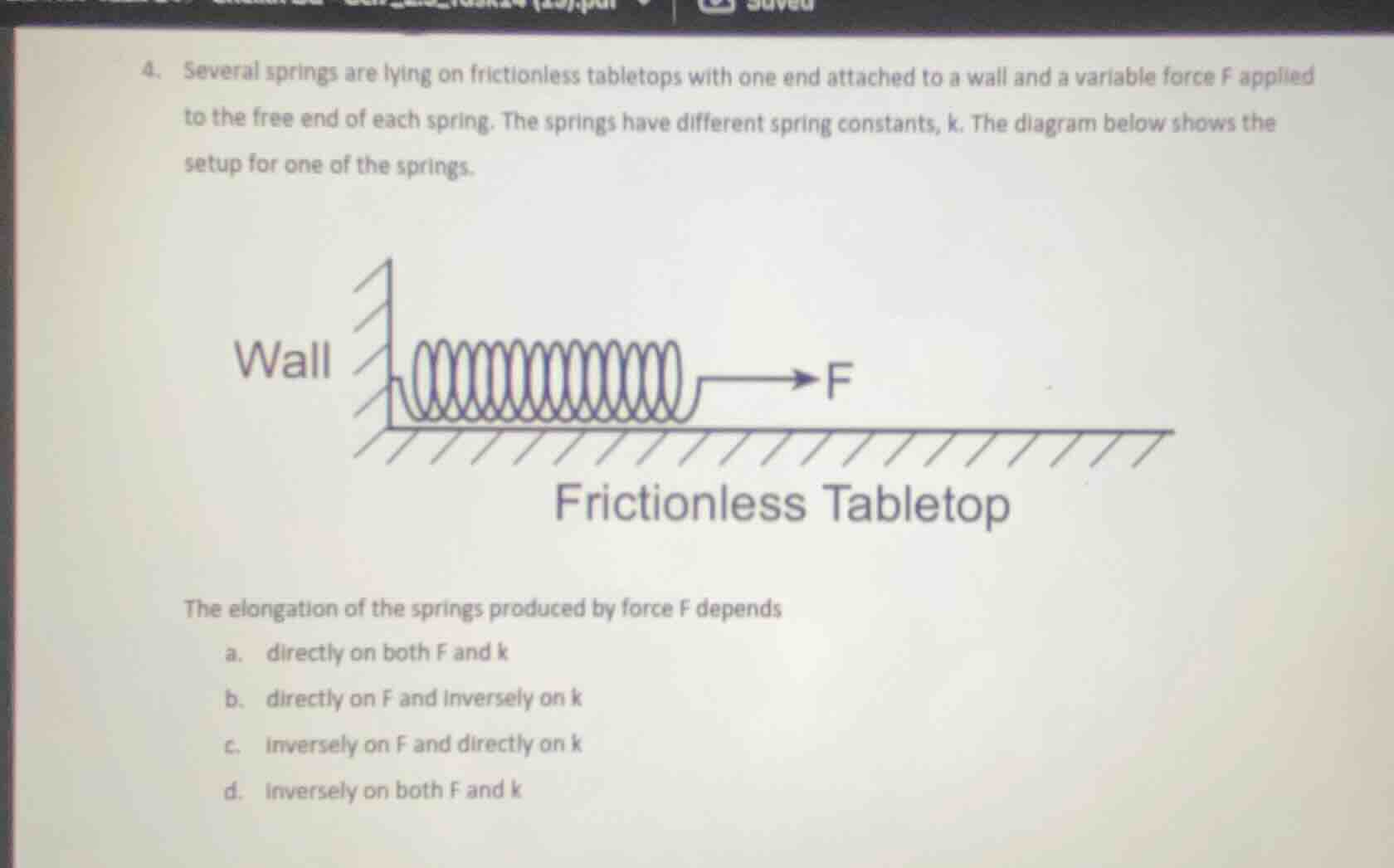
- several springs are lying on frictionless tabletops with one end attached to a wall and a variable force f applied to the free end of each spring. the springs have different spring constants, k. the diagram below shows the setup for one of the springs.
diagram of a spring attached to a wall on a frictionless tabletop with a force f applied to the free end
the elongation of the springs produced by force f depends
a. directly on both f and k
b. directly on f and inversely on k
c. inversely on f and directly on k
d. inversely on both f and k
To solve this, we use Hooke's Law, which states that the force \( F \) applied to a spring is related to its elongation \( x \) and spring constant \( k \) by the formula \( F = kx \). Rearranging for elongation, we get \( x=\frac{F}{k} \). From this formula, we can see that elongation \( x \) is directly proportional to the force \( F \) (as \( F \) is in the numerator) and inversely proportional to the spring constant \( k \) (as \( k \) is in the denominator). So we analyze each option:
- Option a: Says directly on both \( F \) and \( k \), but from \( x=\frac{F}{k} \), \( x \) is inversely on \( k \), so a is wrong.
- Option b: Says directly on \( F \) and inversely on \( k \), which matches \( x=\frac{F}{k} \), so this is correct.
- Option c: Says inversely on \( F \) and directly on \( k \), but \( x \) is directly on \( F \) and inversely on \( k \), so c is wrong.
- Option d: Says inversely on both \( F \) and \( k \), but \( x \) is directly on \( F \), so d is wrong.

Snap & solve any problem in the app
Get step-by-step solutions on Sovi AI
Photo-based solutions with guided steps
Explore more problems and detailed explanations
b. directly on F and inversely on k