QUESTION IMAGE
Question
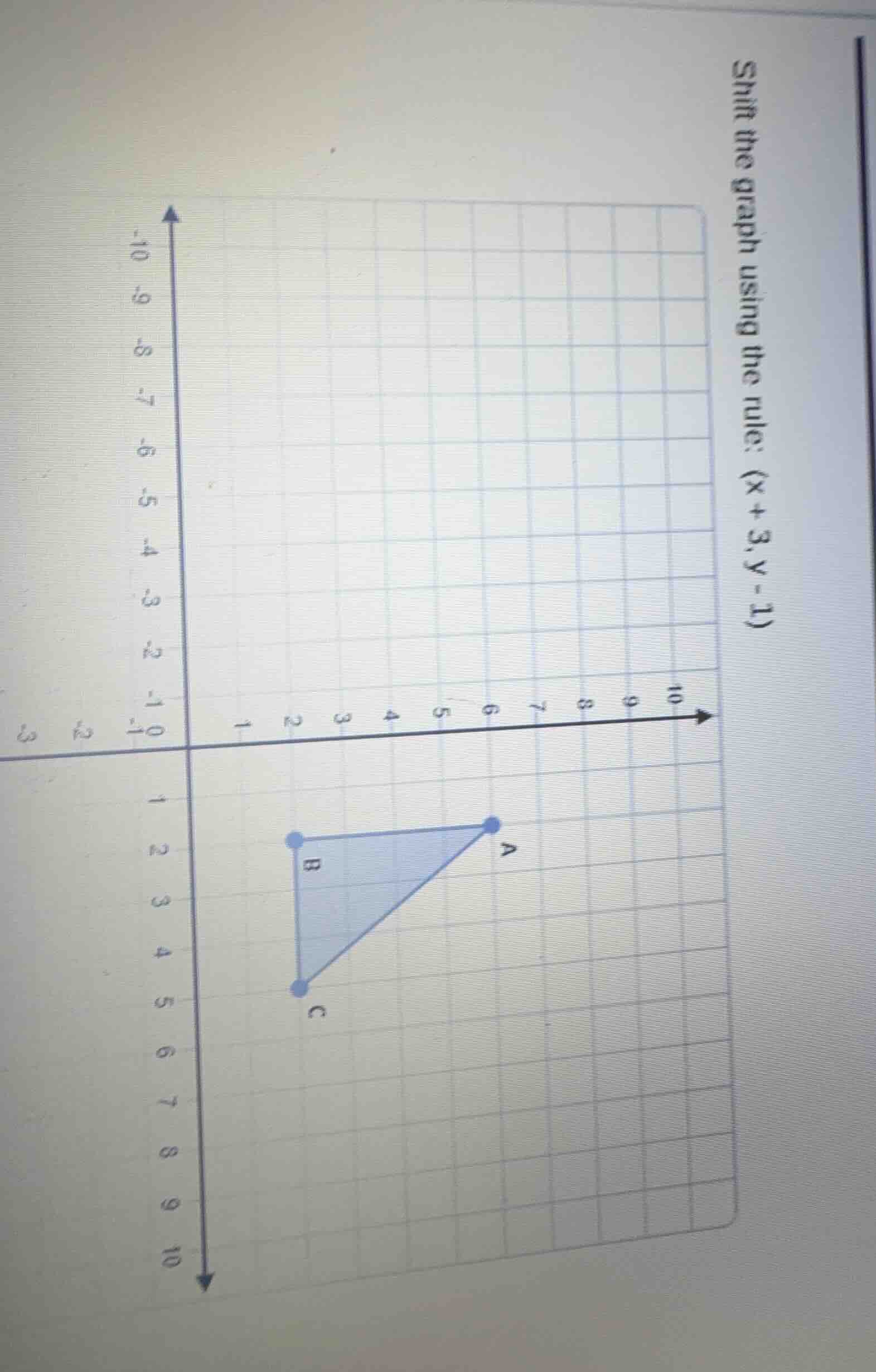
shift the graph using the rule: (x + 3, y - 1)
Step1: Identify original coordinates
First, we find the coordinates of points A, B, and C from the graph. Let's assume:
- Point A: $(6, 2)$ (since it's at x=6, y=2)
- Point B: $(2, 2)$ (at x=2, y=2)
- Point C: $(2, 5)$ (at x=2, y=5)
Step2: Apply the translation rule
The translation rule is $(x + 3, y - 1)$. We apply this to each point:
For Point A:
New x-coordinate: $6 + 3 = 9$
New y-coordinate: $2 - 1 = 1$
So, A' is $(9, 1)$
For Point B:
New x-coordinate: $2 + 3 = 5$
New y-coordinate: $2 - 1 = 1$
So, B' is $(5, 1)$
For Point C:
New x-coordinate: $2 + 3 = 5$
New y-coordinate: $5 - 1 = 4$
So, C' is $(5, 4)$
Step3: Plot the translated points
Now, we can plot the points A'$(9, 1)$, B'$(5, 1)$, and C'$(5, 4)$ on the coordinate plane. Connecting these points will give the translated triangle.

Snap & solve any problem in the app
Get step-by-step solutions on Sovi AI
Photo-based solutions with guided steps
Explore more problems and detailed explanations
The translated coordinates are: A'$(9, 1)$, B'$(5, 1)$, C'$(5, 4)$. To graph the translated figure, plot these points and connect them.