QUESTION IMAGE
Question
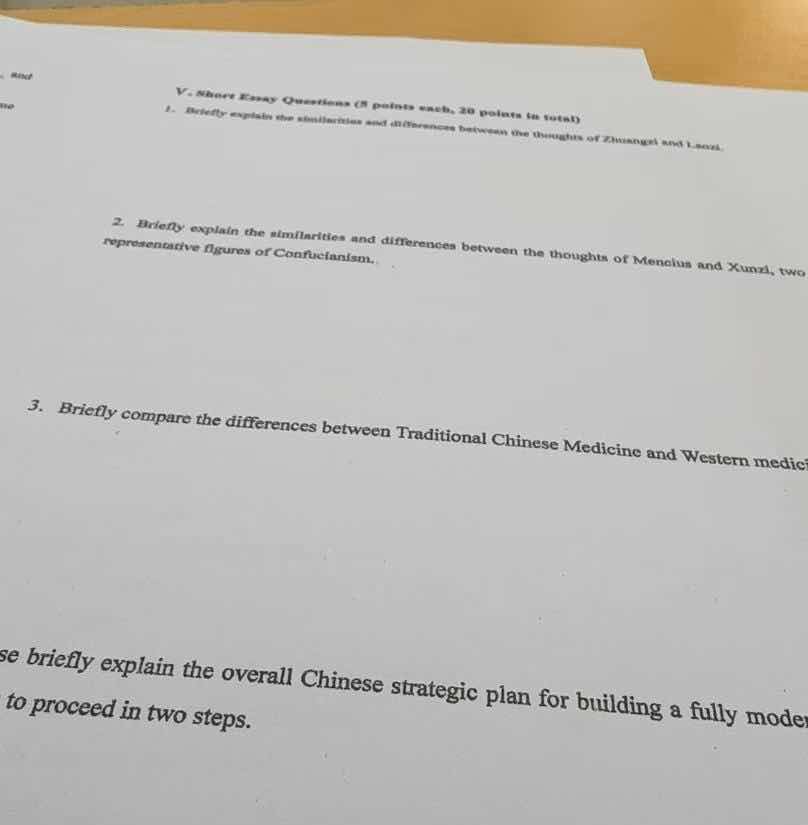
v. short essay questions (5 points each, 20 points in total)
- briefly explain the similarities and differences between the thoughts of zhuangzi and laozi.
- briefly explain the similarities and differences between the thoughts of mencius and xunzi, two representative figures of confucianism.
- briefly compare the differences between traditional chinese medicine and western medicine
se briefly explain the overall chinese strategic plan for building a fully modern to proceed in two steps.
Response
Question 2 (Mencius and Xunzi)
Brief Explanations
- Similarities: Both Mencius and Xunzi are Confucian scholars. They both uphold the core Confucian values like benevolence (\(ren\)), righteousness (\(yi\)), and emphasize the importance of moral cultivation for individuals and social order. They believe in the significance of education in shaping people's moral character.
- Differences:
- Human Nature View: Mencius holds that human nature is inherently good (性善论, \(xing\ shan\ lun\)). He argues that people are born with innate moral inclinations like compassion, shame, respect, and a sense of right - wrong. Xunzi claims human nature is evil (性恶论, \(xing\ e\ lun\)), believing people's natural tendencies are self - interested, and moral behavior comes from external education and ritual (礼, \(li\)) constraints.
- Approach to Morality Cultivation: Mencius focuses on developing the innate good nature, like nurturing the "four sprouts" (四端, \(si\ duan\)) of morality. Xunzi emphasizes strict adherence to rituals and laws, and learning from sages' teachings to transform the evil - natured self.
- Political Thought: Mencius advocates "benevolent governance" (仁政, \(ren\ zheng\)) based on the king's compassion for people, believing that the people are the most important in a state. Xunzi's political thought is more authoritarian - leaning, stressing the ruler's use of rituals and laws to govern, and the hierarchical order in society.
Brief Explanations
- Philosophical Basis:
- Traditional Chinese Medicine (TCM) is based on Taoist and Confucian philosophies, with concepts like Yin - Yang (阴阳, \(yin\ yang\)) and Five Elements (五行, \(wu\ xing\)) to explain the human body as a holistic system, where the body, mind, and environment are interconnected.
- Western Medicine is based on modern scientific principles (e.g., anatomy, physiology, biochemistry), viewing the body as a combination of organs, tissues, and cells, and diseases as often related to specific pathological changes (e.g., microbial infection, cell mutation).
- Diagnosis Method:
- TCM: Uses "four diagnostic methods" (四诊, \(si\ zhen\)) - inspection (望, \(wang\)), auscultation and olfaction (闻, \(wen\)), inquiry (问, \(wen\)), and palpation (切, \(qie\)), especially pulse - taking and tongue - diagnosis, to get a holistic picture of the patient's "Qi" (气, \(qi\)), blood, and organ functions.
- Western Medicine: Relies on laboratory tests (e.g., blood tests, imaging like X - ray, MRI), physical examinations of specific symptoms, and pathological analysis to diagnose diseases.
- Treatment Approach:
- TCM: Treats the "root cause" (治本, \(zhi\ ben\)) of the imbalance in the body's energy (Qi), blood, and Yin - Yang. Uses herbal medicine, acupuncture, massage (Tuina), and dietary therapy, aiming to restore the body's self - regulating ability.
- Western Medicine: Focuses on treating specific symptoms or disease entities. Uses drugs (e.g., antibiotics for infection), surgery for organic lesions, and targeted therapies for diseases like cancer, with a more symptom - oriented and disease - specific approach.
- Therapeutic Time and Effect:
- TCM: Often has a longer treatment course, especially for chronic diseases, but has fewer side - effects in the long run and can improve the overall health condition.
- Western Medicine: Acts quickly for acute diseases (e.g., antibiotics for severe infection), but may have more side - effects, and for chronic diseases, long - term drug use may lead to drug resistance or other complications.
Brief Explanations
The Chinese strategic plan for building a fully modernized socialist country is to be carried out in two steps:
- First Step (2020 - 2035):
- Goal: basically realize socialist modernization.
- Specifics: Significantly enhance economic strength, scientific and technological strength, and comprehensive national strength. Per capita GDP will reach the level of moderately developed countries. The people will enjoy a more prosperous life, and more substantial progress will be made in achieving common prosperity for all. The modernization of the national governance system and governance capacity will be basically achieved. The people's sense of gain, happiness, and security will be further enhanced. China will become a global leader in innovation, and its cultural soft power will be much stronger. The ecological environment will be fundamentally improved, and the goal of carbon peak and carbon neutrality will be steadily advanced.
- Second Step (2035 - Mid - Century):
- Goal: Build China into a great modern socialist country that is prosperous, strong, democratic, civilized, harmonious, and beautiful.
- Specifics: China will be a global leader in terms of economic, scientific and technological, cultural, educational, talent, and comprehensive national strength. The people will enjoy a happier life, and common prosperity will be basically achieved. The Chinese nation will achieve great rejuvenation, and China will become a leading country in the world, making greater contributions to mankind.

Snap & solve any problem in the app
Get step-by-step solutions on Sovi AI
Photo-based solutions with guided steps
Explore more problems and detailed explanations
- Similarities: Both are Confucian, uphold core Confucian values, and stress moral cultivation and education's role.
- Differences:
- Mencius: Human nature is good; cultivate innate goodness (e.g., "four sprouts"); advocates benevolent governance with people - centered view.
- Xunzi: Human nature is evil; transform via rituals/laws and sage - based learning; more authoritarian - leaning political thought with hierarchical order.