QUESTION IMAGE
Question
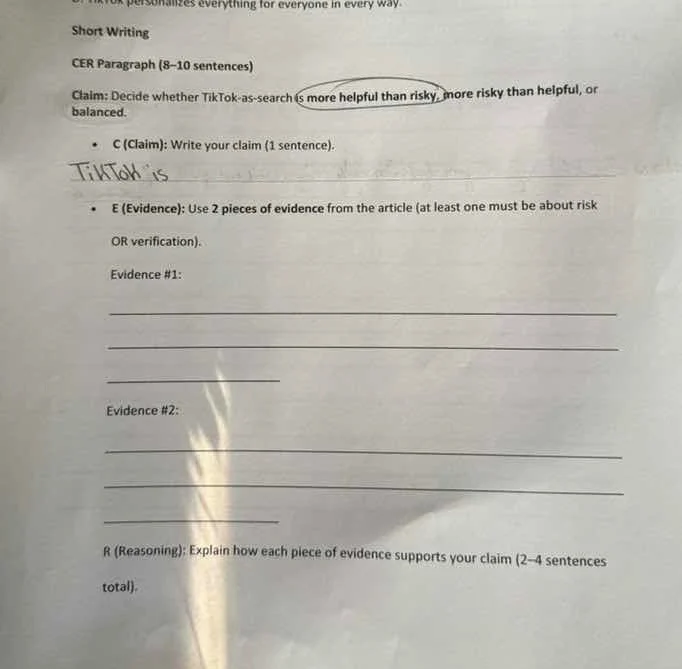
short writing
cer paragraph (8 - 10 sentences)
claim: decide whether tiktok - as - search is more helpful than risky, more risky than helpful, or balanced.
- c (claim): write your claim (1 sentence).
tiktok is
- e (evidence): use 2 pieces of evidence from the article (at least one must be about risk or verification).
evidence #1:
evidence #2:
r (reasoning): explain how each piece of evidence supports your claim (2 - 4 sentences total).
To complete this CER paragraph about TikTok - as - search, we'll follow the Claim - Evidence - Reasoning structure:
Claim
TikTok - as - search is more risky than helpful.
Evidence #1
TikTok's algorithm - driven search often prioritizes engaging or viral content over accurate and verified information. For example, in topics related to health advice, many videos might spread misinformation about treatments or diets.
Evidence #2
The lack of a strict content verification process on TikTok means that when users search for information, they are likely to encounter content from unqualified creators. For instance, in educational - related searches, some videos might present incorrect historical facts or scientific concepts.
Reasoning
For Evidence #1, since the search results prioritize engagement over accuracy, users relying on TikTok for information are at risk of making decisions based on wrong information, which can have negative consequences (like following a dangerous diet). For Evidence #2, the absence of strict verification allows misinformation to be easily spread through search results. This means that the information users get from TikTok - as - search is not reliable, making the search more of a risk as it can mislead users rather than be truly helpful.
If you want to adjust the claim (for example, to say it's more helpful or balanced) or need to use specific evidence from a given article, you can modify the above content. For example, if the article has evidence about TikTok's search helping small businesses reach audiences, you can include that in the evidence and adjust the claim and reasoning accordingly.

Snap & solve any problem in the app
Get step-by-step solutions on Sovi AI
Photo-based solutions with guided steps
Explore more problems and detailed explanations
To complete this CER paragraph about TikTok - as - search, we'll follow the Claim - Evidence - Reasoning structure:
Claim
TikTok - as - search is more risky than helpful.
Evidence #1
TikTok's algorithm - driven search often prioritizes engaging or viral content over accurate and verified information. For example, in topics related to health advice, many videos might spread misinformation about treatments or diets.
Evidence #2
The lack of a strict content verification process on TikTok means that when users search for information, they are likely to encounter content from unqualified creators. For instance, in educational - related searches, some videos might present incorrect historical facts or scientific concepts.
Reasoning
For Evidence #1, since the search results prioritize engagement over accuracy, users relying on TikTok for information are at risk of making decisions based on wrong information, which can have negative consequences (like following a dangerous diet). For Evidence #2, the absence of strict verification allows misinformation to be easily spread through search results. This means that the information users get from TikTok - as - search is not reliable, making the search more of a risk as it can mislead users rather than be truly helpful.
If you want to adjust the claim (for example, to say it's more helpful or balanced) or need to use specific evidence from a given article, you can modify the above content. For example, if the article has evidence about TikTok's search helping small businesses reach audiences, you can include that in the evidence and adjust the claim and reasoning accordingly.