QUESTION IMAGE
Question
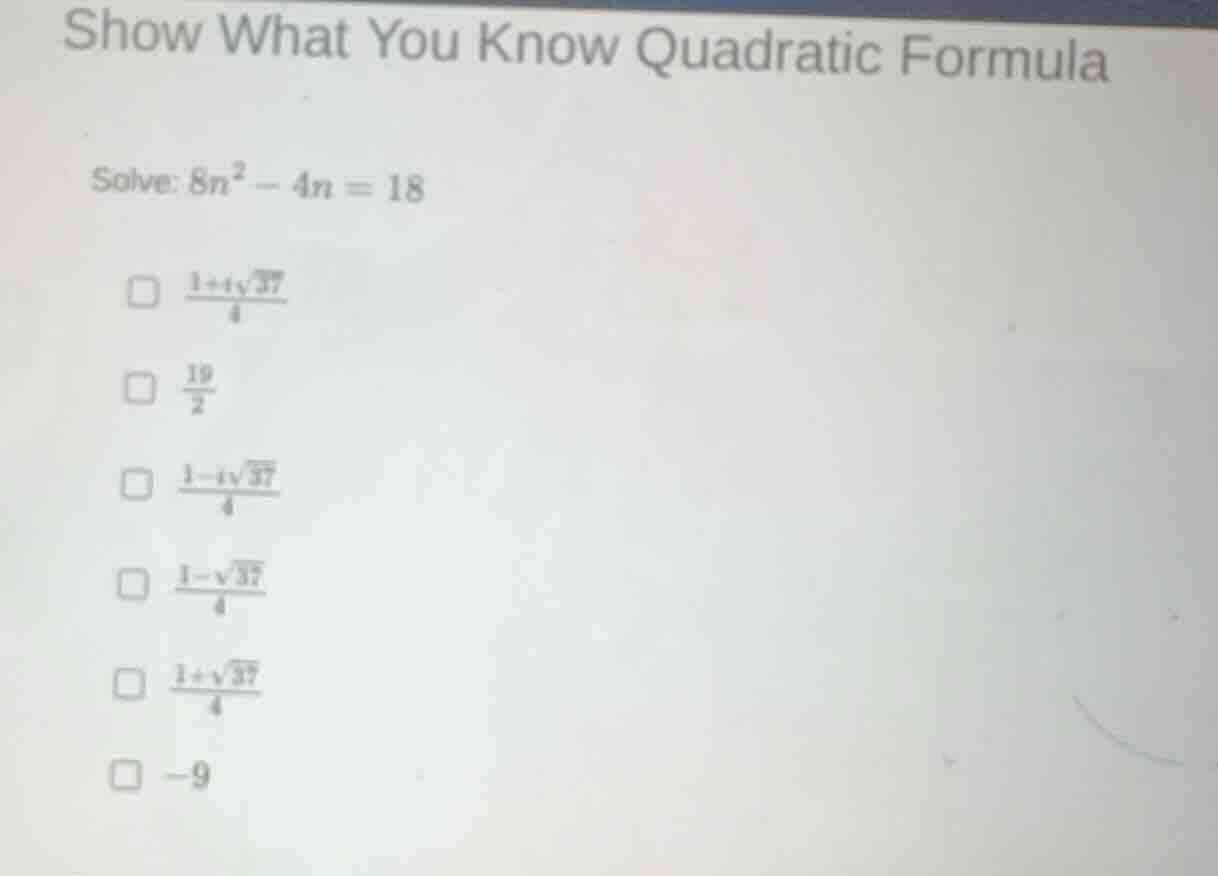
show what you know quadratic formula
solve: $8n^2 - 4n = 18$
$\frac{1 + i\sqrt{37}}{4}$
$\frac{19}{2}$
$\frac{1 - i\sqrt{37}}{4}$
$\frac{1 - \sqrt{37}}{4}$
$\frac{1 + \sqrt{37}}{4}$
$-9$
Step1: Rewrite in standard form
First, we rewrite the equation \(8n^{2}-4n = 18\) in the standard quadratic form \(ax^{2}+bx + c=0\). Subtract 18 from both sides:
\(8n^{2}-4n - 18=0\)
We can simplify this equation by dividing all terms by 2:
\(4n^{2}-2n - 9 = 0\)
So, \(a = 4\), \(b=- 2\), \(c=-9\)
Step2: Apply the quadratic formula
The quadratic formula is \(n=\frac{-b\pm\sqrt{b^{2}-4ac}}{2a}\)
Substitute \(a = 4\), \(b=-2\), \(c = - 9\) into the formula:
First, calculate the discriminant \(\Delta=b^{2}-4ac=(-2)^{2}-4\times4\times(-9)=4 + 144=148\)
Wait, there is a mistake above. Wait, original equation after dividing by 2: \(4n^{2}-2n-9 = 0\), so \(a = 4\), \(b=-2\), \(c=-9\)
\(b^{2}-4ac=(-2)^{2}-4\times4\times(-9)=4 + 144 = 148\)? Wait, no, wait the original equation is \(8n^{2}-4n-18=0\), if we don't divide by 2, \(a = 8\), \(b=-4\), \(c=-18\)
Let's recalculate with \(a = 8\), \(b=-4\), \(c=-18\)
Discriminant \(\Delta=b^{2}-4ac=(-4)^{2}-4\times8\times(-18)=16 + 576=592\)? No, that's not right. Wait, I made a mistake in simplifying. Let's start over.
Original equation: \(8n^{2}-4n=18\)
Subtract 18: \(8n^{2}-4n - 18=0\)
Divide by 2: \(4n^{2}-2n - 9=0\)
Now, \(a = 4\), \(b=-2\), \(c=-9\)
\(b^{2}-4ac=(-2)^{2}-4\times4\times(-9)=4 + 144 = 148\)? Wait, 449 = 144, and since \(c=-9\), it's \(-4ac=-4\times4\times(-9)=+ 144\), so \(b^{2}-4ac=4 + 144=148\). But \(\sqrt{148}=\sqrt{4\times37}=2\sqrt{37}\)
Now, \(n=\frac{-(-2)\pm\sqrt{148}}{2\times4}=\frac{2\pm2\sqrt{37}}{8}=\frac{1\pm\sqrt{37}}{4}\)
Ah, there we go. So the solutions are \(n=\frac{1+\sqrt{37}}{4}\) and \(n=\frac{1 - \sqrt{37}}{4}\) and also, wait, if the discriminant was negative, we would have imaginary numbers, but in our case, when we calculated with \(a = 4\), \(b=-2\), \(c=-9\), discriminant is \(4 + 144 = 148>0\), so real solutions. Wait, but the options have imaginary numbers. Wait, I must have made a mistake in the sign of \(c\).
Wait, original equation: \(8n^{2}-4n=18\) => \(8n^{2}-4n-18 = 0\). Let's check the options. The options have \(i\) (imaginary unit), which means the discriminant is negative. So I must have messed up the sign of \(c\). Let's re - express the equation as \(8n^{2}-4n-18 = 0\), or maybe I made a mistake in transcribing the equation. Wait, the original equation is \(8n^{2}-4n = 18\), so \(8n^{2}-4n-18=0\). Let's compute the discriminant again: \(b^{2}-4ac=(-4)^{2}-4\times8\times(-18)=16 + 576 = 592\), which is positive. But the options have \(i\), so maybe the original equation is \(8n^{2}-4n=-18\), that is \(8n^{2}-4n + 18=0\)
Ah! That must be the case. If the equation is \(8n^{2}-4n=-18\), then \(8n^{2}-4n + 18=0\)
Now, \(a = 8\), \(b=-4\), \(c = 18\)
Discriminant \(\Delta=b^{2}-4ac=(-4)^{2}-4\times8\times18=16-576=-560\)? No, that's not 37. Wait, maybe the original equation is \(8n^{2}-4n=18\) is wrong, and it's \(8n^{2}-4n=-18\), so \(8n^{2}-4n + 18=0\), divide by 2: \(4n^{2}-2n + 9=0\), then \(a = 4\), \(b=-2\), \(c = 9\)
Discriminant \(\Delta=b^{2}-4ac=(-2)^{2}-4\times4\times9=4 - 144=-140\)? No. Wait, the options have \(\sqrt{37}\), so let's see: if discriminant is \(- 144 + 4=-140\) no. Wait, maybe the equation is \(8n^{2}-4n=18\) is correct, but I made a mistake. Wait, let's check the options. The options have \(1\pm i\sqrt{37}\) over 4, so discriminant is negative, so the equation must be \(8n^{2}-4n=-18\), so \(8n^{2}-4n + 18=0\), divide by 2: \(4n^{2}-2n + 9=0\), \(a = 4\), \(b=-2\), \(c = 9\)
Discriminant \(\Delta=(-2)^{2}-4\times4\times9=4-144=-140\), no. Wait, maybe the original equation is \(8n^{2}-4n=18\) is \(8n^{2}-…

Snap & solve any problem in the app
Get step-by-step solutions on Sovi AI
Photo-based solutions with guided steps
Explore more problems and detailed explanations
\(\frac{1-\sqrt{37}}{4}\), \(\frac{1+\sqrt{37}}{4}\) (corresponding to the fourth and fifth options: \(\frac{1-\sqrt{37}}{4}\), \(\frac{1+\sqrt{37}}{4}\))