QUESTION IMAGE
Question
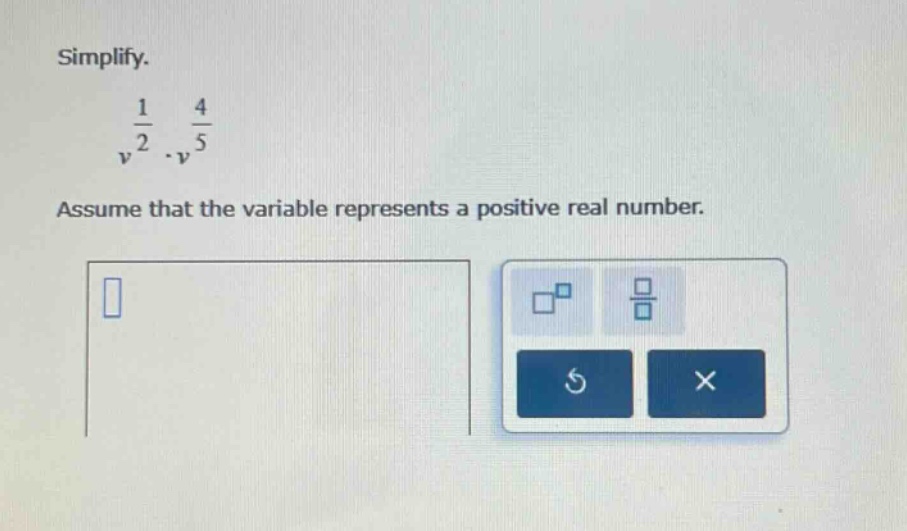
simplify.
$v^{\frac{1}{2}} cdot v^{\frac{4}{5}}$
assume that the variable represents a positive real number.
Step1: Recall exponent rule for multiplication
When multiplying two exponential expressions with the same base \( a^m \cdot a^n=a^{m + n} \), here the base is \( v \), so we add the exponents.
The exponents are \( \frac{1}{2} \) and \( \frac{4}{5} \). So we calculate \( \frac{1}{2}+\frac{4}{5} \).
Step2: Add the fractions
To add \( \frac{1}{2}+\frac{4}{5} \), find a common denominator, which is \( 10 \).
\( \frac{1}{2}=\frac{1\times5}{2\times5}=\frac{5}{10} \) and \( \frac{4}{5}=\frac{4\times2}{5\times2}=\frac{8}{10} \).
Then \( \frac{5}{10}+\frac{8}{10}=\frac{5 + 8}{10}=\frac{13}{10} \).
So \( v^{\frac{1}{2}}\cdot v^{\frac{4}{5}}=v^{\frac{13}{10}} \).

Snap & solve any problem in the app
Get step-by-step solutions on Sovi AI
Photo-based solutions with guided steps
Explore more problems and detailed explanations
\( v^{\frac{13}{10}} \)