QUESTION IMAGE
Question
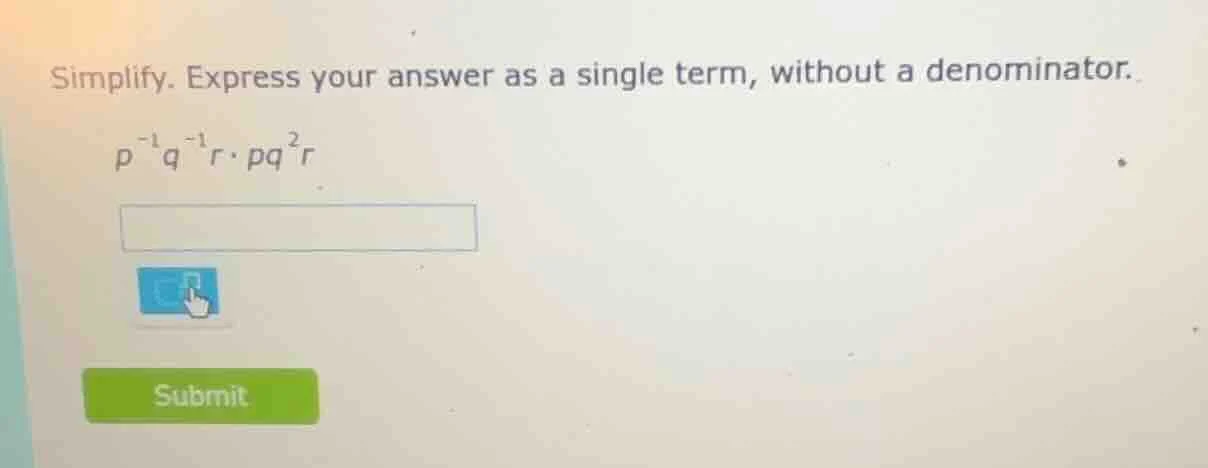
simplify. express your answer as a single term, without a denominator.
$p^{-1}q^{-1}r \cdot pq^2r$
Step1: Use exponent rule \(a^m \cdot a^n = a^{m + n}\) for \(p\) terms.
For \(p\) terms: \(p^{-1} \cdot p = p^{-1 + 1}\)
Step2: Use exponent rule for \(q\) terms.
For \(q\) terms: \(q^{-1} \cdot q^{2} = q^{-1 + 2}\)
Step3: Use exponent rule for \(r\) terms.
For \(r\) terms: \(r \cdot r = r^{1 + 1}\)
Step4: Simplify each exponent.
\(p^{-1 + 1}=p^{0}=1\) (but we can just consider the exponent sum), \(q^{-1 + 2}=q^{1}=q\), \(r^{1 + 1}=r^{2}\)
Combining them, we get \(p^{-1 + 1}q^{-1 + 2}r^{1 + 1}=p^{0}q^{1}r^{2}=1\times q\times r^{2}=qr^{2}\) (Wait, no, wait: Wait, \(p^{-1}\cdot p = p^{-1 + 1}=p^{0}=1\), but actually, when multiplying, the \(p\) terms: \(p^{-1}\times p = p^{-1 + 1}=p^{0}=1\), but let's redo:
Wait, the original expression is \(p^{-1}q^{-1}r \cdot pq^{2}r\)
So for \(p\): \(-1 + 1 = 0\), so \(p^{0}=1\), but we can write it as \(p^{0}\), but when we multiply, the \(p\) terms: \(p^{-1} \times p^{1}=p^{-1 + 1}=p^{0}=1\), so the \(p\) part is \(p^{0}\), but actually, let's do each variable:
- \(p\): exponent of first \(p\) is \(-1\), second is \(1\), so sum is \(-1 + 1 = 0\), so \(p^{0}=1\) (but we can keep it as \(p^{0}\) but since \(p^{0}=1\), it doesn't affect the product, so we can ignore it or just have \(p^{0}\) but in the final term, since \(p^{0}=1\), the \(p\) part is 1, so we can omit it? Wait no, wait: Wait, no, the problem says "express as a single term without a denominator". Let's do it again:
\(p^{-1} \cdot p = p^{-1 + 1}=p^{0}=1\)
\(q^{-1} \cdot q^{2}=q^{-1 + 2}=q^{1}=q\)
\(r \cdot r = r^{1 + 1}=r^{2}\)
So multiplying all together: \(1 \times q \times r^{2}=q r^{2}\)? Wait, no, wait, that's wrong. Wait, no, the first term has \(r\) (exponent 1) and the second term has \(r\) (exponent 1), so \(r^1 \times r^1 = r^{2}\). The \(p\) terms: \(p^{-1} \times p^1 = p^{0}=1\). The \(q\) terms: \(q^{-1} \times q^2 = q^{1}=q\). So putting it all together: \(p^{0} q^{1} r^{2}\). But \(p^{0}=1\), so it's \(1 \times q \times r^{2}=q r^{2}\)? Wait, no, wait, I think I made a mistake. Wait, no: Wait, the original expression is \(p^{-1}q^{-1}r \times pq^{2}r\). Let's group the like terms:
\((p^{-1} \times p) \times (q^{-1} \times q^{2}) \times (r \times r)\)
So \(p^{-1 + 1}=p^{0}=1\), \(q^{-1 + 2}=q^{1}=q\), \(r^{1 + 1}=r^{2}\). So multiplying these: \(1 \times q \times r^{2}=q r^{2}\). Wait, but that seems off. Wait, no, wait, maybe I messed up the \(p\) terms. Wait, \(p^{-1}\) is \(1/p\), and \(p\) is \(p/1\), so multiplying them: \((1/p) \times p = 1\). Then \(q^{-1}\) is \(1/q\), \(q^{2}\) is \(q^2\), so \((1/q) \times q^2 = q\). Then \(r \times r = r^2\). So multiplying all together: \(1 \times q \times r^2 = q r^2\). Wait, but that seems correct? Wait, no, wait, let's check with actual numbers. Let \(p = 2\), \(q = 3\), \(r = 4\).
Original expression: \(p^{-1}q^{-1}r \times pq^{2}r = (1/2)(1/3)(4) \times (2)(9)(4)\)
First part: \((1/2)(1/3)(4) = (4)/(6) = 2/3\)
Second part: \(2 \times 9 \times 4 = 72\)
Multiply them: \(2/3 \times 72 = 48\)
Now, \(q r^2 = 3 \times 16 = 48\). Yes! So that works. So the simplified form is \(q r^{2}\)? Wait, no, wait, wait, in the calculation, when we did \(p^{-1} \times p = 1\), \(q^{-1} \times q^2 = q\), \(r \times r = r^2\), so the product is \(1 \times q \times r^2 = q r^2\). Wait, but let's check the exponents again.
Wait, the exponents for \(p\): \(-1 + 1 = 0\), so \(p^0 = 1\), so the \(p\) part is 1. For \(q\): \(-1 + 2 = 1\), so \(q^1 = q\). For \(r\): \(1 + 1 = 2\), so \(r^2\). So multiplying all together: \(1 \times q \times r^2 = q r^2\). Yes, that's corre…

Snap & solve any problem in the app
Get step-by-step solutions on Sovi AI
Photo-based solutions with guided steps
Explore more problems and detailed explanations
\(qr^{2}\)