QUESTION IMAGE
Question
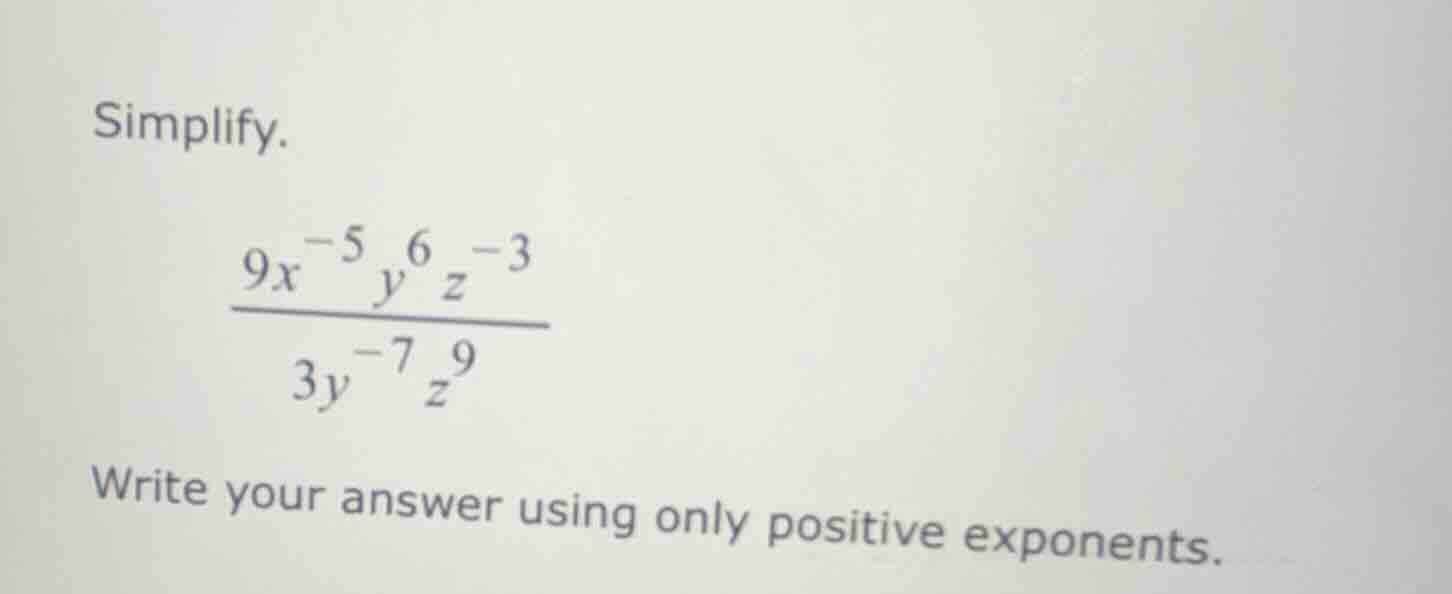
simplify.
\\(\dfrac{9x^{-5}y^{6}z^{-3}}{3y^{-7}z^{9}}\\)
write your answer using only positive exponents.
Step1: Simplify the coefficient
Divide the coefficient 9 by 3.
$\frac{9}{3} = 3$
Step2: Simplify the \(x\)-term
The \(x\)-term is \(x^{-5}\) in the numerator and there is no \(x\)-term in the denominator, so it remains \(x^{-5}\). Using the rule \(a^{-n}=\frac{1}{a^{n}}\), we can rewrite it as \(\frac{1}{x^{5}}\) later, but for now, we'll handle exponents first.
Step3: Simplify the \(y\)-terms
Using the rule \(\frac{a^{m}}{a^{n}} = a^{m - n}\), for \(y\)-terms: \(y^{6}\) in the numerator and \(y^{-7}\) in the denominator. So \(y^{6 - (-7)} = y^{6 + 7} = y^{13}\)
Step4: Simplify the \(z\)-terms
Using the same rule for \(z\)-terms: \(z^{-3}\) in the numerator and \(z^{9}\) in the denominator. So \(z^{-3 - 9} = z^{-12}\). Using the rule \(a^{-n}=\frac{1}{a^{n}}\), this becomes \(\frac{1}{z^{12}}\)
Step5: Combine all terms
Now, combine the coefficient, \(x\)-term, \(y\)-term, and \(z\)-term. The \(x^{-5}\) becomes \(\frac{1}{x^{5}}\), \(z^{-12}\) becomes \(\frac{1}{z^{12}}\). So we have:
\(3\times\frac{1}{x^{5}}\times y^{13}\times\frac{1}{z^{12}}=\frac{3y^{13}}{x^{5}z^{12}}\)

Snap & solve any problem in the app
Get step-by-step solutions on Sovi AI
Photo-based solutions with guided steps
Explore more problems and detailed explanations
\(\frac{3y^{13}}{x^{5}z^{12}}\)