QUESTION IMAGE
Question
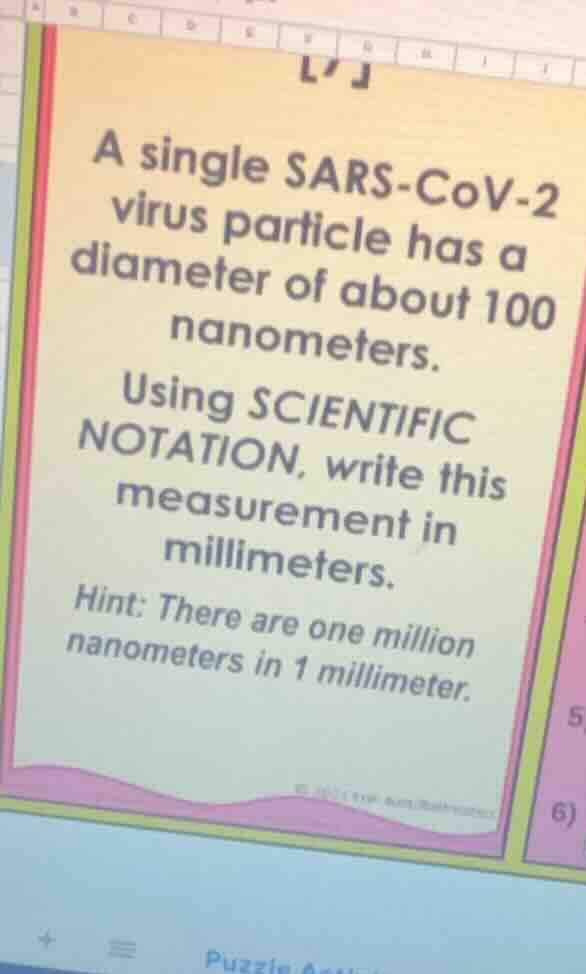
a single sars - cov - 2 virus particle has a diameter of about 100 nanometers. using scientific notation, write this measurement in millimeters. hint: there are one million nanometers in 1 millimeter.
Step1: Recall the conversion factor
We know that 1 millimeter = \(10^6\) nanometers (since there are one million nanometers in 1 millimeter). So to convert nanometers to millimeters, we divide by \(10^6\).
The diameter of the virus particle is 100 nanometers. So we have the value \(100\) nanometers, and we want to convert it to millimeters. So we calculate \(100\div10^6\) millimeters.
Step2: Perform the division and express in scientific notation
First, \(100 = 1\times10^2\). Then, \(100\div10^6=\frac{1\times 10^2}{1\times 10^6}\). Using the rule of exponents \(\frac{a^m}{a^n}=a^{m - n}\), we get \(1\times10^{2-6}=1\times10^{-4}\) millimeters. Wait, no, wait: \(100\) is \(1\times10^2\), and dividing by \(10^6\) is multiplying by \(10^{-6}\). So \(1\times10^2\times10^{-6}=1\times10^{2 + (-6)}=1\times10^{-4}\)? Wait, no, that's not right. Wait, 100 nanometers is 100 divided by 1,000,000 millimeters. Let's do the division: 100 ÷ 1,000,000. 1,000,000 is \(10^6\), 100 is \(10^2\). So \(10^2\div10^6 = 10^{2 - 6}=10^{-4}\)? Wait, no, 100 divided by 1,000,000 is 0.0001. And 0.0001 in scientific notation is \(1\times10^{-4}\)? Wait, no, 0.0001 is \(1\times10^{-4}\)? Wait, 10^{-4} is 0.0001, yes. Wait, but let's check again. 1 millimeter = 1,000,000 nanometers, so 1 nanometer = \(1\times10^{-6}\) millimeters. Therefore, 100 nanometers = \(100\times1\times10^{-6}\) millimeters. \(100 = 1\times10^2\), so \(1\times10^2\times1\times10^{-6}=1\times10^{2 - 6}=1\times10^{-4}\) millimeters? Wait, no, 10^2 times 10^{-6} is 10^{-4}, yes. So 100 nanometers is \(1\times10^{-4}\) millimeters? Wait, no, wait, 100 nanometers: 100 divided by 1,000,000. Let's compute 100 / 1,000,000. 1,000,000 is 10^6, 100 is 10^2. So 10^2 / 10^6 = 10^(2-6) = 10^(-4). So 10^(-4) is 0.0001, which is 100 / 1,000,000 = 0.0001. And 0.0001 in scientific notation is \(1\times10^{-4}\)? Wait, no, 0.0001 is 1 × 10^-4? Wait, 10^-1 is 0.1, 10^-2 is 0.01, 10^-3 is 0.001, 10^-4 is 0.0001. Yes. So 100 nanometers is \(1\times10^{-4}\) millimeters? Wait, no, wait, that can't be right. Wait, 1 millimeter is 1,000,000 nanometers. So 1 nanometer is 1e-6 millimeters. So 100 nanometers is 100 1e-6 millimeters = 1e2 1e-6 = 1e-4 millimeters. Yes, that's correct. So 100 nanometers is \(1\times10^{-4}\) millimeters? Wait, no, wait, 1e-4 is 0.0001, and 100 nanometers is 0.0001 millimeters? Wait, let's check with actual numbers. 1 millimeter = 1,000,000 nanometers. So 1 nanometer = 1/1,000,000 millimeter = 0.000001 millimeter. Then 100 nanometers = 100 * 0.000001 = 0.0001 millimeter. And 0.0001 in scientific notation is \(1\times10^{-4}\) millimeter? Wait, no, 0.0001 is \(1\times10^{-4}\)? Wait, 10^-4 is 0.0001, yes. So that's correct.
Wait, but let's do the calculation again. 100 nanometers. Convert to millimeters: divide by 1,000,000. So 100 / 1,000,000 = 0.0001. Now, 0.0001 in scientific notation: we move the decimal point 4 places to the right to get a number between 1 and 10, so we get 1.0, and since we moved the decimal 4 places to the right, the exponent is -4. So 0.0001 = \(1\times10^{-4}\) millimeters.

Snap & solve any problem in the app
Get step-by-step solutions on Sovi AI
Photo-based solutions with guided steps
Explore more problems and detailed explanations
\(1\times10^{-4}\) millimeters