QUESTION IMAGE
Question
six graphs are shown below. click on the tabs to see them.
graph 1 graph 2 graph 3 graph 4 graph 5 graph 6
check the box corresponding to each graph that represents a function.
□ graph 1 □ graph 2 □ graph 3 □ graph 4 □ graph 5 □ graph 6 □ none of the graphs
To determine if a graph represents a function, we use the vertical line test: a graph is a function if no vertical line intersects it more than once.
Analyzing Graph 1:
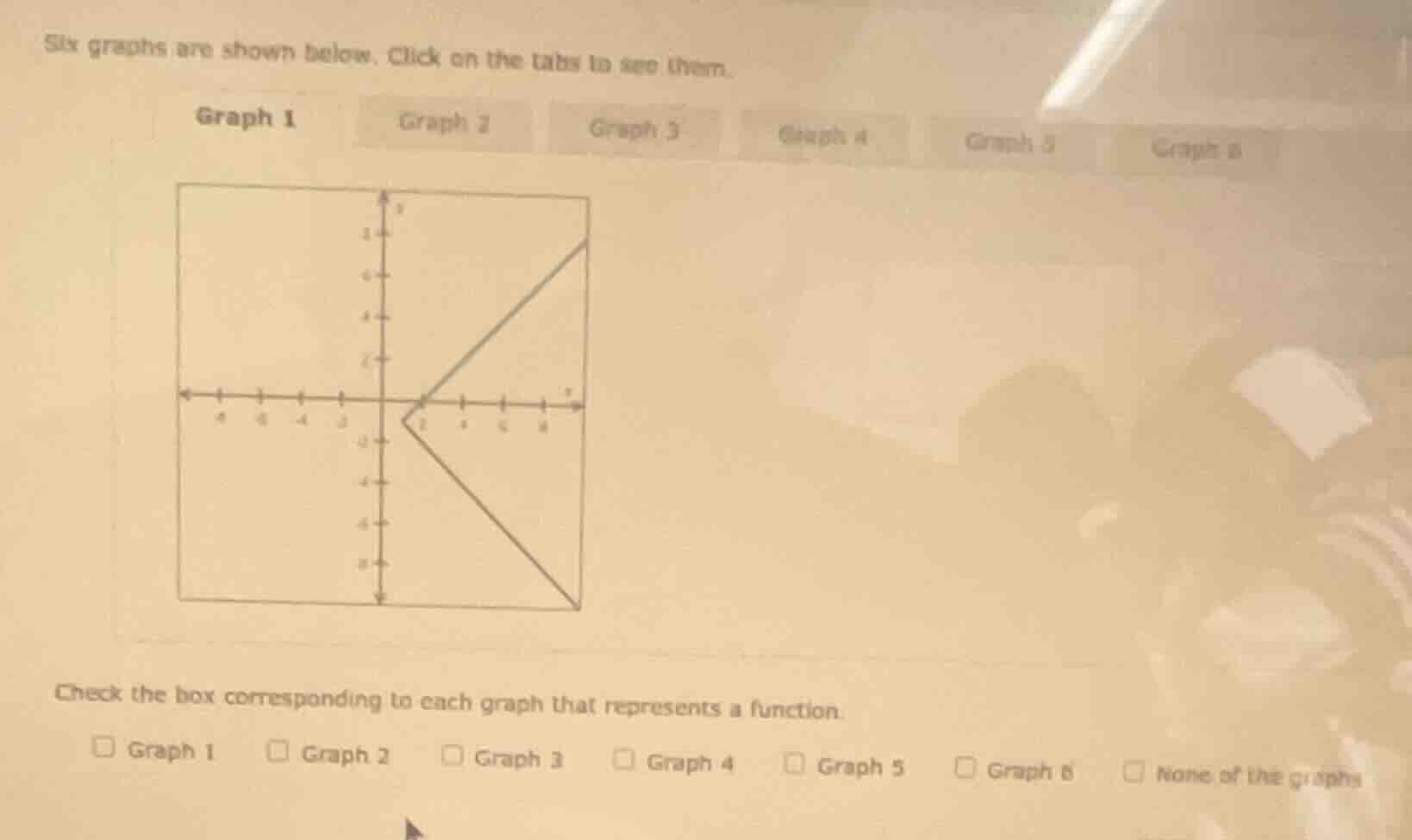
Looking at Graph 1, if we draw a vertical line (e.g., at \( x = 1 \), \( x = 2 \), etc.), we observe that some vertical lines will intersect the graph at two points (due to the "corner" or the two lines forming a V - shape that might be intersected twice by a vertical line). Wait, actually, let's re - examine. Wait, the graph in Graph 1: let's check the vertical line test. For a vertical line \( x = a \), how many times does it intersect the graph? Wait, maybe I made a mistake. Wait, no—wait, the graph shown: let's see, the upper line and the lower line. If we take a vertical line, say \( x = 1 \), does it intersect the upper line and the lower line? Wait, no, maybe the graph is such that for each \( x \), there is only one \( y \)? Wait, no, let's think again. Wait, the vertical line test: a relation is a function if for every \( x \) - value, there is exactly one \( y \) - value. So in Graph 1, if we have a vertical line, does it hit two points? Wait, maybe the graph is not a function? Wait, no, maybe I misread. Wait, the user's Graph 1: let's assume that when we apply the vertical line test, Graph 1 fails (has two \( y \) - values for some \( x \)). But wait, maybe other graphs? Wait, the problem is about Graph 1 first. Wait, no—wait, maybe the original problem's Graph 1: let's check again. Wait, the graph in Graph 1: if we look at the \( x \) - axis, at \( x = 0 \), what's the \( y \) - value? Wait, no, maybe the graph is not a function. But wait, maybe I made a mistake. Wait, perhaps the correct approach is:
Wait, the vertical line test: for a graph to be a function, any vertical line drawn through the graph must intersect the graph at most once.
In Graph 1, if we draw a vertical line (e.g., at \( x = 1 \)), does it intersect the graph at two points? If yes, then Graph 1 is not a function. But maybe the other graphs? Wait, the problem is to check the box for each graph that represents a function. But since we only have Graph 1 shown, but the question is about Graph 1. Wait, maybe I misanalyzed. Wait, no—wait, maybe the graph in Graph 1: let's see, the two lines form a sort of V - shape but with a corner at the origin? Wait, no, maybe it's a piece - wise function. Wait, no, if a vertical line intersects the graph at two points, it's not a function.
Wait, perhaps the correct answer is that Graph 1 does not represent a function (so the box for Graph 1 is not checked). But wait, maybe I made a mistake. Wait, let's start over.
The vertical line test: a graph is a function if and only if every vertical line intersects the graph at most once.
For Graph 1: If we take a vertical line, say \( x = 1 \), does it intersect the upper line and the lower line? If so, then there are two \( y \) - values for \( x = 1 \), so Graph 1 is not a function.
But wait, maybe the user's Graph 1 is actually a function? No, the shape (two lines forming a V - like shape with a corner) would mean that for some \( x \), there are two \( y \) - values. So Graph 1 is not a function, so the box for Graph 1 is not checked.
But wait, the problem is to check the box for each graph that represents a function. Since we are only shown Graph 1, and if Graph 1 is not a function, then the box for Graph 1 is not checked.
But maybe I made a mistake. Wait, perhaps the graph is a function. Wait, no—let's think of the definition. A function is a relation where each input (\( x \)) has exactly one ou…
To determine if Graph 1 represents a function, we use the vertical line test. A graph represents a function if every vertical line intersects it at most once. For Graph 1, some vertical lines (e.g., \( x = 1 \)) intersect the graph at two points (one on the upper line, one on the lower line), meaning there are two \( y \) - values for a single \( x \) - value. Thus, Graph 1 fails the vertical line test and is not a function.

Snap & solve any problem in the app
Get step-by-step solutions on Sovi AI
Photo-based solutions with guided steps
Explore more problems and detailed explanations
The box for Graph 1 is not checked (i.e., Graph 1 does not represent a function, so we do not mark its corresponding checkbox).