QUESTION IMAGE
Question
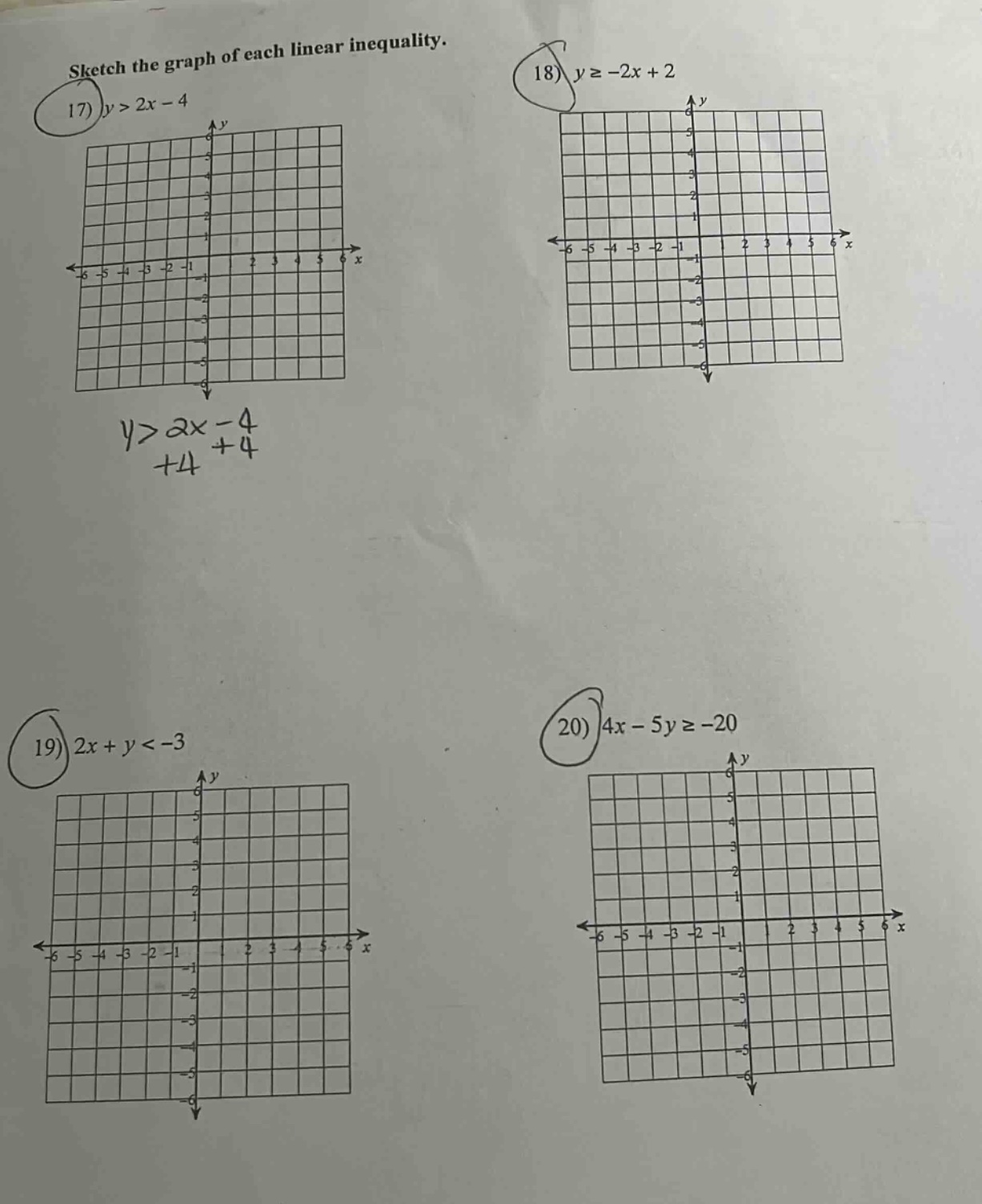
sketch the graph of each linear inequality.
- $y > 2x - 4$
- $y \geq -2x + 2$
- $2x + y < -3$
- $4x - 5y \geq -20$
Problem 17: \( y > 2x - 4 \)
Step 1: Graph the boundary line
The inequality is \( y > 2x - 4 \). First, consider the boundary line \( y = 2x - 4 \). This is a linear equation in slope - intercept form (\( y=mx + b \)) where the slope \( m = 2 \) and the y - intercept \( b=-4 \). Since the inequality is \( y>2x - 4 \) (not \( y\geq2x - 4 \)), we draw a dashed line for \( y = 2x - 4 \) (a dashed line indicates that the points on the line are not included in the solution set).
Step 2: Determine the region to shade
To determine which side of the line to shade, we can use a test point. A common test point is the origin \((0,0)\) (as long as it is not on the line). Substitute \( x = 0 \) and \( y = 0 \) into the inequality: \( 0>2(0)-4\), which simplifies to \( 0>-4 \). This is a true statement. So we shade the region that contains the origin \((0,0)\) with respect to the line \( y = 2x - 4 \).
Problem 18: \( y\geq - 2x + 2 \)
Step 1: Graph the boundary line
The inequality is \( y\geq - 2x + 2 \). The boundary line is \( y=-2x + 2 \), which is in slope - intercept form with slope \( m=-2 \) and y - intercept \( b = 2 \). Since the inequality is \( y\geq - 2x+2 \) (the "greater than or equal to" sign), we draw a solid line for \( y=-2x + 2 \) (a solid line means the points on the line are included in the solution set).
Step 2: Determine the region to shade
Use the origin \((0,0)\) as a test point (it is not on the line \( y=-2x + 2 \) since \( 0
eq-2(0)+2=2 \)). Substitute \( x = 0 \) and \( y = 0 \) into the inequality: \( 0\geq-2(0)+2\), which simplifies to \( 0\geq2 \). This is a false statement. So we shade the region that does not contain the origin, i.e., the region above the line \( y=-2x + 2 \).
Problem 19: \( 2x + y<-3 \)
Step 1: Rewrite in slope - intercept form and graph the boundary line
Rewrite the inequality \( 2x + y<-3 \) as \( y<-2x - 3 \). The boundary line is \( y=-2x - 3 \), with slope \( m=-2 \) and y - intercept \( b=-3 \). Since the inequality is \( y<-2x - 3 \) (not \( y\leq-2x - 3 \)), we draw a dashed line for \( y=-2x - 3 \).
Step 2: Determine the region to shade
Use the origin \((0,0)\) as a test point. Substitute \( x = 0 \) and \( y = 0 \) into the inequality: \( 2(0)+0<-3\), which simplifies to \( 0<-3 \). This is a false statement. So we shade the region that does not contain the origin, i.e., the region below the line \( y=-2x - 3 \).
Problem 20: \( 4x-5y\geq - 20 \)

Snap & solve any problem in the app
Get step-by-step solutions on Sovi AI
Photo-based solutions with guided steps
Explore more problems and detailed explanations
Step 1: Rewrite in slope - intercept form and graph the boundary line
First, solve the inequality \( 4x-5y\geq - 20 \) for \( y \).
Subtract \( 4x \) from both sides: \( -5y\geq-4x - 20 \)
Divide both sides by \(-5\). Remember that when we divide or multiply an inequality by a negative number, the direction of the inequality sign changes. So we get \( y\leq\frac{4}{5}x + 4 \).
The boundary line is \( y=\frac{4}{5}x + 4 \), with slope \( m=\frac{4}{5} \) and y - intercept \( b = 4 \). Since the inequality is \( y\leq\frac{4}{5}x + 4 \), we draw a solid line for \( y=\frac{4}{5}x + 4 \).
Step 2: Determine the region to shade
Use the origin \((0,0)\) as a test point. Substitute \( x = 0 \) and \( y = 0 \) into the inequality \( 4(0)-5(0)\geq - 20 \), which simplifies to \( 0\geq - 20 \). This is a true statement. So we shade the region that contains the origin, i.e., the region below (or on) the line \( y=\frac{4}{5}x + 4 \).
(Note: For the actual graphing, on the coordinate grids provided, you would plot the boundary lines as described (dashed or solid) and then shade the appropriate regions. The above steps describe the process of determining the boundary line and the shaded region for each inequality.)