QUESTION IMAGE
Question
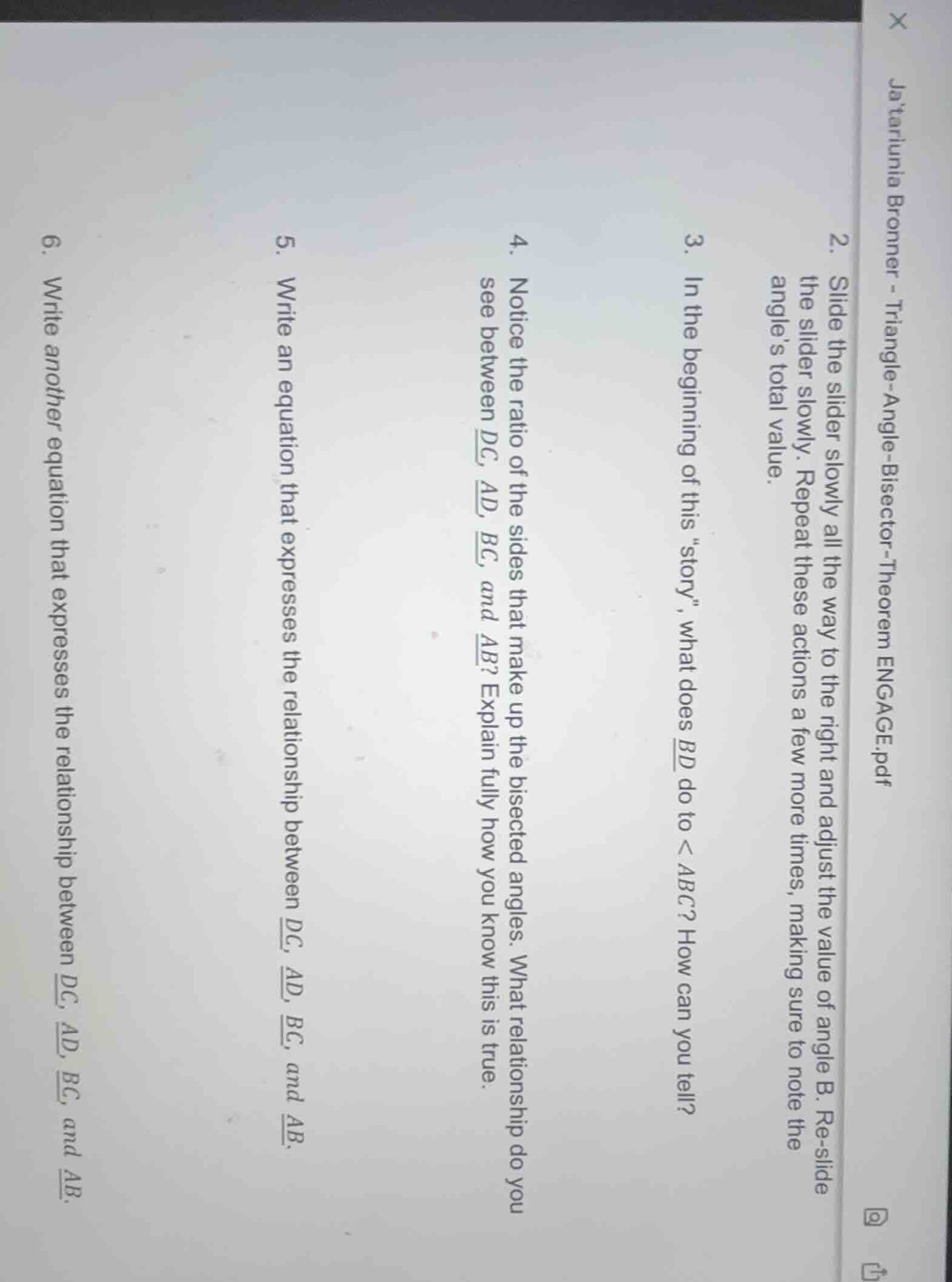
- slide the slider slowly all the way to the right and adjust the value of angle b. re - slide the slider slowly. repeat these actions a few more times, making sure to note the angle’s total value.
- in the beginning of this “story”, what does \\(\overline{bd}\\) do to \\(\angle abc\\)? how can you tell?
- notice the ratio of the sides that make up the bisected angles. what relationship do you see between \\(\overline{dc}\\), \\(\overline{ad}\\), \\(\overline{bc}\\), and \\(\overline{ab}\\)? explain fully how you know this is true.
- write an equation that expresses the relationship between \\(\overline{dc}\\), \\(\overline{ad}\\), \\(\overline{bc}\\), and \\(\overline{ab}\\).
- write another equation that expresses the relationship between \\(\overline{dc}\\), \\(\overline{ad}\\), \\(\overline{bc}\\), and \\(\overline{ab}\\).
To solve questions related to the Angle - Bisector Theorem (which is likely the context here, as the document is titled "Triangle - Angle - Bisector - Theorem"), we can use the following information:
The Angle - Bisector Theorem states that if a bisector of an angle of a triangle divides the opposite side into two segments, then the ratio of the lengths of these two segments is equal to the ratio of the lengths of the other two sides of the triangle.
For question 4, 5 and 6 (assuming the triangle is \(\triangle ABC\) with angle bisector \(BD\) where \(D\) lies on \(AC\)):
Step 1: Recall the Angle - Bisector Theorem
The Angle - Bisector Theorem states that \(\frac{AD}{DC}=\frac{AB}{BC}\)
Step 2: Derive other equations (for questions 5 and 6)
- From \(\frac{AD}{DC}=\frac{AB}{BC}\), we can cross - multiply to get \(AD\times BC=DC\times AB\) (this can be an equation for question 5 or 6)
- We can also rearrange the original ratio to get other forms, for example, \(\frac{DC}{AD}=\frac{BC}{AB}\) (another possible equation for question 6)
for each question:
Question 2
This is a hands - on exploration. By sliding the slider to adjust angle \(B\) and observing the total value of the angle (and the effect of the angle bisector), you are likely to notice that the angle bisector \(BD\) divides \(\angle ABC\) into two equal angles. Repeating the process helps to confirm that the angle bisector always splits the original angle into two congruent angles.
Question 3
At the beginning (when you start the exploration), the angle bisector \(BD\) of \(\angle ABC\) will divide \(\angle ABC\) into two angles of equal measure. You can tell this by observing the measures of the two angles formed by \(BD\) with \(BA\) and \(BC\) (either through the given slider values or by using a protractor - like tool in the interactive slide).
Question 4
The relationship between \(DC\), \(AD\), \(BC\), and \(AB\) is given by the Angle - Bisector Theorem. The theorem states that if \(BD\) is the angle bisector of \(\angle ABC\) in \(\triangle ABC\) and \(D\) is on \(AC\), then \(\frac{AD}{DC}=\frac{AB}{BC}\). This is true because the angle bisector creates two similar triangles (in some cases) or by using the properties of triangle angle bisectors and the Law of Sines. If we apply the Law of Sines to \(\triangle ABD\) and \(\triangle CBD\):
- In \(\triangle ABD\), \(\frac{AD}{\sin\angle ABD}=\frac{AB}{\sin\angle ADB}\)
- In \(\triangle CBD\), \(\frac{DC}{\sin\angle CBD}=\frac{BC}{\sin\angle CDB}\)
- Since \(\angle ABD = \angle CBD\) (because \(BD\) is an angle bisector) and \(\angle ADB+\angle CDB = 180^{\circ}\), so \(\sin\angle ADB=\sin\angle CDB\). From the two Law of Sines equations, we can cancel out \(\sin\angle ABD\) (or \(\sin\angle CBD\)) and \(\sin\angle ADB\) (or \(\sin\angle CDB\)) and we get \(\frac{AD}{DC}=\frac{AB}{BC}\)
Question 5
Using the Angle - Bisector Theorem \(\frac{AD}{DC}=\frac{AB}{BC}\), we can cross - multiply to get the equation \(AD\times BC = DC\times AB\). This equation expresses the relationship between the lengths of the segments \(AD\), \(DC\), \(AB\), and \(BC\)
Question 6
We can rearrange the ratio from the Angle - Bisector Theorem. Starting from \(\frac{AD}{DC}=\frac{AB}{BC}\), we can take the reciprocal of both sides to get \(\frac{DC}{AD}=\frac{BC}{AB}\) or we can also use cross - multiplication in a different form. Another possible equation is \(\frac{AB}{AD}=\frac{BC}{DC}\) (by rearranging \(AD\times BC = DC\times AB\))

Snap & solve any problem in the app
Get step-by-step solutions on Sovi AI
Photo-based solutions with guided steps
Explore more problems and detailed explanations
s:
Question 2
By sliding the slider and observing, you will find that the angle bisector \(BD\) divides \(\angle ABC\) into two equal - sized angles. Repeating the process confirms that the angle bisector splits the original angle into two congruent angles.
Question 3
\(BD\) bisects \(\angle ABC\) (divides it into two equal angles). We can tell this by observing that the two angles formed by \(BD\) with \(BA\) and \(BC\) have equal measures.
Question 4
The relationship is \(\frac{AD}{DC}=\frac{AB}{BC}\) (by the Angle - Bisector Theorem). This is true because the angle bisector creates proportional segments on the opposite side with respect to the other two sides of the triangle (proven by the Law of Sines or by the properties of angle - bisected triangles).
Question 5
One equation is \(AD\times BC=DC\times AB\) (derived from cross - multiplying the ratio from the Angle - Bisector Theorem \(\frac{AD}{DC}=\frac{AB}{BC}\))
Question 6
One equation is \(\frac{DC}{AD}=\frac{BC}{AB}\) (derived by taking the reciprocal of the ratio from the Angle - Bisector Theorem) or \(\frac{AB}{AD}=\frac{BC}{DC}\) (derived from \(AD\times BC = DC\times AB\))