QUESTION IMAGE
Question
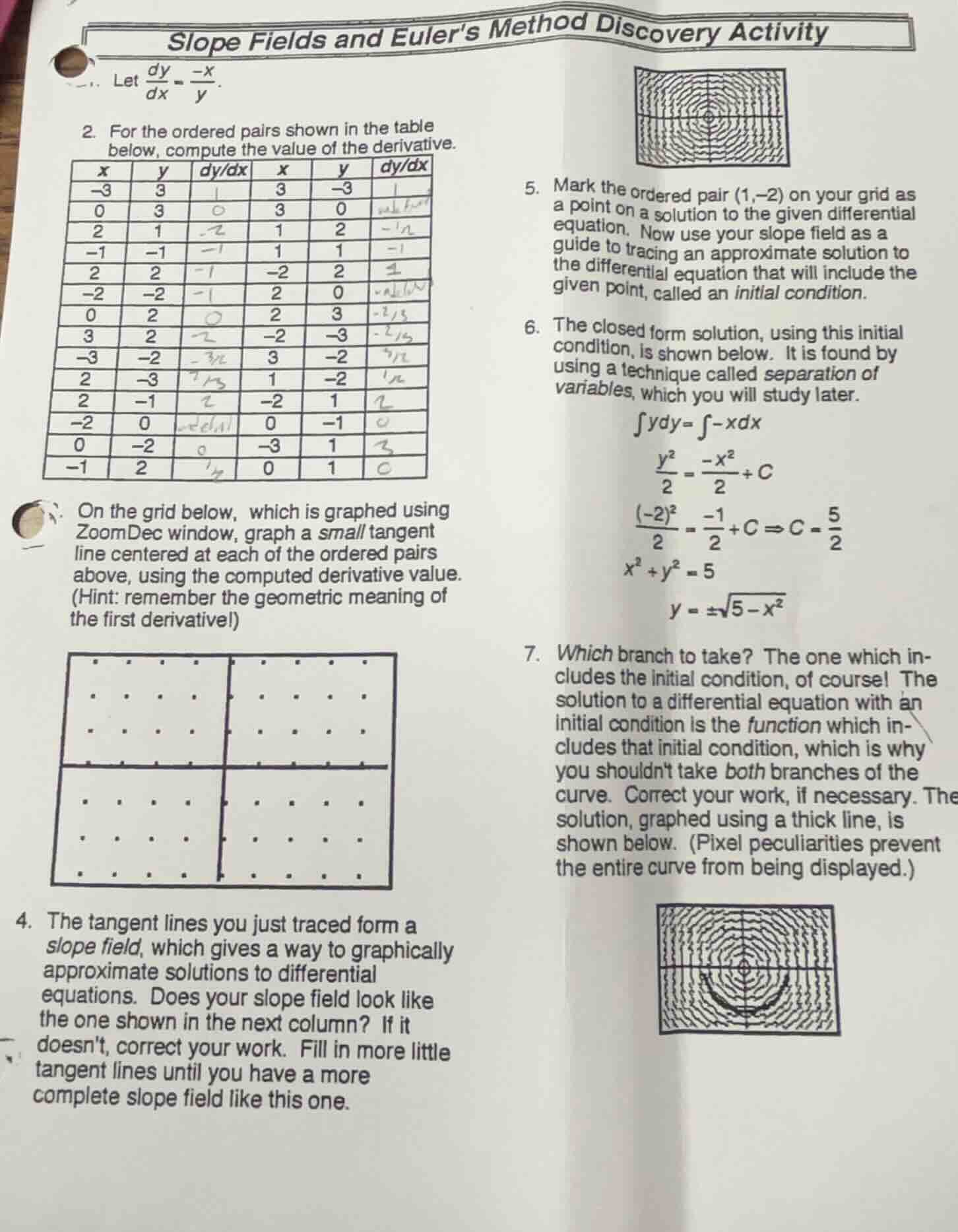
slope fields and eulers method discovery activity let \\(\frac{dy}{dx} = \frac{-x}{y}\\). 2. for the ordered pairs shown in the table below, compute the value of the derivative. \\(\
\\) 3. on the grid below, which is graphed using zoomdec window, graph a small tangent line centered at each of the ordered pairs above, using the computed derivative value. (hint: remember the geometric meaning of the first derivative!) grid image 4. the tangent lines you just traced form a slope field, which gives a way to graphically approximate solutions to differential equations. does your slope field look like the one shown in the next column? if it doesnt, correct your work. fill in more little tangent lines until you have a more complete slope field like this one. slope field image 5. mark the ordered pair (1, -2) on your grid as a point on a solution to the given differential equation. now use your slope field as a guide to tracing an approximate solution to the differential equation that will include the given point, called an initial condition. 6. the closed form solution, using this initial condition, is shown below. it is found by using a technique called separation of variables, which you will study later. \\(\int y dy = \int -x dx\\) \\(\frac{y^2}{2} = \frac{-x^2}{2} + c\\) \\(\frac{(-2)^2}{2} = \frac{-1}{2} + c \implies c = \frac{5}{2}\\) \\(x^2 + y^2 = 5\\) \\(y = \pm \sqrt{5 - x^2}\\) 7. which branch to take? the one which includes the initial condition, of course! the solution to a differential equation with an initial condition is the function which includes that initial condition, which is why you shouldnt take both branches of the curve. correct your work, if necessary. the solution, graphed using a thick line, is shown below. (pixel peculiarities prevent the entire curve from being displayed.) solution curve image
Step1: Use given derivative formula
The derivative is defined as $\frac{dy}{dx} = \frac{-x}{y}$. We substitute each $(x,y)$ pair into this formula to find $\frac{dy}{dx}$.
Step2: Calculate for each ordered pair
- For $(-3,3)$: $\frac{dy}{dx} = \frac{-(-3)}{3} = 1$
- For $(0,3)$: $\frac{dy}{dx} = \frac{-0}{3} = 0$
- For $(2,1)$: $\frac{dy}{dx} = \frac{-2}{1} = -2$
- For $(-1,-1)$: $\frac{dy}{dx} = \frac{-(-1)}{-1} = -1$
- For $(2,2)$: $\frac{dy}{dx} = \frac{-2}{2} = -1$
- For $(-2,-2)$: $\frac{dy}{dx} = \frac{-(-2)}{-2} = -1$
- For $(0,2)$: $\frac{dy}{dx} = \frac{-0}{2} = 0$
- For $(3,2)$: $\frac{dy}{dx} = \frac{-3}{2}$
- For $(-3,-2)$: $\frac{dy}{dx} = \frac{-(-3)}{-2} = -\frac{3}{2}$
- For $(2,-3)$: $\frac{dy}{dx} = \frac{-2}{-3} = \frac{2}{3}$
- For $(2,-1)$: $\frac{dy}{dx} = \frac{-2}{-1} = 2$
- For $(-2,0)$: $\frac{dy}{dx}$ is undefined (division by 0)
- For $(0,-2)$: $\frac{dy}{dx} = \frac{-0}{-2} = 0$
- For $(-1,2)$: $\frac{dy}{dx} = \frac{-(-1)}{2} = \frac{1}{2}$
- For $(3,-3)$: $\frac{dy}{dx} = \frac{-3}{-3} = 1$
- For $(3,0)$: $\frac{dy}{dx}$ is undefined (division by 0)
- For $(1,2)$: $\frac{dy}{dx} = \frac{-1}{2}$
- For $(1,1)$: $\frac{dy}{dx} = \frac{-1}{1} = -1$
- For $(-2,2)$: $\frac{dy}{dx} = \frac{-(-2)}{2} = 1$
- For $(2,0)$: $\frac{dy}{dx}$ is undefined (division by 0)
- For $(2,3)$: $\frac{dy}{dx} = \frac{-2}{3}$
- For $(2,-2)$: $\frac{dy}{dx} = \frac{-2}{-2} = 1$
- For $(1,-2)$: $\frac{dy}{dx} = \frac{-1}{-2} = \frac{1}{2}$
- For $(-2,1)$: $\frac{dy}{dx} = \frac{-(-2)}{1} = 2$
- For $(0,-1)$: $\frac{dy}{dx} = \frac{-0}{-1} = 0$
- For $(-3,1)$: $\frac{dy}{dx} = \frac{-(-3)}{1} = 3$
- For $(0,1)$: $\frac{dy}{dx} = \frac{-0}{1} = 0$
Step3: Identify solution branch for initial condition
For initial condition $(1,-2)$, substitute into $y = \pm\sqrt{5-x^2}$:
$y = -\sqrt{5-(1)^2} = -\sqrt{4} = -2$, which matches. So we take the negative branch.

Snap & solve any problem in the app
Get step-by-step solutions on Sovi AI
Photo-based solutions with guided steps
Explore more problems and detailed explanations
Completed $\frac{dy}{dx}$ values (matching table order):
1, 0, -2, -1, -1, -1, 0, $\frac{-3}{2}$, $-\frac{3}{2}$, $\frac{2}{3}$, 2, undefined, 0, $\frac{1}{2}$,
1, undefined, $-\frac{1}{2}$, -1, 1, undefined, $-\frac{2}{3}$, 1, $\frac{1}{2}$, 2, 0, 3, 0
Solution for initial condition $(1,-2)$:
$y = -\sqrt{5-x^2}$