QUESTION IMAGE
Question
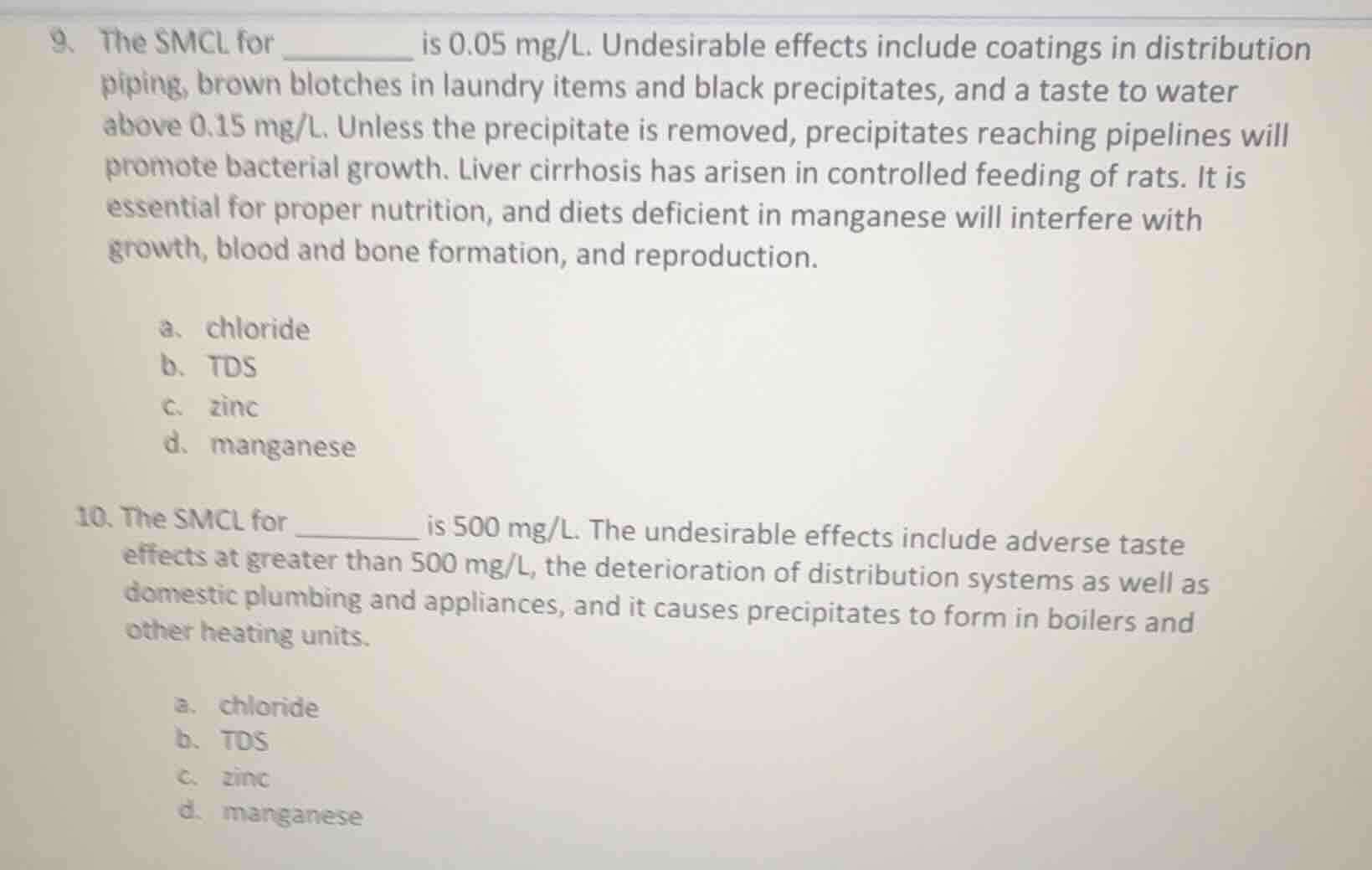
- the smcl for ________ is 0.05 mg/l. undesirable effects include coatings in distribution piping, brown blotches in laundry items and black precipitates, and a taste to water above 0.15 mg/l. unless the precipitate is removed, precipitates reaching pipelines will promote bacterial growth. liver cirrhosis has arisen in controlled feeding of rats. it is essential for proper nutrition, and diets deficient in manganese will interfere with growth, blood and bone formation, and reproduction.
a. chloride
b. tds
c. zinc
d. manganese
- the smcl for ________ is 500 mg/l. the undesirable effects include adverse taste effects at greater than 500 mg/l, the deterioration of distribution systems as well as domestic plumbing and appliances, and it causes precipitates to form in boilers and other heating units.
a. chloride
b. tds
c. zinc
d. manganese
Brief Explanations
- The description explicitly mentions that diets deficient in this substance interfere with growth, blood and bone formation, and reproduction, and lists its SMCL as 0.05 mg/L, all matching manganese.
- Chloride has a secondary maximum contaminant level (SMCL) of 500 mg/L, and its undesirable effects include bad taste above this level, plumbing corrosion, and precipitate formation in heating units, which matches the given details.

Snap & solve any problem in the app
Get step-by-step solutions on Sovi AI
Photo-based solutions with guided steps
Explore more problems and detailed explanations
- d. manganese
- a. chloride