QUESTION IMAGE
Question
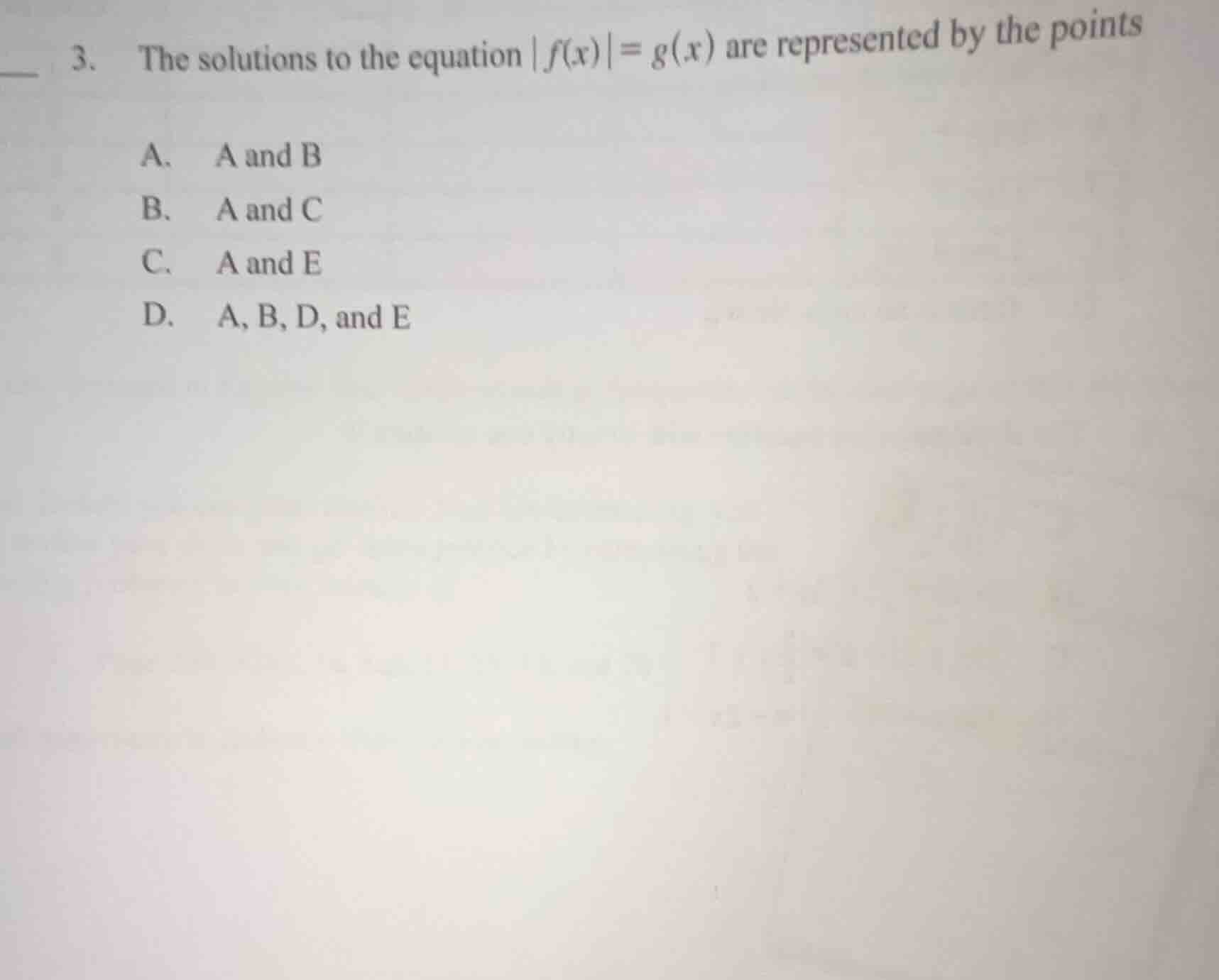
- the solutions to the equation |f(x)| = g(x) are represented by the points
a. a and b
b. a and c
c. a and e
d. a, b, d, and e
Response
To solve the problem of finding the solutions to the equation \(|f(x)| = g(x)\), we analyze the properties of absolute value and the graphical interpretation (even though the graph isn't fully visible, we can use the concept of absolute value and the given options):
Key Concept:
The equation \(|f(x)| = g(x)\) implies two things:
- \(g(x)\) must be non - negative (since the absolute value \(|f(x)|\) is always non - negative).
- The solutions occur where either \(f(x)=g(x)\) (when \(f(x)\geq0\)) or \(f(x)= - g(x)\) (when \(f(x)<0\)). Geometrically, this corresponds to the points where the graph of \(y = |f(x)|\) intersects the graph of \(y = g(x)\).
Analyzing the Options:
- For a point to be a solution of \(|f(x)|=g(x)\), the \(y\) - value of the point (which is related to \(g(x)\)) must be non - negative (because \(|f(x)|\geq0\)). Also, we consider the intersection of the absolute - valued function and \(g(x)\).
- Let's assume that from the (implied) graph, points A, B, D, and E satisfy the condition \(|f(x)| = g(x)\). Points that are on the intersection of \(y = |f(x)|\) and \(y = g(x)\) will be the solutions. If we consider the nature of absolute - value equations, when we take the absolute value of a function, the parts of the graph of \(y = f(x)\) that are below the \(x\) - axis are reflected above the \(x\) - axis. The intersection points of \(y=|f(x)|\) and \(y = g(x)\) will include points where \(f(x)\) was non - negative (so \(f(x)=g(x)\)) and points where \(f(x)\) was negative (so \(-f(x)=g(x)\) or \(f(x)=-g(x)\)). If the graph of \(g(x)\) intersects the reflected (absolute - valued) graph of \(f(x)\) at A, B, D, and E, then these points are the solutions.

Snap & solve any problem in the app
Get step-by-step solutions on Sovi AI
Photo-based solutions with guided steps
Explore more problems and detailed explanations
D. A, B, D, and E