QUESTION IMAGE
Question
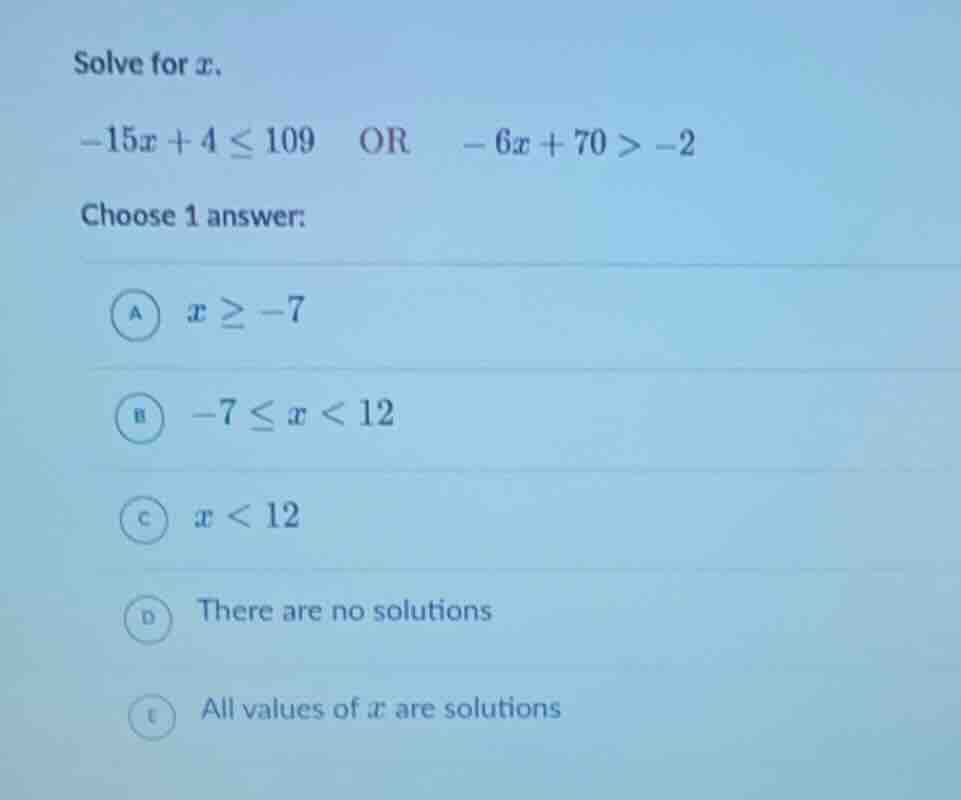
solve for x.
-15x + 4 ≤ 109 or -6x + 70 > -2
choose 1 answer:
a x ≥ -7
b -7 ≤ x < 12
c x < 12
d there are no solutions
e all values of x are solutions
Step1: Solve the first inequality \(-15x + 4 \leq 109\)
Subtract 4 from both sides: \(-15x \leq 109 - 4\)
Simplify: \(-15x \leq 105\)
Divide both sides by -15 (remember to reverse the inequality sign): \(x \geq \frac{105}{-15}\)
Simplify: \(x \geq -7\)
Step2: Solve the second inequality \(-6x + 70 > -2\)
Subtract 70 from both sides: \(-6x > -2 - 70\)
Simplify: \(-6x > -72\)
Divide both sides by -6 (reverse the inequality sign): \(x < \frac{-72}{-6}\)
Simplify: \(x < 12\)
Step3: Analyze the "OR" condition
The solution to the compound inequality \( -15x + 4 \leq 109 \) OR \( -6x + 70 > -2 \) is the union of the solutions to each individual inequality. The first inequality gives \(x \geq -7\) and the second gives \(x < 12\). But when we take the union of all real numbers (since any real number is either greater than or equal to -7 or less than 12, and in fact all real numbers satisfy at least one of these; for example, a number like 13 is less than 12? No, 13 is greater than 12, but 13 is greater than or equal to -7, so it satisfies the first inequality. A number like -8 is less than 12, so it satisfies the second inequality. A number like 5 is both greater than or equal to -7 and less than 12. So actually, every real number satisfies at least one of the two inequalities. Wait, let's check again. Wait, the first inequality: \(x \geq -7\), the second: \(x < 12\). The union of \(x \geq -7\) and \(x < 12\) is all real numbers? Wait no, wait: if we have \(x \geq -7\) OR \(x < 12\), then any real number x will satisfy either \(x \geq -7\) (if x is, say, 13, which is ≥ -7) or \(x < 12\) (if x is, say, -8, which is < 12) or both (like x=5). So actually, every real number is in the union of these two sets. So all values of x are solutions. Wait, but let's re-examine the solving:
Wait, first inequality: \(-15x +4 \leq 109\)
\(-15x \leq 105\)
Divide by -15 (reverse inequality): \(x \geq -7\)
Second inequality: \(-6x +70 > -2\)
\(-6x > -72\)
Divide by -6 (reverse inequality): \(x < 12\)
Now, the "OR" means that x satisfies either the first inequality, or the second, or both. So let's take a number greater than or equal to -7: say x=13. 13 ≥ -7, so it satisfies the first inequality. A number less than 12: say x=-8. -8 < 12, so it satisfies the second. A number between -7 and 12: say x=0, satisfies both. Now, is there any real number that satisfies neither? Let's suppose x is less than -7, say x=-8. Then x=-8 < 12, so it satisfies the second inequality. If x is greater than or equal to 12, say x=13, then x=13 ≥ -7, so it satisfies the first inequality. So every real number satisfies at least one of the two inequalities. Therefore, all values of x are solutions.
Wait, but let's check the options. Option E is "All values of x are solutions". So that's the answer.

Snap & solve any problem in the app
Get step-by-step solutions on Sovi AI
Photo-based solutions with guided steps
Explore more problems and detailed explanations
E. All values of x are solutions