QUESTION IMAGE
Question
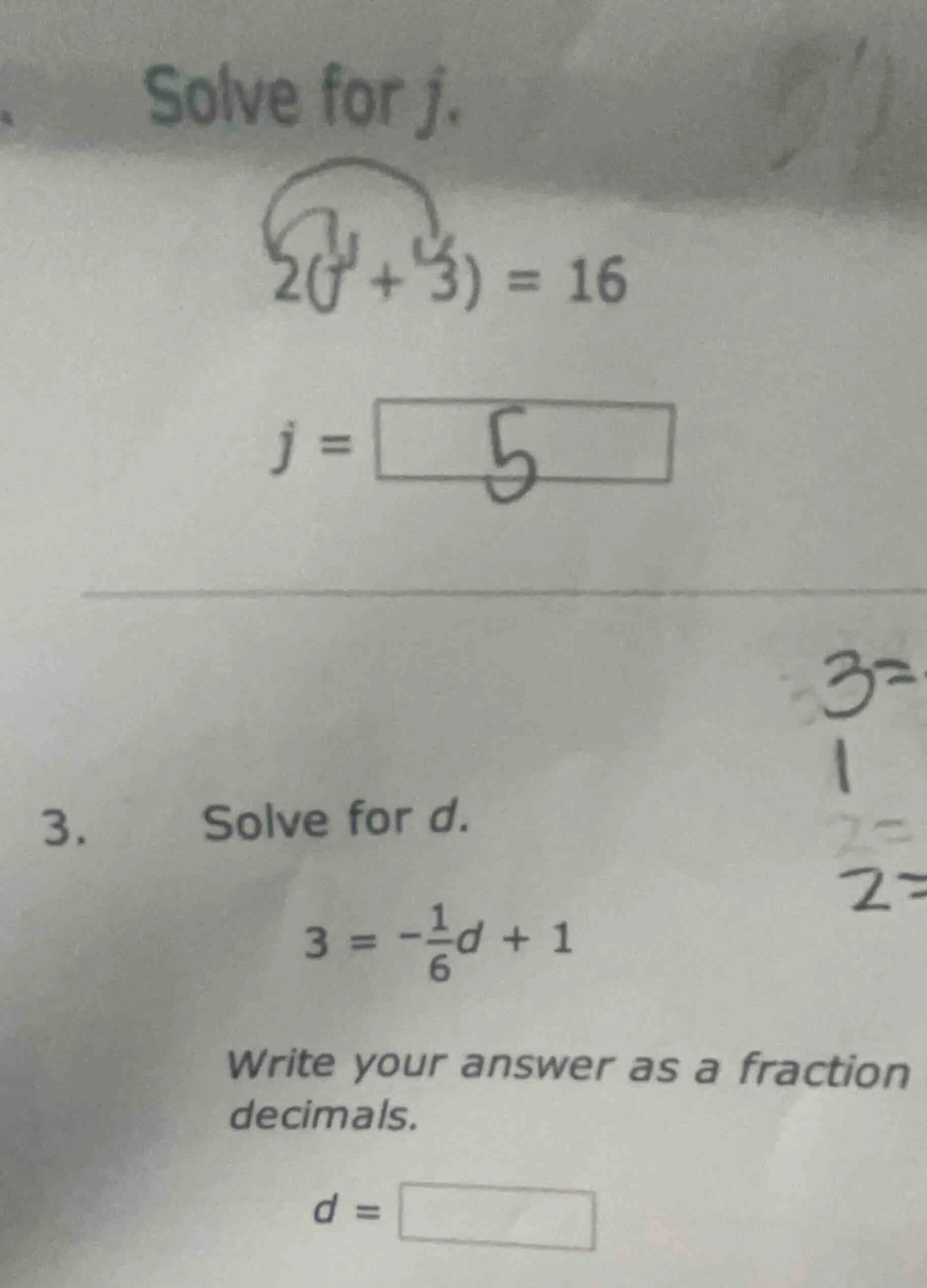
solve for j.
2(j + 3) = 16
j =
- solve for d.
3 = -\frac{1}{6}d + 1
write your answer as a fraction decimals.
d =
Solve for \( j \):
Step 1: Divide both sides by 2
To isolate the parentheses, divide both sides of the equation \( 2(j + 3) = 16 \) by 2.
\( \frac{2(j + 3)}{2} = \frac{16}{2} \)
Simplifying gives \( j + 3 = 8 \).
Step 2: Subtract 3 from both sides
To solve for \( j \), subtract 3 from both sides of the equation \( j + 3 = 8 \).
\( j + 3 - 3 = 8 - 3 \)
Simplifying gives \( j = 5 \).
Step 1: Subtract 1 from both sides
Start with the equation \( 3 = -\frac{1}{6}d + 1 \). Subtract 1 from both sides to isolate the term with \( d \).
\( 3 - 1 = -\frac{1}{6}d + 1 - 1 \)
Simplifying gives \( 2 = -\frac{1}{6}d \).
Step 2: Multiply both sides by -6
To solve for \( d \), multiply both sides of the equation \( 2 = -\frac{1}{6}d \) by -6.
\( 2 \times (-6) = -\frac{1}{6}d \times (-6) \)
Simplifying gives \( -12 = d \), or \( d = -12 \).

Snap & solve any problem in the app
Get step-by-step solutions on Sovi AI
Photo-based solutions with guided steps
Explore more problems and detailed explanations
\( j = 5 \)