QUESTION IMAGE
Question
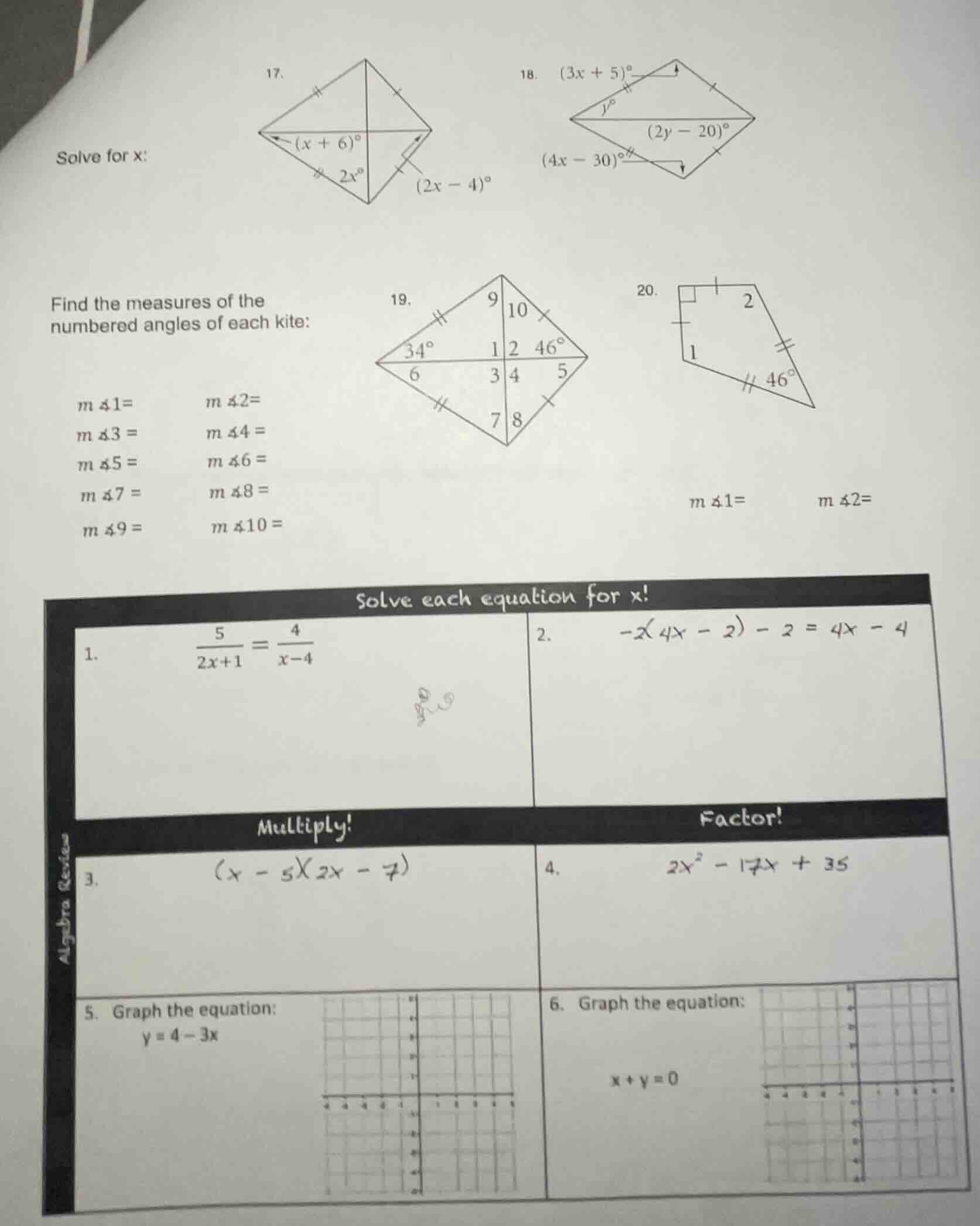
solve for x:
- (diagram of a kite with angles ((x + 6)^circ), (2x^circ), ((2x - 4)^circ))
- (diagram of a kite with angles ((3x + 5)^circ), (y^circ), ((2y - 20)^circ), ((4x - 30)^circ))
find the measures of the numbered angles of each kite:
m ∠1=
m ∠2=
m ∠3=
m ∠4=
m ∠5=
m ∠6=
m ∠7=
m ∠8=
m ∠9=
m ∠10=
- (diagram of a kite with angles (34^circ), (46^circ) and segments 9, 10, 6, 5 and angles 1,2,3,4)
- (diagram of a kite with a right angle, side 2, angle (46^circ) and angles 1,2)
solve each equation for x!
- (\frac{5}{2x + 1}=\frac{4}{x - 4})
- (-2(4x - 2)-2 = 4x - 4)
multiply!
- ((x - 5)(2x - 7))
factor!
- (2x^2 - 17x + 35)
- graph the equation:
(y = 4 - 3x) (diagram of a coordinate grid)
- graph the equation:
(x + y = 0) (diagram of a coordinate grid)
Kite Geometry Problems (17-20)
Step1: Use kite angle properties
In a kite, one pair of opposite angles are equal, and the diagonals bisect the angles. Also, adjacent angles between unequal sides are supplementary.
Problem 17:
Step1: Set equal angles equal
$2x = 2x - 4$ is invalid. Instead, use angle bisector: $x+6 = 2x-4$
Step2: Solve for x
$x+6=2x-4 \implies 6+4=2x-x \implies x=10$
Problem 18:
Step1: Set supplementary angles equal
$3x+5 = 4x-30$ (opposite angles between equal sides are equal)
Step2: Solve for x
$5+30=4x-3x \implies x=35$
Step3: Solve for y
$y + 2y-20=180$ (adjacent angles are supplementary)
$3y=200 \implies y=\frac{200}{3}\approx66.67$ (only x requested)
Problem 19:
Step1: Right angles from diagonals
$m\angle1 = 90^\circ$, $m\angle2 = 90^\circ$, $m\angle3 = 90^\circ$, $m\angle4 = 90^\circ$
Step2: Calculate base angles
$m\angle5 = 90-46=44^\circ$, $m\angle6 = 90-34=56^\circ$
Step3: Equal angles in congruent triangles
$m\angle7 = m\angle6=56^\circ$, $m\angle8 = m\angle5=44^\circ$
$m\angle9 = m\angle6=56^\circ$, $m\angle10 = m\angle5=44^\circ$
Problem 20:
Step1: Calculate $\angle1$
Sum of quadrilateral angles is $360^\circ$. $\angle1 = 360 - 90 - 90 - 46=134^\circ$
Step2: Calculate $\angle2$
$\angle2 = 180 - 46=134^\circ$ (adjacent to 46° in trapezoid pair)
Problem 1:
Step1: Cross-multiply to eliminate fractions
$5(x-4)=4(2x+1)$
Step2: Expand and solve for x
$5x-20=8x+4 \implies -20-4=8x-5x \implies -24=3x \implies x=-8$
Problem 2:
Step1: Expand left side
$-8x+4-2=4x-4$
Step2: Simplify and solve for x
$-8x+2=4x-4 \implies 2+4=4x+8x \implies 6=12x \implies x=0.5$
Problem 3:
Step1: Use FOIL method
$(x-5)(2x-7)=x(2x)+x(-7)-5(2x)-5(-7)$
Step2: Simplify expression
$2x^2-7x-10x+35=2x^2-17x+35$
Problem 4:
Step1: Factor quadratic
Find two numbers: $-10$ and $-7$ (product=70, sum=-17)
Step2: Write factored form
$2x^2-17x+35=(2x-7)(x-5)$
Problem 5: $y=4-3x$
Step1: Find intercepts
x-intercept: $0=4-3x \implies x=\frac{4}{3}$; y-intercept: $y=4$
Step2: Plot points $(0,4)$ and $(\frac{4}{3},0)$, draw line
Problem 6: $x+y=0 \implies y=-x$
Step1: Find intercepts
x-intercept: $x=0$; y-intercept: $y=0$
Step2: Plot points $(1,-1)$ and $(-1,1)$, draw line through origin

Snap & solve any problem in the app
Get step-by-step solutions on Sovi AI
Photo-based solutions with guided steps
Explore more problems and detailed explanations
- $x=10$
- $x=35$
- $m\angle1=90^\circ$, $m\angle2=90^\circ$, $m\angle3=90^\circ$, $m\angle4=90^\circ$, $m\angle5=44^\circ$, $m\angle6=56^\circ$, $m\angle7=56^\circ$, $m\angle8=44^\circ$, $m\angle9=56^\circ$, $m\angle10=44^\circ$
- $m\angle1=134^\circ$, $m\angle2=134^\circ$
---