QUESTION IMAGE
Question
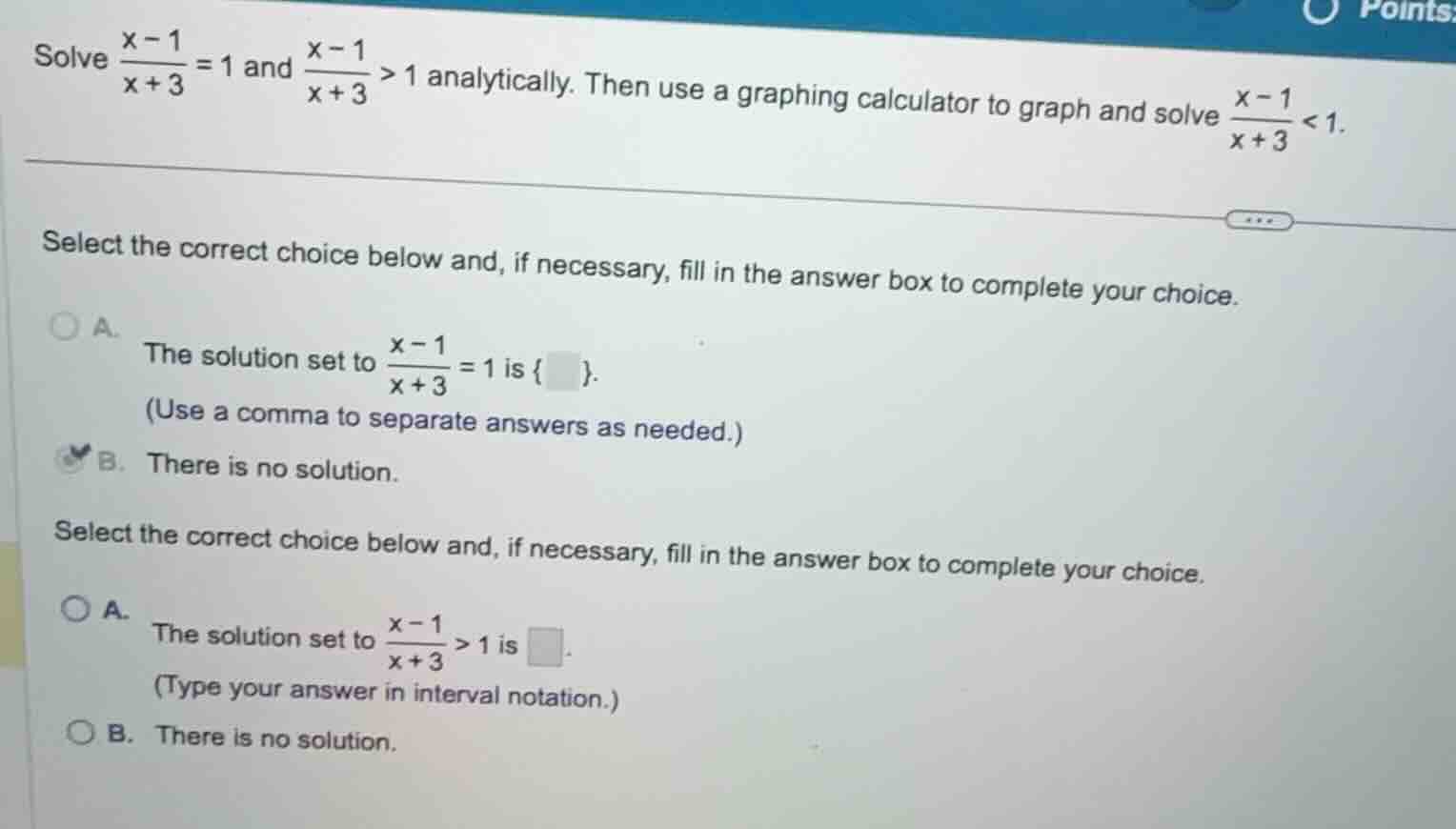
solve \\(\frac{x - 1}{x + 3} = 1\\) and \\(\frac{x - 1}{x + 3} > 1\\) analytically. then use a graphing calculator to graph and solve \\(\frac{x - 1}{x + 3} < 1\\). select the correct choice below and, if necessary, fill in the answer box to complete your choice. \\(\bigcirc\\) a. the solution set to \\(\frac{x - 1}{x + 3} = 1\\) is \\(\\{\\ \\}\\). (use a comma to separate answers as needed.) \\(\bigcirc\\) b. there is no solution. select the correct choice below and, if necessary, fill in the answer box to complete your choice. \\(\bigcirc\\) a. the solution set to \\(\frac{x - 1}{x + 3} > 1\\) is \\(\\ \\). (type your answer in interval notation.) \\(\bigcirc\\) b. there is no solution.
Solving \(\boldsymbol{\frac{x - 1}{x + 3}=1}\)
Step1: Multiply both sides by \(x + 3\) (note \(x
eq - 3\))
\(\frac{x - 1}{x + 3}\times(x + 3)=1\times(x + 3)\)
\(x-1=x + 3\)
Step2: Subtract \(x\) from both sides
\(x-1-x=x + 3-x\)
\(-1 = 3\)
This is a contradiction, so there is no solution for \(\frac{x - 1}{x + 3}=1\).
Solving \(\boldsymbol{\frac{x - 1}{x + 3}>1}\)
Step1: Subtract 1 from both sides
\(\frac{x - 1}{x + 3}-1>0\)
Step2: Get a common denominator
\(\frac{x - 1-(x + 3)}{x + 3}>0\)
Step3: Simplify the numerator
\(\frac{x - 1-x - 3}{x + 3}>0\)
\(\frac{-4}{x + 3}>0\)
Step4: Analyze the sign
For \(\frac{-4}{x + 3}>0\), since \(- 4<0\), we need \(x + 3<0\) (because a negative divided by a negative is positive)
\(x+3<0\)
\(x<-3\)
But we also need to consider the domain \(x
eq - 3\). However, when we test values less than \(-3\) (e.g., \(x=-4\)), \(\frac{-4 - 1}{-4+3}=\frac{-5}{-1} = 5>1\), but wait, earlier when we solved the equation we had a contradiction. Wait, let's re - examine the inequality solving:
Starting over for the inequality:
\(\frac{x - 1}{x + 3}>1\)
Case 1: \(x+3>0\) (i.e., \(x>-3\))
Multiply both sides by \(x + 3\) (since \(x + 3>0\), the inequality sign remains the same)
\(x-1>x + 3\)
\(x-1-x>x + 3-x\)
\(-1>3\), which is false.
Case 2: \(x + 3<0\) (i.e., \(x<-3\))
Multiply both sides by \(x + 3\) (since \(x + 3<0\), the inequality sign flips)
\(x-1
eq - 3\). However, let's check with \(x=-4\) (which is less than \(-3\)): \(\frac{-4-1}{-4 + 3}=\frac{-5}{-1}=5>1\), which satisfies the inequality. Wait, but earlier when we solved the equation, we had a contradiction. But for the inequality, when \(x<-3\), let's go back to the step where we had \(\frac{-4}{x + 3}>0\). Since \(-4\) is negative, \(\frac{-4}{x + 3}>0\) implies \(x + 3<0\) (because negative divided by negative is positive). So \(x<-3\). But wait, when we plug \(x = - 4\) into the original inequality \(\frac{-4-1}{-4 + 3}=\frac{-5}{-1}=5>1\), which works. But there is a mistake in the first approach to the inequality. Wait, no, when we did the first method of subtracting 1, we got \(\frac{-4}{x + 3}>0\), which is equivalent to \(x+3<0\) (since numerator is negative, denominator must be negative for the fraction to be positive). So the solution to the inequality is \(x<-3\)? But wait, let's check with \(x=-3\), the function is undefined. But when we solved the equation, we saw that there is no solution for the equation. But for the inequality, let's re - express the inequality:
\(\frac{x - 1}{x + 3}-1=\frac{x - 1-(x + 3)}{x + 3}=\frac{-4}{x + 3}\)
We want \(\frac{-4}{x + 3}>0\). Since \(-4<0\), we need \(x + 3<0\) (because \(\frac{\text{negative}}{\text{negative}}=\text{positive}\)). So \(x<-3\). But when we check the domain, \(x
eq - 3\), so the solution to the inequality is \(x\in(-\infty,-3)\). But wait, there is a conflict with the equation solution? No, the equation and the inequality are different. The equation has no solution, but the inequality has a solution? Wait, no, let's take \(x=-4\): \(\frac{-4 - 1}{-4+3}=\frac{-5}{-1}=5>1\), which is true. Take \(x=-2\) (which is greater than \(-3\)): \(\frac{-2-1}{-2 + 3}=\frac{-3}{1}=-3<1\), which is false. Take \(x=-3\), undefined. So the solution to the inequality is \(x<-3\). But wait, in the first step of solving the inequality by subtracting 1, we got \(\frac{-4}{x + 3}>0\), which gives \(x<-3\). So the solution to the inequality \(\frac{x - 1}{x + 3}>1\) is \(x\in(-\infty,-3)\)? But wait, the initial equation has no solution, and the inequality has a solution? But let's check the problem again.
Wait, the user's first part (the equation) has no solution (option B), and the second part (the inequality):
Wait, whe…

Snap & solve any problem in the app
Get step-by-step solutions on Sovi AI
Photo-based solutions with guided steps
Explore more problems and detailed explanations
s:
- For \(\frac{x - 1}{x + 3}=1\): B. There is no solution.
- For \(\frac{x - 1}{x + 3}>1\): A. The solution set to \(\frac{x - 1}{x + 3}>1\) is \((-\infty,-3)\).