QUESTION IMAGE
Question
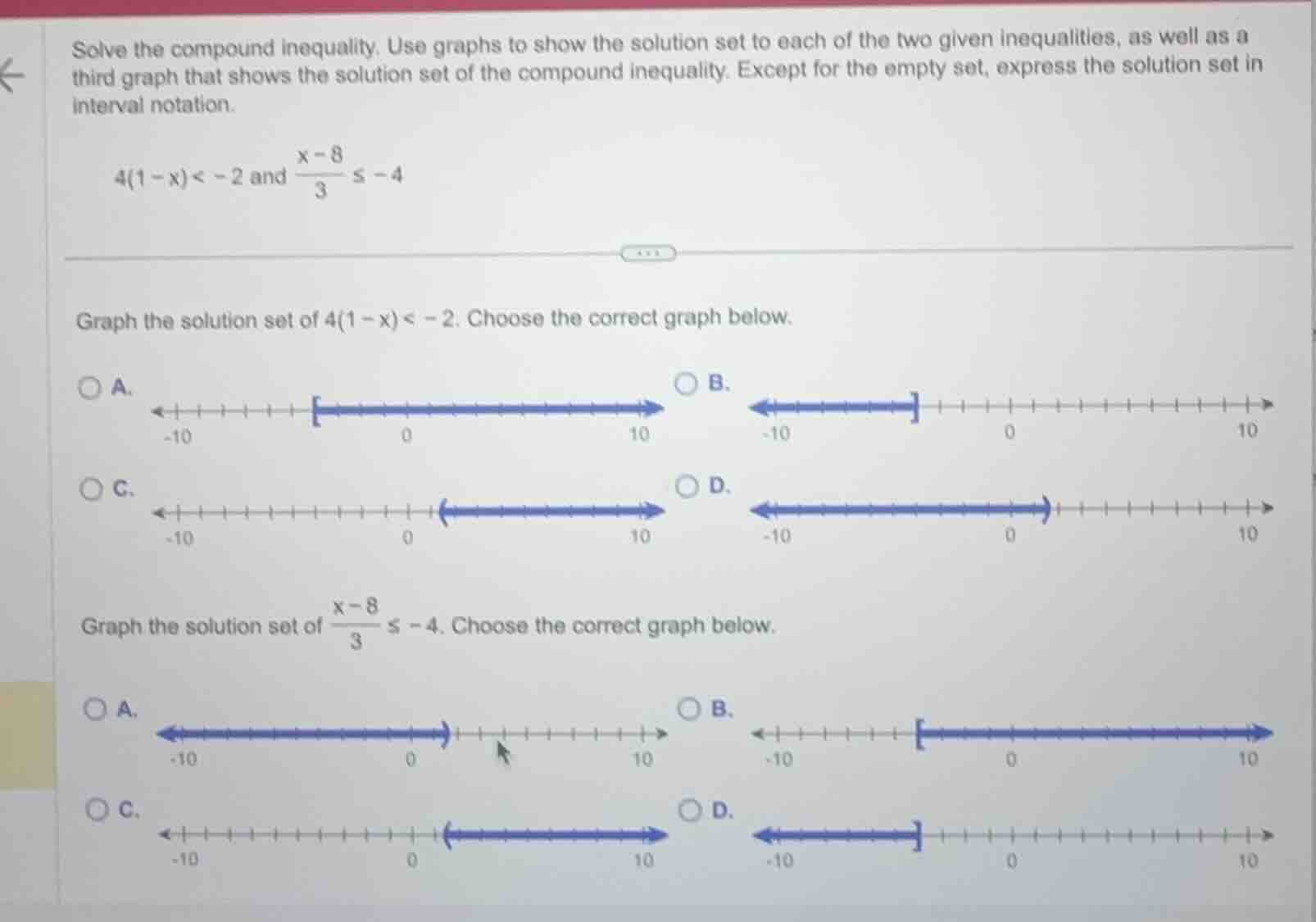
solve the compound inequality. use graphs to show the solution set to each of the two given inequalities, as well as a third graph that shows the solution set of the compound inequality. except for the empty set, express the solution set in interval notation. \\( 4(1 - x) < -2 \\) and \\( \frac{x - 8}{3} \leq -4 \\) \\( \dots \\) graph the solution set of \\( 4(1 - x) < -2 \\). choose the correct graph below. \\( \bigcirc \\) a. \\( \bigcirc \\) b. \\( \bigcirc \\) c. \\( \bigcirc \\) d. graph the solution set of \\( \frac{x - 8}{3} \leq -4 \\). choose the correct graph below. \\( \bigcirc \\) a. \\( \bigcirc \\) b. \\( \bigcirc \\) c. \\( \bigcirc \\) d.
Solving \( 4(1 - x) < -2 \)
Step 1: Distribute the 4
We start with the inequality \( 4(1 - x) < -2 \). First, we distribute the 4 on the left side:
\( 4 - 4x < -2 \)
Step 2: Subtract 4 from both sides
Next, we subtract 4 from both sides to isolate the term with \( x \):
\( 4 - 4x - 4 < -2 - 4 \)
Simplifying both sides gives:
\( -4x < -6 \)
Step 3: Divide by -4 (and reverse the inequality)
Now, we divide both sides by -4. Remember that when we divide or multiply an inequality by a negative number, we must reverse the inequality sign:
\( \frac{-4x}{-4} > \frac{-6}{-4} \)
Simplifying, we get:
\( x > \frac{3}{2} = 1.5 \)
The solution to \( 4(1 - x) < -2 \) is \( x > 1.5 \). On a number line, this is an open circle at 1.5 (or \( \frac{3}{2} \)) and an arrow pointing to the right. Looking at the options for the first graph (solving \( 4(1 - x) < -2 \)):
- Option A: Closed circle, arrow right. Not correct (we have an open circle).
- Option B: Closed circle, arrow left. Not correct.
- Option C: Open circle, arrow right. This matches our solution.
- Option D: Open circle, arrow left. Not correct.
So the correct graph for \( 4(1 - x) < -2 \) is Option C.
Solving \( \frac{x - 8}{3} \leq -4 \)
Step 1: Multiply both sides by 3
We start with the inequality \( \frac{x - 8}{3} \leq -4 \). Multiply both sides by 3 to eliminate the denominator:
\( 3 \cdot \frac{x - 8}{3} \leq -4 \cdot 3 \)
Simplifying both sides gives:
\( x - 8 \leq -12 \)
Step 2: Add 8 to both sides
Next, add 8 to both sides to isolate \( x \):
\( x - 8 + 8 \leq -12 + 8 \)
Simplifying both sides gives:
\( x \leq -4 \)
The solution to \( \frac{x - 8}{3} \leq -4 \) is \( x \leq -4 \). On a number line, this is a closed circle at -4 and an arrow pointing to the left. Looking at the options for the second graph (solving \( \frac{x - 8}{3} \leq -4 \)):
- Option A: Open circle, arrow right. Not correct.
- Option B: Closed circle, arrow right. Not correct.
- Option C: Open circle, arrow right. Not correct.
- Option D: Closed circle, arrow left. This matches our solution.
So the correct graph for \( \frac{x - 8}{3} \leq -4 \) is Option D.
Solving the Compound Inequality \( 4(1 - x) < -2 \) and \( \frac{x - 8}{3} \leq -4 \)
Now, we need to find the solution to the compound inequality "and", which means we need the intersection of the two solution sets.
- Solution to \( 4(1 - x) < -2 \): \( x > 1.5 \)
- Solution to \( \frac{x - 8}{3} \leq -4 \): \( x \leq -4 \)
To find the intersection, we look for values of \( x \) that satisfy both inequalities. However, \( x > 1.5 \) and \( x \leq -4 \) have no overlap (there are no numbers that are both greater than 1.5 and less than or equal to -4). Therefore, the solution set of the compound inequality is the empty set, \( \emptyset \).
Final Answers:
- Graph for \( 4(1 - x) < -2 \): \(\boldsymbol{\text{Option C}}\)
- Graph for \( \frac{x - 8}{3} \leq -4 \): \(\boldsymbol{\text{Option D}}\)
- Solution set of the compound inequality: \(\boldsymbol{\emptyset}\) (or "no solution")

Snap & solve any problem in the app
Get step-by-step solutions on Sovi AI
Photo-based solutions with guided steps
Explore more problems and detailed explanations
Step 1: Multiply both sides by 3
We start with the inequality \( \frac{x - 8}{3} \leq -4 \). Multiply both sides by 3 to eliminate the denominator:
\( 3 \cdot \frac{x - 8}{3} \leq -4 \cdot 3 \)
Simplifying both sides gives:
\( x - 8 \leq -12 \)
Step 2: Add 8 to both sides
Next, add 8 to both sides to isolate \( x \):
\( x - 8 + 8 \leq -12 + 8 \)
Simplifying both sides gives:
\( x \leq -4 \)
The solution to \( \frac{x - 8}{3} \leq -4 \) is \( x \leq -4 \). On a number line, this is a closed circle at -4 and an arrow pointing to the left. Looking at the options for the second graph (solving \( \frac{x - 8}{3} \leq -4 \)):
- Option A: Open circle, arrow right. Not correct.
- Option B: Closed circle, arrow right. Not correct.
- Option C: Open circle, arrow right. Not correct.
- Option D: Closed circle, arrow left. This matches our solution.
So the correct graph for \( \frac{x - 8}{3} \leq -4 \) is Option D.
Solving the Compound Inequality \( 4(1 - x) < -2 \) and \( \frac{x - 8}{3} \leq -4 \)
Now, we need to find the solution to the compound inequality "and", which means we need the intersection of the two solution sets.
- Solution to \( 4(1 - x) < -2 \): \( x > 1.5 \)
- Solution to \( \frac{x - 8}{3} \leq -4 \): \( x \leq -4 \)
To find the intersection, we look for values of \( x \) that satisfy both inequalities. However, \( x > 1.5 \) and \( x \leq -4 \) have no overlap (there are no numbers that are both greater than 1.5 and less than or equal to -4). Therefore, the solution set of the compound inequality is the empty set, \( \emptyset \).
Final Answers:
- Graph for \( 4(1 - x) < -2 \): \(\boldsymbol{\text{Option C}}\)
- Graph for \( \frac{x - 8}{3} \leq -4 \): \(\boldsymbol{\text{Option D}}\)
- Solution set of the compound inequality: \(\boldsymbol{\emptyset}\) (or "no solution")