QUESTION IMAGE
Question
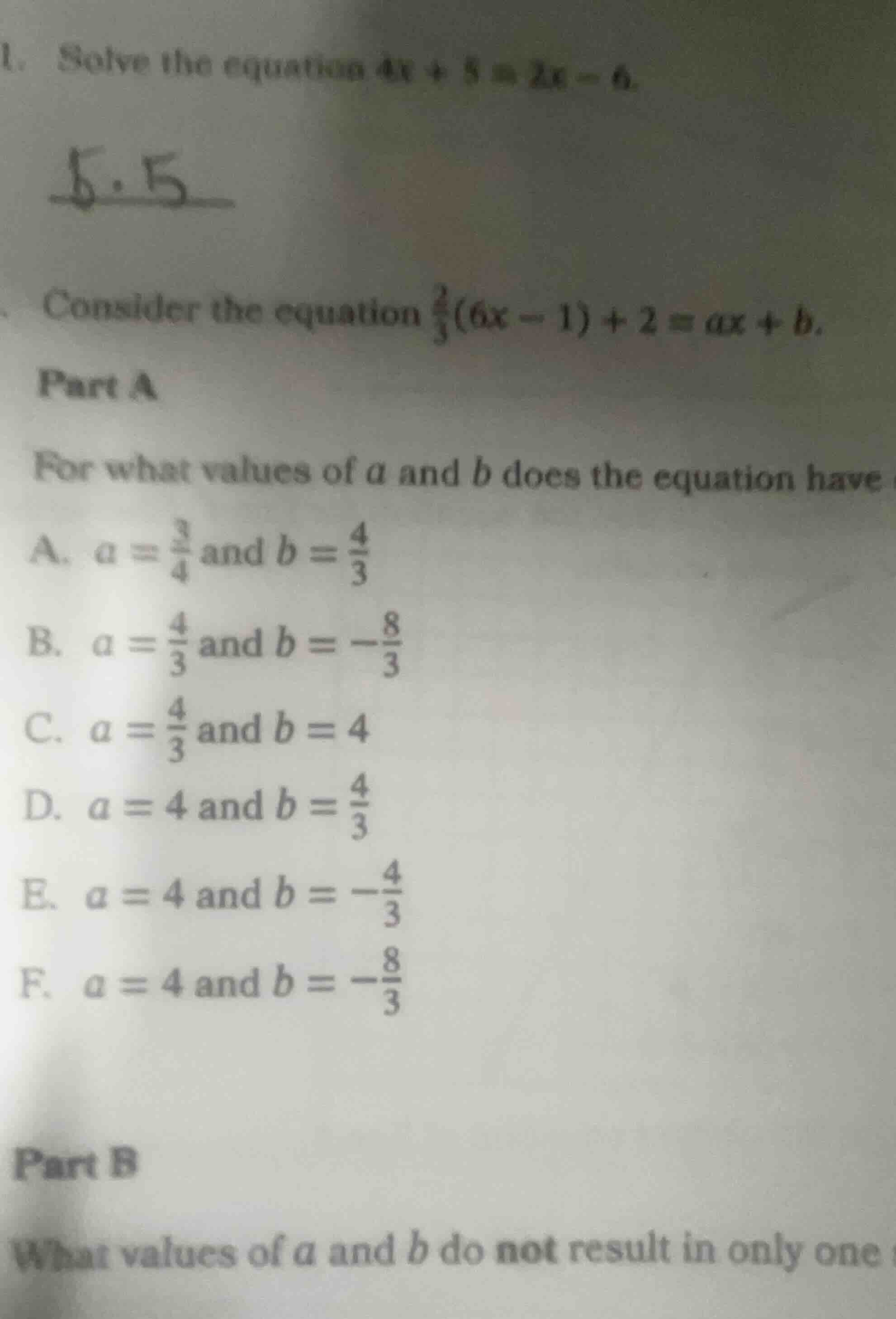
- solve the equation 4x + 5 = 2x - 6.
consider the equation \\(\frac{2}{3}(6x - 1) + 2 = ax + b\\).
part a
for what values of a and b does the equation have
a. \\(a = \frac{3}{4}\\) and \\(b = \frac{4}{3}\\)
b. \\(a = \frac{4}{3}\\) and \\(b = -\frac{8}{3}\\)
c. \\(a = \frac{4}{3}\\) and \\(b = 4\\)
d. \\(a = 4\\) and \\(b = \frac{4}{3}\\)
e. \\(a = 4\\) and \\(b = -\frac{4}{3}\\)
f. \\(a = 4\\) and \\(b = -\frac{8}{3}\\)
part b
what values of a and b do not result in only one
Sub - Question 1: Solve the equation \(4x + 5=2x - 6\)
Step 1: Subtract \(2x\) from both sides
To get all the \(x\) terms on one side, we subtract \(2x\) from both sides of the equation.
\(4x+5 - 2x=2x - 6-2x\)
Simplifying, we have \(2x + 5=-6\)
Step 2: Subtract 5 from both sides
To isolate the term with \(x\), we subtract 5 from both sides.
\(2x+5 - 5=-6 - 5\)
Simplifying, we get \(2x=-11\)
Step 3: Divide by 2
To solve for \(x\), we divide both sides by 2.
\(x =-\frac{11}{2}=- 5.5\)
First, we simplify the left - hand side of the equation.
Step 1: Distribute \(\frac{2}{3}\)
Using the distributive property \(a(b + c)=ab+ac\), we have \(\frac{2}{3}(6x)-\frac{2}{3}(1)+2=ax + b\)
\(\frac{2\times6x}{3}-\frac{2}{3}+2=ax + b\)
\(4x-\frac{2}{3}+2=ax + b\)
Step 2: Combine constant terms
We combine the constant terms \(-\frac{2}{3}\) and \(2\). We know that \(2=\frac{6}{3}\), so \(-\frac{2}{3}+\frac{6}{3}=\frac{- 2 + 6}{3}=\frac{4}{3}\)
The equation becomes \(4x+\frac{4}{3}=ax + b\)
By comparing the coefficients of \(x\) and the constant terms on both sides, we can see that \(a = 4\) and \(b=\frac{4}{3}\)

Snap & solve any problem in the app
Get step-by-step solutions on Sovi AI
Photo-based solutions with guided steps
Explore more problems and detailed explanations
\(x=-5.5\)