QUESTION IMAGE
Question
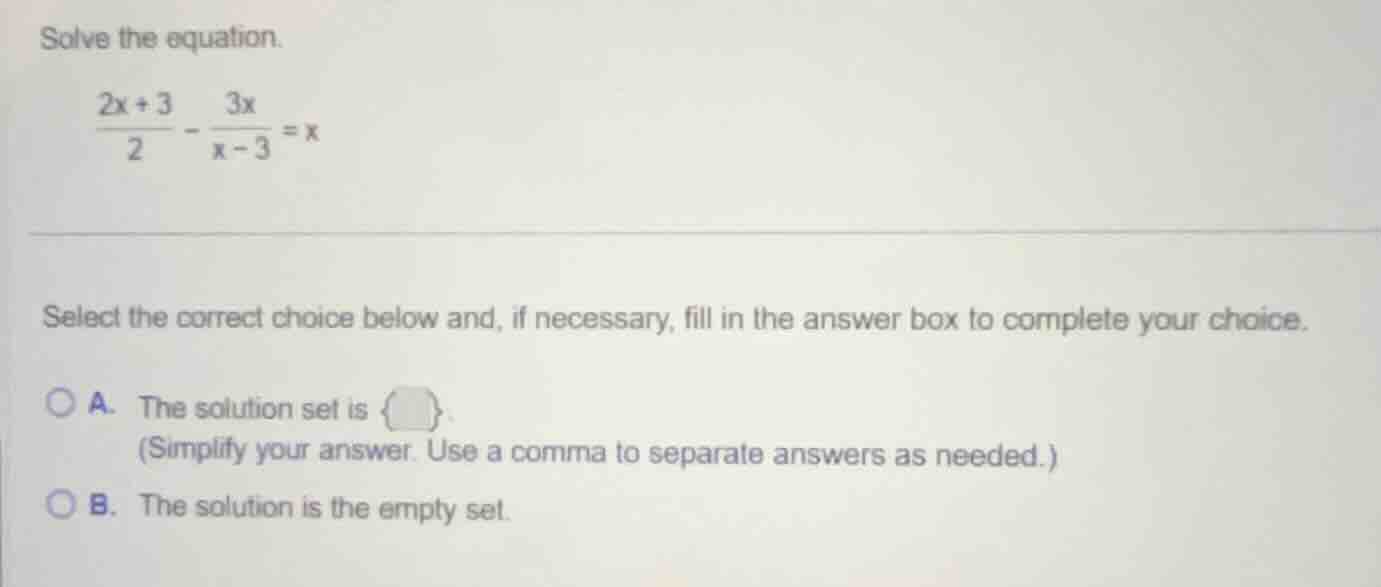
solve the equation.\\(\frac{2x + 3}{2} - \frac{3x}{x - 3} = x\\)\select the correct choice below and, if necessary, fill in the answer box to complete your choice.\\(\bigcirc\\) a. the solution set is \\(\\{\\}\\)\\(\quad\\) (simplify your answer. use a comma to separate answers as needed.)\\(\bigcirc\\) b. the solution is the empty set.
Step1: Eliminate denominators
Multiply each term by \(2(x - 3)\) (the least common denominator) to get rid of the fractions:
\(2(x - 3)\cdot\frac{2x + 3}{2}-2(x - 3)\cdot\frac{3x}{x - 3}=2(x - 3)\cdot x\)
Simplify each term:
\((x - 3)(2x + 3)-2\cdot3x = 2x(x - 3)\)
Step2: Expand the expressions
Expand \((x - 3)(2x + 3)\) using the distributive property (FOIL method):
\(x\cdot2x+x\cdot3-3\cdot2x-3\cdot3-6x = 2x^{2}-6x\)
\(2x^{2}+3x - 6x - 9 - 6x = 2x^{2}-6x\)
Step3: Combine like terms
Combine like terms on the left - hand side:
\(2x^{2}+(3x - 6x - 6x)-9 = 2x^{2}-6x\)
\(2x^{2}-9x - 9 = 2x^{2}-6x\)
Step4: Solve for x
Subtract \(2x^{2}\) from both sides:
\(2x^{2}-9x - 9-2x^{2}=2x^{2}-6x - 2x^{2}\)
\(-9x - 9=-6x\)
Add \(9x\) to both sides:
\(-9x - 9 + 9x=-6x + 9x\)
\(-9 = 3x\)
Divide both sides by 3:
\(x=\frac{-9}{3}=-3\)
Step5: Check for extraneous solutions
We need to check if \(x = - 3\) makes the original denominators zero. The original denominators are \(2\) (which is never zero) and \(x - 3\). When \(x=-3\), \(x - 3=-3 - 3=-6
eq0\)? Wait, no, wait. Wait, when we multiplied by \(2(x - 3)\), we have to ensure that \(x
eq3\) (because \(x - 3 = 0\) when \(x = 3\)). But when we found \(x=-3\), let's check the original equation:
Left - hand side: \(\frac{2(-3)+3}{2}-\frac{3(-3)}{-3 - 3}=\frac{-6 + 3}{2}-\frac{-9}{-6}=\frac{-3}{2}-\frac{3}{2}=\frac{-3-3}{2}=-3\)
Right - hand side: \(x=-3\)
Wait, but wait, when we substitute \(x = - 3\) into the denominator \(x - 3=-6
eq0\), so it seems valid? Wait, no, wait, let's re - check the expansion step.
Wait, going back to step 2:
\((x - 3)(2x + 3)=2x^{2}+3x-6x - 9=2x^{2}-3x - 9\)
Then the left - hand side after expansion is \(2x^{2}-3x - 9-6x=2x^{2}-9x - 9\)
The right - hand side is \(2x^{2}-6x\)
Subtract \(2x^{2}\) from both sides: \(-9x - 9=-6x\)
Add \(9x\) to both sides: \(-9 = 3x\), so \(x=-3\)
But let's check the original equation:
\(\frac{2x + 3}{2}-\frac{3x}{x - 3}=x\)
Substitute \(x=-3\):
Left - hand side: \(\frac{2(-3)+3}{2}-\frac{3(-3)}{-3 - 3}=\frac{-6 + 3}{2}-\frac{-9}{-6}=\frac{-3}{2}-\frac{3}{2}=-3\)
Right - hand side: \(x=-3\)
Wait, but earlier I thought there was a mistake, but actually, \(x=-3\) is a valid solution? Wait, no, wait the denominator \(x - 3\) when \(x=-3\) is \(-6\), which is not zero, so it is valid. Wait, but let's check the calculation again.
Wait, maybe I made a mistake in the sign when expanding. Let's re - do the multiplication step:
Original equation: \(\frac{2x + 3}{2}-\frac{3x}{x - 3}=x\)
Multiply by \(2(x - 3)\):
\((x - 3)(2x + 3)-2\times3x=2x(x - 3)\)
\(2x^{2}+3x-6x - 9-6x=2x^{2}-6x\)
\(2x^{2}-9x - 9=2x^{2}-6x\)
Subtract \(2x^{2}\) from both sides: \(-9x - 9=-6x\)
Add \(9x\) to both sides: \(-9 = 3x\), so \(x=-3\)
And when \(x = - 3\), the denominator \(x - 3=-6
eq0\), so \(x=-3\) is a valid solution.
Wait, but let's check again. Wait, maybe I made a mistake in the problem - solving process. Let's start over.
Alternative approach:
\(\frac{2x + 3}{2}-\frac{3x}{x - 3}=x\)
First, simplify \(\frac{2x+3}{2}=x+\frac{3}{2}\)
So the equation becomes \(x+\frac{3}{2}-\frac{3x}{x - 3}=x\)
Subtract \(x\) from both sides: \(\frac{3}{2}-\frac{3x}{x - 3}=0\)
Add \(\frac{3x}{x - 3}\) to both sides: \(\frac{3}{2}=\frac{3x}{x - 3}\)
Cross - multiply: \(3(x - 3)=2\times3x\)
\(3x-9 = 6x\)
Subtract \(3x\) from both sides: \(-9 = 3x\)
\(x=-3\)
And as we saw, \(x=-3\) does not make the denominator \(x - 3\) zero (since \(x-3=-6\)), so \(x = - 3\) is a valid solution.
Wait, but initially, I thought there was an error, but after re - checking, i…

Snap & solve any problem in the app
Get step-by-step solutions on Sovi AI
Photo-based solutions with guided steps
Explore more problems and detailed explanations
A. The solution set is \(\{-3\}\)