QUESTION IMAGE
Question
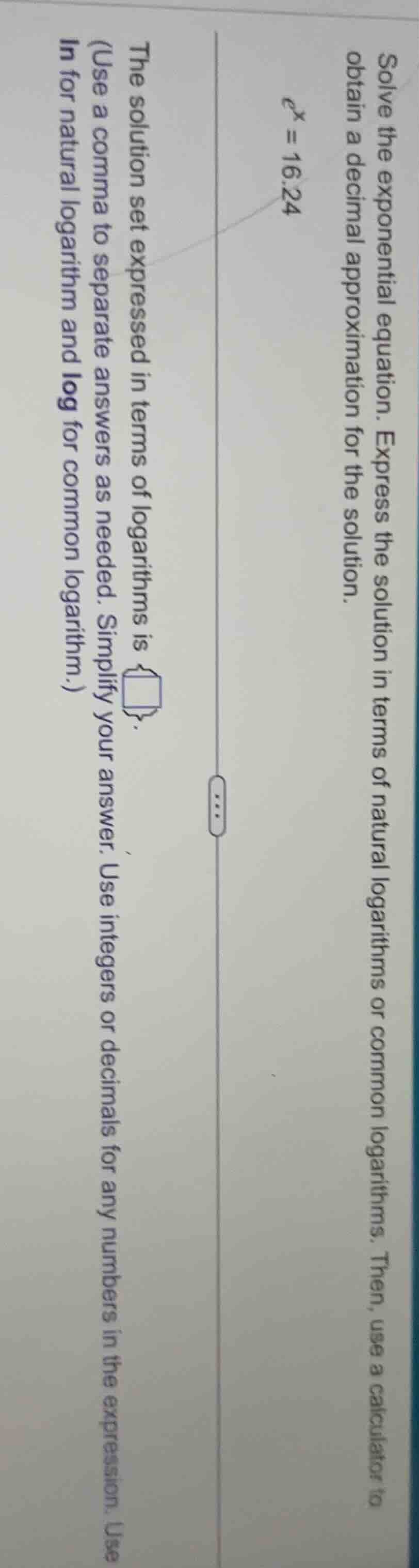
solve the exponential equation. express the solution in terms of natural logarithms or common logarithms. then, use a calculator to obtain a decimal approximation for the solution.\\(e^x = 16.24\\)\\(\\)\\(\\)the solution set expressed in terms of logarithms is \\(\boxed{}\\). (use a comma to separate answers as needed. simplify your answer. use integers or decimals for any numbers in the expression. use \\(\ln\\) for natural logarithm and \\(\log\\) for common logarithm.)
Step1: Take natural log of both sides
To solve the exponential equation \( e^{x}=16.24 \), we take the natural logarithm (ln) of both sides. Recall that \( \ln(e^{a}) = a \) by the property of logarithms (inverse of exponential function with base \( e \)). So, applying \( \ln \) to both sides:
\( \ln(e^{x})=\ln(16.24) \)
Step2: Simplify left side
Using the property \( \ln(e^{x}) = x \) (since \( \ln \) and \( e^{x} \) are inverse functions), the left - hand side simplifies to \( x \). So we have:
\( x = \ln(16.24) \)
Step3: Calculate the decimal approximation
Now, we use a calculator to find the value of \( \ln(16.24) \). Using a calculator, \( \ln(16.24)\approx2.79 \) (the more precise value can be obtained by using a calculator with more decimal places, but approximately it is around 2.79)

Snap & solve any problem in the app
Get step-by-step solutions on Sovi AI
Photo-based solutions with guided steps
Explore more problems and detailed explanations
In terms of natural logarithms, the solution is \( x = \ln(16.24) \), and the decimal approximation is approximately \( 2.79 \) (or more precisely, using a calculator, \( \ln(16.24)\approx2.790 \) depending on the calculator's precision). If we consider the boxed answer for the decimal approximation (rounded to two decimal places), it is \(\boxed{2.79}\) (or more precise values like \(\boxed{2.790}\) can be given depending on the requirement).