QUESTION IMAGE
Question
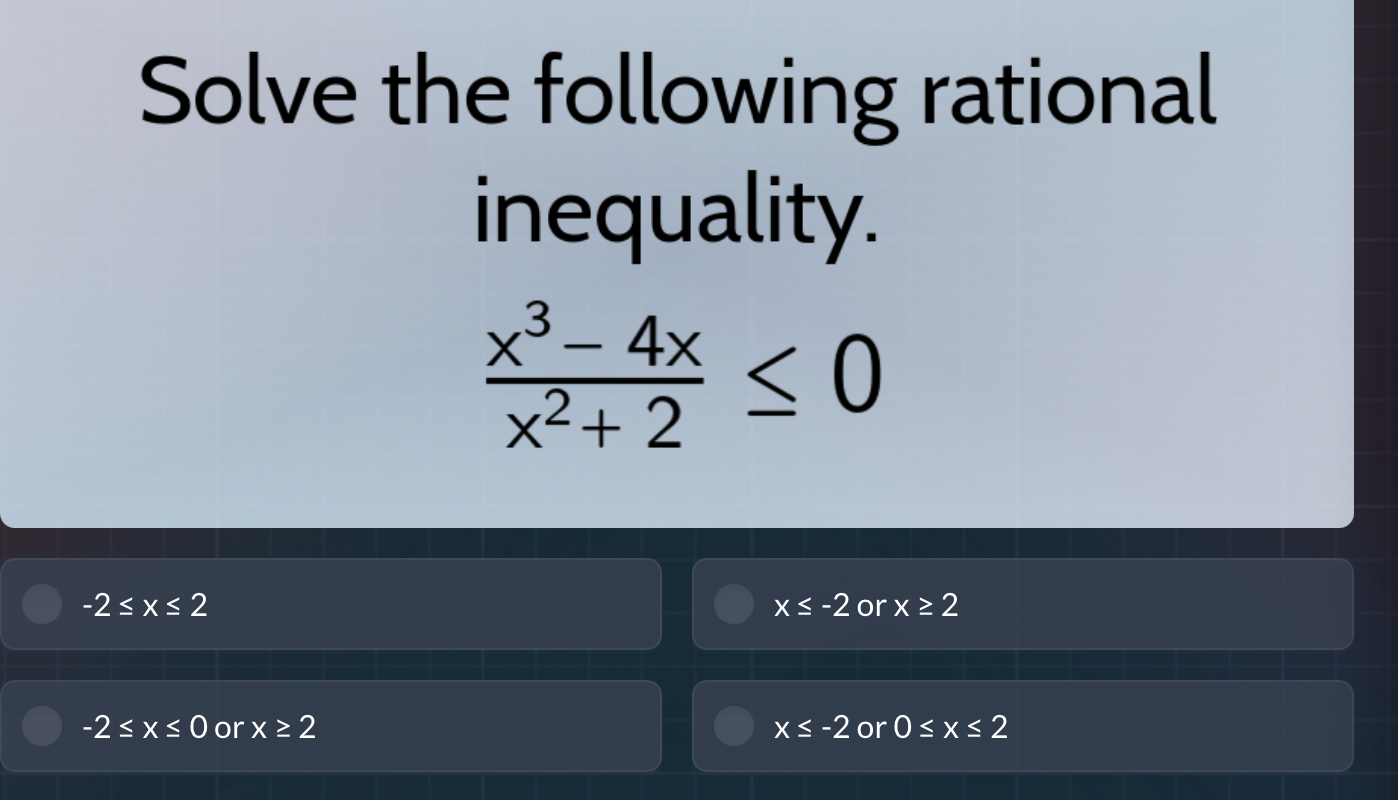
solve the following rational inequality.\\(\frac{x^3 - 4x}{x^2 + 2} \leq 0\\)\\(-2 \leq x \leq 2\\)\\(x \leq -2\\) or \\(x \geq 2\\)\\(-2 \leq x \leq 0\\) or \\(x \geq 2\\)\\(x \leq -2\\) or \\(0 \leq x \leq 2\\)
Step1: Analyze the denominator
The denominator is \(x^2 + 2\). Since \(x^2\geq0\) for all real \(x\), then \(x^2 + 2\geq2>0\) for all real \(x\). So the sign of the rational expression \(\frac{x^3 - 4x}{x^2 + 2}\) is the same as the sign of the numerator \(x^3 - 4x\).
Step2: Factor the numerator
Factor the numerator \(x^3 - 4x\):
\[
\]
Step3: Find critical points
Set the numerator equal to zero: \(x(x - 2)(x + 2)=0\). The critical points are \(x=-2\), \(x = 0\), and \(x = 2\). These points divide the real number line into four intervals: \((-\infty, -2)\), \((-2, 0)\), \((0, 2)\), and \((2, \infty)\).
Step4: Test intervals
- For \(x\in(-\infty, -2)\), let's take \(x=-3\). Then \(x(x - 2)(x + 2)=(-3)(-5)(-1)=-15<0\).
- For \(x\in(-2, 0)\), let's take \(x=-1\). Then \(x(x - 2)(x + 2)=(-1)(-3)(1)=3>0\).
- For \(x\in(0, 2)\), let's take \(x = 1\). Then \(x(x - 2)(x + 2)=(1)(-1)(3)=-3<0\).
- For \(x\in(2, \infty)\), let's take \(x = 3\). Then \(x(x - 2)(x + 2)=(3)(1)(5)=15>0\).
We also need to consider the critical points themselves. When \(x=-2\), \(x = 0\), or \(x = 2\), the numerator is zero, so the expression is zero, which satisfies \(\frac{x^3 - 4x}{x^2 + 2}\leq0\).
Step5: Determine the solution set
From the tests, the expression is less than or equal to zero when \(x\leq - 2\) (where it's negative or zero) or \(0\leq x\leq2\) (where it's negative or zero).

Snap & solve any problem in the app
Get step-by-step solutions on Sovi AI
Photo-based solutions with guided steps
Explore more problems and detailed explanations
x ≤ -2 or 0 ≤ x ≤ 2 (the option: x ≤ -2 or 0 ≤ x ≤ 2)