QUESTION IMAGE
Question
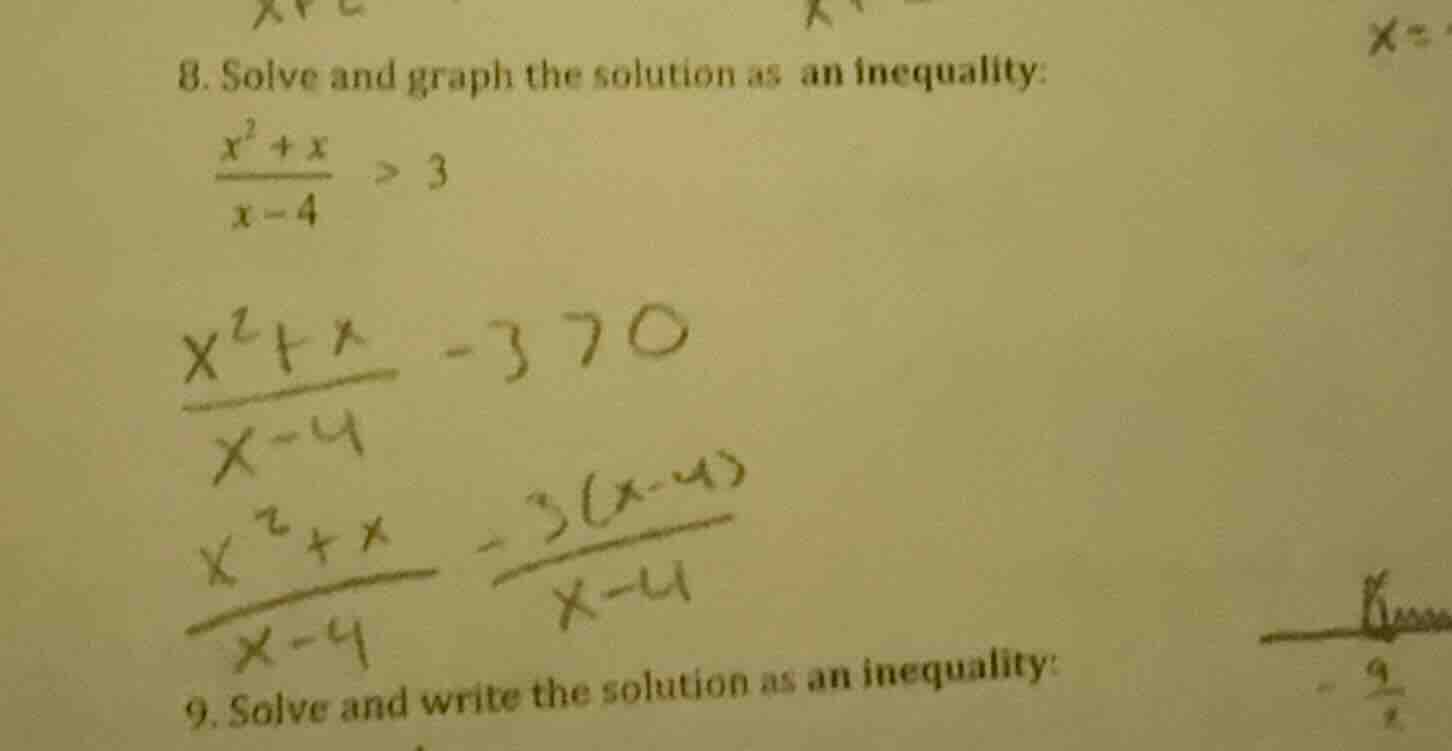
- solve and graph the solution as an inequality:
\\(\frac{x^2 + x}{x - 4} > 3\\)
\\(\frac{x^2 + x}{x - 4} - 3 > 0\\)
\\(\frac{x^2 + x}{x - 4} - \frac{3(x - 4)}{x - 4}\\)
- solve and write the solution as an inequality:
Step1: Rewrite the inequality
Start with \(\frac{x^{2}+x}{x - 4}>3\). Subtract 3 from both sides to get a single fraction: \(\frac{x^{2}+x}{x - 4}-3>0\).
Step2: Get a common denominator
Rewrite 3 as \(\frac{3(x - 4)}{x - 4}\) (note that \(x
eq4\) because the denominator cannot be zero). Then the inequality becomes \(\frac{x^{2}+x-3(x - 4)}{x - 4}>0\).
Step3: Simplify the numerator
Expand and simplify the numerator: \(x^{2}+x-3x + 12=x^{2}-2x + 12\). Wait, discriminant of \(x^{2}-2x + 12\) is \(\Delta=(-2)^{2}-4\times1\times12=4 - 48=-44<0\), so \(x^{2}-2x + 12\) is always positive (since the coefficient of \(x^{2}\) is positive). Wait, maybe I made a mistake in step 2. Let's redo step 2 and 3.
Wait, original inequality: \(\frac{x^{2}+x}{x - 4}>3\). Subtract 3: \(\frac{x^{2}+x}{x - 4}-3=\frac{x^{2}+x-3(x - 4)}{x - 4}=\frac{x^{2}+x-3x + 12}{x - 4}=\frac{x^{2}-2x + 12}{x - 4}\). But as we saw, \(x^{2}-2x + 12=(x - 1)^{2}+11>0\) for all real \(x\). So the sign of \(\frac{x^{2}-2x + 12}{x - 4}\) is determined by the denominator \(x - 4\). Since the numerator is always positive, the inequality \(\frac{x^{2}-2x + 12}{x - 4}>0\) is equivalent to \(x - 4>0\) (because positive divided by positive is positive, positive divided by negative is negative). So \(x - 4>0\) implies \(x>4\). But wait, let's check the original inequality. If \(x>4\), then denominator \(x - 4>0\), numerator \(x^{2}+x>0\) (since \(x>4\) implies \(x^{2}+x=x(x + 1)>0\)), and 3 is positive. Let's test \(x = 5\): \(\frac{25 + 5}{5 - 4}=\frac{30}{1}=30>3\), which works. What if we made a mistake in the algebra? Let's start over.
Alternative approach: \(\frac{x^{2}+x}{x - 4}-3>0\) => \(\frac{x^{2}+x-3x + 12}{x - 4}>0\) => \(\frac{x^{2}-2x + 12}{x - 4}>0\). Since \(x^{2}-2x + 12=(x - 1)^{2}+11\), which is always positive, so the inequality holds when \(x - 4>0\) (because positive over positive is positive), so \(x>4\). But wait, maybe the original problem was written incorrectly? Or maybe I misread the numerator. Wait, the numerator is \(x^{2}+x\), denominator \(x - 4\). Let's try another way. Multiply both sides by \(x - 4\), but we have to consider the sign of \(x - 4\).
Case 1: \(x - 4>0\) (i.e., \(x>4\)). Then multiplying both sides by \(x - 4\) (positive) gives \(x^{2}+x>3(x - 4)\) => \(x^{2}+x>3x - 12\) => \(x^{2}-2x + 12>0\), which is always true (as before). So all \(x>4\) are solutions.
Case 2: \(x - 4<0\) (i.e., \(x<4\)). Then multiplying both sides by \(x - 4\) (negative) reverses the inequality: \(x^{2}+x<3(x - 4)\) => \(x^{2}+x<3x - 12\) => \(x^{2}-2x + 12<0\). But \(x^{2}-2x + 12=(x - 1)^{2}+11\geq11>0\), so no solutions in this case.
So the solution is \(x>4\).

Snap & solve any problem in the app
Get step-by-step solutions on Sovi AI
Photo-based solutions with guided steps
Explore more problems and detailed explanations
The solution to the inequality \(\frac{x^{2}+x}{x - 4}>3\) is \(x>4\), or in interval notation \((4,\infty)\).