QUESTION IMAGE
Question
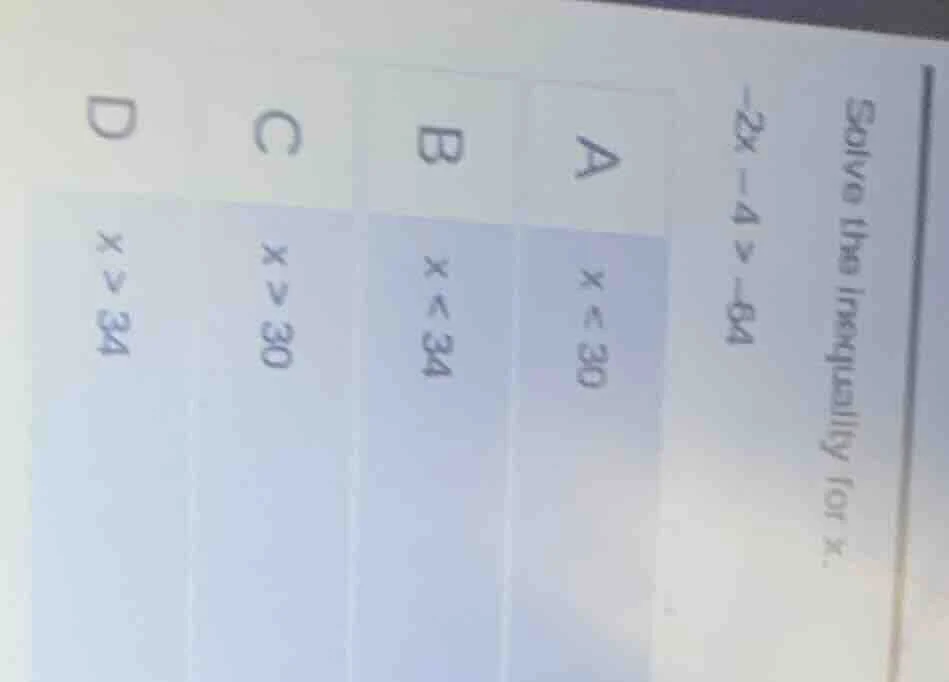
solve the inequality for x.
-2x - 4 > -64
a x < 30
b x < 34
c x > 30
d x > 34
Step1: Add 4 to both sides
To isolate the term with \(x\), we add 4 to both sides of the inequality \(-2x - 4 > -64\). This gives us \(-2x - 4 + 4 > -64 + 4\), which simplifies to \(-2x > -60\).
Step2: Divide by -2 (and reverse inequality)
When dividing an inequality by a negative number, we must reverse the inequality sign. Dividing both sides of \(-2x > -60\) by \(-2\) gives \(x < 30\)? Wait, no, wait. Wait, \(-64 + 4\) is \(-60\), so \(-2x > -60\). Dividing both sides by \(-2\) (and reversing the inequality) gives \(x < 30\)? Wait, no, let's check again. Wait, the original inequality is \(-2x - 4 > -64\). Let's do it step by step.
Wait, maybe I made a mistake. Let's start over.
Original inequality: \(-2x - 4 > -64\)
Step 1: Add 4 to both sides: \(-2x - 4 + 4 > -64 + 4\) => \(-2x > -60\)
Step 2: Divide both sides by \(-2\). When dividing by a negative number, the inequality sign flips. So \(\frac{-2x}{-2} < \frac{-60}{-2}\) (because we divided by a negative number, we reverse the > to <). So \(x < 30\)? Wait, but the options are A: \(x < 30\), B: \(x < 34\), C: \(x > 30\), D: \(x > 34\). Wait, maybe I misread the original inequality. Let me check the image again. The inequality is \(-2x - 4 > -64\)? Wait, maybe it's \(-2x - 4 > -68\)? No, the image shows \(-2x - 4 > -64\). Wait, let's recalculate \(-64 + 4 = -60\), so \(-2x > -60\), divide by -2: \(x < 30\), which is option A. Wait, but maybe the original inequality is different. Wait, maybe the user made a typo, but based on the given, let's proceed.
Wait, maybe I made a mistake in the arithmetic. Let's check:
If the inequality is \(-2x - 4 > -64\), then:
Add 4 to both sides: \(-2x > -64 + 4 = -60\)
Divide both sides by -2 (reverse inequality): \(x < \frac{-60}{-2} = 30\)
So \(x < 30\), which is option A.
Wait, but let's confirm. Let's test with x = 29 (which is less than 30). Plug into \(-2x - 4\): \(-2(29) - 4 = -58 - 4 = -62\). Is \(-62 > -64\)? Yes, because -62 is to the right of -64 on the number line. Now test x = 30: \(-2(30) - 4 = -60 - 4 = -64\). The inequality is > -64, so -64 is not greater than -64, so x < 30 is correct.
So the solution is \(x < 30\), which is option A.

Snap & solve any problem in the app
Get step-by-step solutions on Sovi AI
Photo-based solutions with guided steps
Explore more problems and detailed explanations
A. \(x < 30\)