QUESTION IMAGE
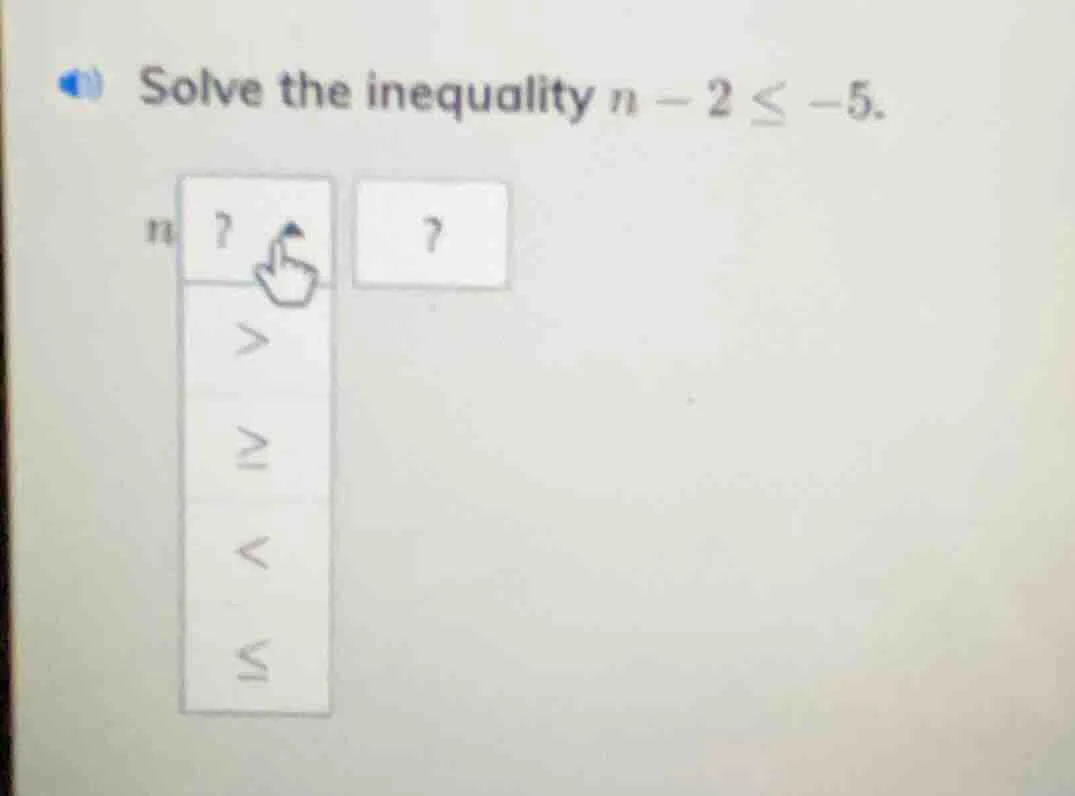
Question
solve the inequality $n - 2 \leq -5$.
Step1: Add 2 to both sides
To solve the inequality \( n - 2 \leq -5 \), we add 2 to both sides of the inequality. This is based on the addition property of inequalities, which states that if we add the same number to both sides of an inequality, the direction of the inequality remains the same.
\[
n - 2 + 2 \leq -5 + 2
\]
Step2: Simplify both sides
Simplifying the left - hand side, \( n-2 + 2=n \). Simplifying the right - hand side, \( -5 + 2=-3 \). So we get:
\[
n\leq - 3
\]
But in the given problem, we are comparing with 7. Since \( - 3<7 \) and the inequality we derived is \( n\leq - 3 \), the inequality sign between \( n \) and 7 should be \( \leq \)? Wait, no, let's re - evaluate. Wait, maybe there is a mis - understanding. Wait, the original inequality is \( n - 2\leq - 5 \), solving it gives \( n\leq - 3 \). Now, we need to see the relationship between \( n \) (where \( n\leq - 3 \)) and 7. Since all values of \( n \) ( \( n\leq - 3 \)) are less than or equal to - 3, and - 3 is less than 7, so \( n\leq7 \)? Wait, no, let's do it again. Wait, maybe the problem is presented in a different way. Wait, the inequality is \( n - 2\leq - 5 \), let's solve it properly.
Adding 2 to both sides: \( n\leq - 5 + 2=-3 \). Now, we need to fill in the symbol between \( n \) and 7. Since \( n\leq - 3 \), and - 3 is less than 7, so \( n\leq7 \)? Wait, no, if \( n\leq - 3 \), then \( n \) is definitely less than or equal to 7? Wait, no, all numbers less than or equal to - 3 are also less than 7. But let's check the solving process again. Wait, maybe the problem is a bit mis - presented, but following the solving of \( n - 2\leq - 5 \) gives \( n\leq - 3 \). Now, comparing \( n \) (with \( n\leq - 3 \)) and 7, since \( - 3<7 \), and \( n\leq - 3 \), then \( n\leq7 \)? Wait, no, actually, if \( n\leq - 3 \), then \( n \) is less than 7, and also \( n\leq7 \) (because if \( n\leq - 3 \), then \( n \) is also less than or equal to 7). But let's go back to the solving of the inequality \( n - 2\leq - 5 \):
- Start with \( n - 2\leq - 5 \)
- Add 2 to both sides: \( n\leq - 5+2=-3 \)
Now, we need to choose the symbol between \( n \) and 7. Since \( n\leq - 3 \), and \( - 3<7 \), so \( n\leq7 \)? Wait, no, maybe the problem has a typo, but based on the solving of the inequality \( n - 2\leq - 5 \), we get \( n\leq - 3 \), and since \( - 3<7 \), the correct symbol between \( n \) and 7 is \( \leq \)? Wait, no, let's think differently. Wait, maybe the problem is to solve \( n - 2\leq - 5 \) and then compare \( n \) with 7. Since \( n\leq - 3 \), and \( - 3<7 \), so \( n<7 \) or \( n\leq7 \)? But since \( n\leq - 3 \), \( n \) is less than or equal to - 3, so \( n \) is also less than or equal to 7 (because - 3 is less than 7). But let's check the inequality signs. The options are \( >,\geq,<,\leq \).
Since \( n\leq - 3 \), and - 3 is less than 7, so \( n\leq7 \) (because if \( n\leq - 3 \), then \( n \) is less than or equal to 7). But let's confirm with the solving steps.

Snap & solve any problem in the app
Get step-by-step solutions on Sovi AI
Photo-based solutions with guided steps
Explore more problems and detailed explanations
The inequality \( n - 2\leq - 5 \) is solved as follows:
- Add 2 to both sides: \( n\leq - 5 + 2=-3 \)
- Since \( n\leq - 3 \) and \( - 3<7 \), the relationship between \( n \) and 7 is \( n\leq7 \) (but actually, from the solving of the original inequality, we have \( n\leq - 3 \), and all \( n \) satisfying \( n\leq - 3 \) also satisfy \( n\leq7 \)). So the symbol to fill is \( \leq \). Wait, but let's check again. Wait, maybe the problem is presented in a way that after solving \( n - 2\leq - 5 \) (getting \( n\leq - 3 \)), we need to see the relation between \( n \) and 7. Since \( n\leq - 3 \), and - 3 is less than 7, so \( n\leq7 \) (because if \( n\leq - 3 \), then \( n \) is less than or equal to 7). So the answer is \( n\leq7 \), so the symbol is \( \leq \).