QUESTION IMAGE
Question
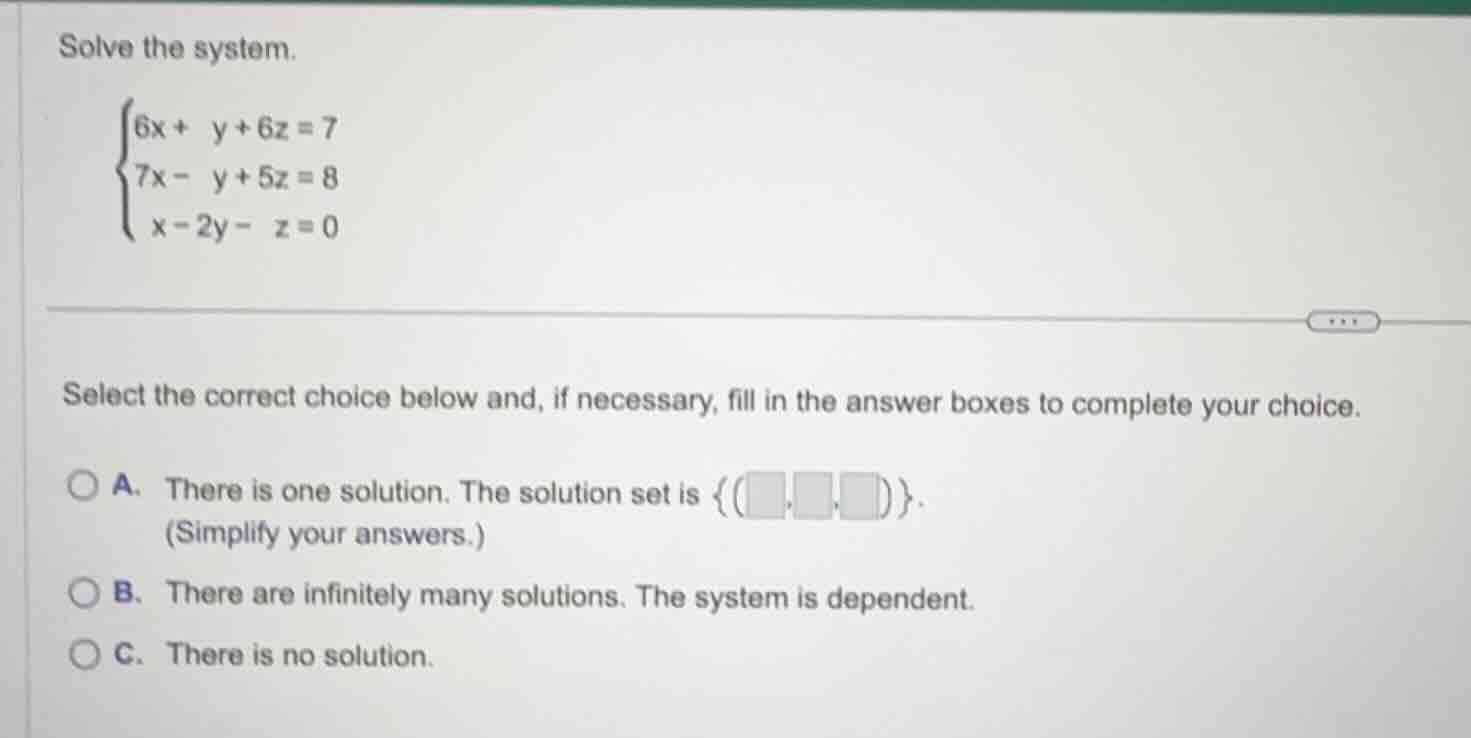
solve the system.\\\
\select the correct choice below and, if necessary, fill in the answer boxes to complete your choice.\
\
\\(\boldsymbol{\circ}\\) a. there is one solution. the solution set is \\(\\{ (\square, \square, \square) \\}\\).\
(simplify your answers.)\
\\(\boldsymbol{\circ}\\) b. there are infinitely many solutions. the system is dependent.\
\\(\boldsymbol{\circ}\\) c. there is no solution.
Step1: Eliminate \( y \) from first two equations
Add the first equation \( 6x + y + 6z = 7 \) and the second equation \( 7x - y + 5z = 8 \):
\( (6x + y + 6z)+(7x - y + 5z)=7 + 8 \)
Simplify: \( 13x + 11z = 15 \) (Equation 4)
Step2: Eliminate \( y \) from second and third equations
Multiply the second equation \( 7x - y + 5z = 8 \) by 2: \( 14x - 2y + 10z = 16 \)
Subtract the third equation \( x - 2y - z = 0 \) from it:
\( (14x - 2y + 10z)-(x - 2y - z)=16 - 0 \)
Simplify: \( 13x + 11z = 16 \) (Equation 5)
Step3: Analyze Equation 4 and 5
Equation 4: \( 13x + 11z = 15 \)
Equation 5: \( 13x + 11z = 16 \)
Subtract Equation 4 from Equation 5: \( 0 = 1 \), which is a contradiction.

Snap & solve any problem in the app
Get step-by-step solutions on Sovi AI
Photo-based solutions with guided steps
Explore more problems and detailed explanations
C. There is no solution.