QUESTION IMAGE
Question
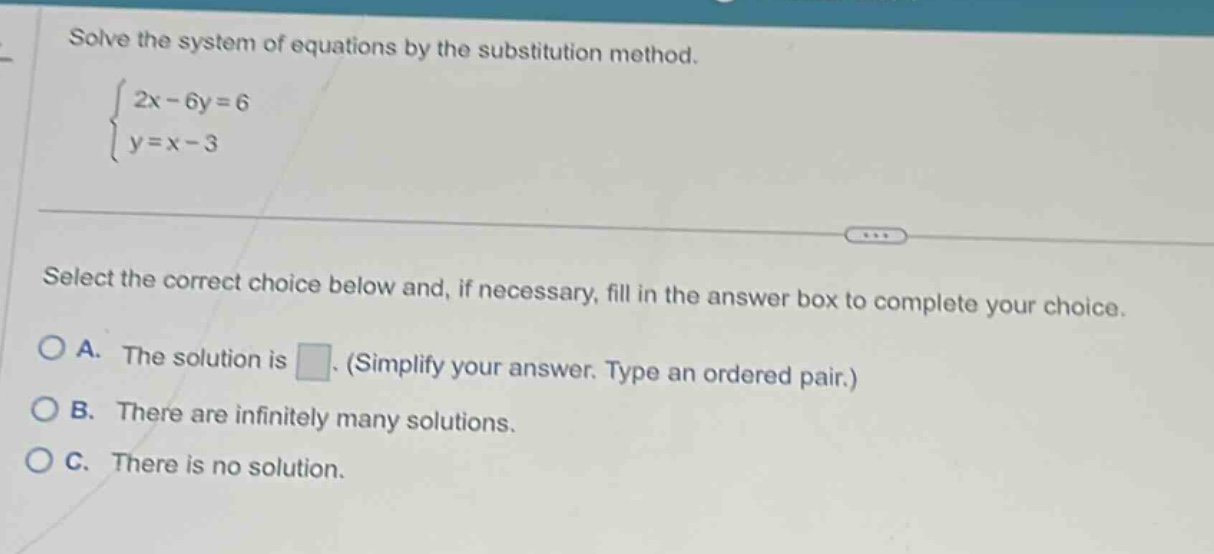
solve the system of equations by the substitution method.\
\select the correct choice below and, if necessary, fill in the answer box to complete your choice.\\(\bigcirc\\) a. the solution is \\(\square\\). (simplify your answer. type an ordered pair.)\\(\bigcirc\\) b. there are infinitely many solutions.\\(\bigcirc\\) c. there is no solution.
Step1: Substitute \( y = x - 3 \) into \( 2x - 6y = 6 \)
Substitute \( y \) in the first equation: \( 2x - 6(x - 3) = 6 \)
Step2: Simplify the equation
Expand and simplify: \( 2x - 6x + 18 = 6 \)
Combine like terms: \( -4x + 18 = 6 \)
Subtract 18 from both sides: \( -4x = 6 - 18 \)
\( -4x = -12 \)
Divide by -4: \( x = \frac{-12}{-4} = 3 \)
Step3: Find \( y \) using \( y = x - 3 \)
Substitute \( x = 3 \) into \( y = x - 3 \): \( y = 3 - 3 = 0 \)
Wait, but let's check again. Wait, when we substitute \( y = x - 3 \) into \( 2x - 6y = 6 \), let's do it again:
\( 2x - 6(x - 3) = 6 \)
\( 2x - 6x + 18 = 6 \)
\( -4x = 6 - 18 = -12 \)
\( x = 3 \), then \( y = 3 - 3 = 0 \). But wait, let's check if these values satisfy the first equation.
First equation: \( 2(3) - 6(0) = 6 - 0 = 6 \), which matches the right-hand side. Second equation: \( y = 3 - 3 = 0 \), which is correct. But wait, actually, let's see the two equations. The second equation is \( y = x - 3 \), which can be rewritten as \( x - y = 3 \), and the first equation \( 2x - 6y = 6 \) can be divided by 2 to get \( x - 3y = 3 \). Wait, no, wait: \( 2x - 6y = 6 \) divided by 2 is \( x - 3y = 3 \). And the second equation is \( y = x - 3 \) or \( x - y = 3 \). Wait, these are two different lines? Wait, no, wait, my mistake earlier. Wait, let's rewrite the first equation:
\( 2x - 6y = 6 \) can be simplified by dividing all terms by 2: \( x - 3y = 3 \).
The second equation is \( y = x - 3 \), which can be rewritten as \( x - y = 3 \).
Now, let's solve the system of \( x - 3y = 3 \) and \( x - y = 3 \).
Subtract the second equation from the first: \( (x - 3y) - (x - y) = 3 - 3 \)
\( x - 3y - x + y = 0 \)
\( -2y = 0 \)
\( y = 0 \), then \( x = 3 \) (from \( x - y = 3 \), so \( x = 3 + y = 3 + 0 = 3 \)). So the solution is \( (3, 0) \). But wait, but let's check the original substitution again. Wait, maybe I made a mistake in the initial check. Wait, the first equation is \( 2x - 6y = 6 \), with \( x = 3 \), \( y = 0 \): \( 2*3 - 6*0 = 6 \), which is correct. The second equation: \( y = 3 - 3 = 0 \), correct. So the solution is \( (3, 0) \). But wait, actually, let's see the two equations. Wait, the second equation is \( y = x - 3 \), and the first equation can be rewritten as \( 2x - 6y = 6 \) => \( x - 3y = 3 \). Let's express \( x \) from the second equation: \( x = y + 3 \), substitute into the first: \( (y + 3) - 3y = 3 \) => \( y + 3 - 3y = 3 \) => \( -2y + 3 = 3 \) => \( -2y = 0 \) => \( y = 0 \), then \( x = 3 \). So the solution is \( (3, 0) \). But wait, the answer options: option A says the solution is an ordered pair, option B is infinitely many, option C is no solution. But wait, let's check if the two equations are dependent or independent. Wait, the second equation is \( y = x - 3 \), and the first equation is \( 2x - 6y = 6 \), which is equivalent to \( x - 3y = 3 \). Let's see if the second equation can be transformed into the first. The second equation is \( y = x - 3 \) => \( x - y = 3 \). These are two different lines (since their slopes are different: first equation \( x - 3y = 3 \) => \( y = \frac{1}{3}x - 1 \), second equation \( y = x - 3 \), slopes 1/3 and 1, different), so they intersect at one point. Wait, but when I solved earlier, I got \( x = 3 \), \( y = 0 \), which satisfies both equations. Let's verify:
First equation: \( 2(3) - 6(0) = 6 - 0 = 6 \), correct.
Second equation: \( 0 = 3 - 3 \), correct.
So the solution is \( (3, 0) \), so option A.
Wait, but earlier when I thought of dividing the first equation by 2, I got \( x - 3y = 3…

Snap & solve any problem in the app
Get step-by-step solutions on Sovi AI
Photo-based solutions with guided steps
Explore more problems and detailed explanations
A. The solution is \((3, 0)\). (Simplify your answer. Type an ordered pair.)