QUESTION IMAGE
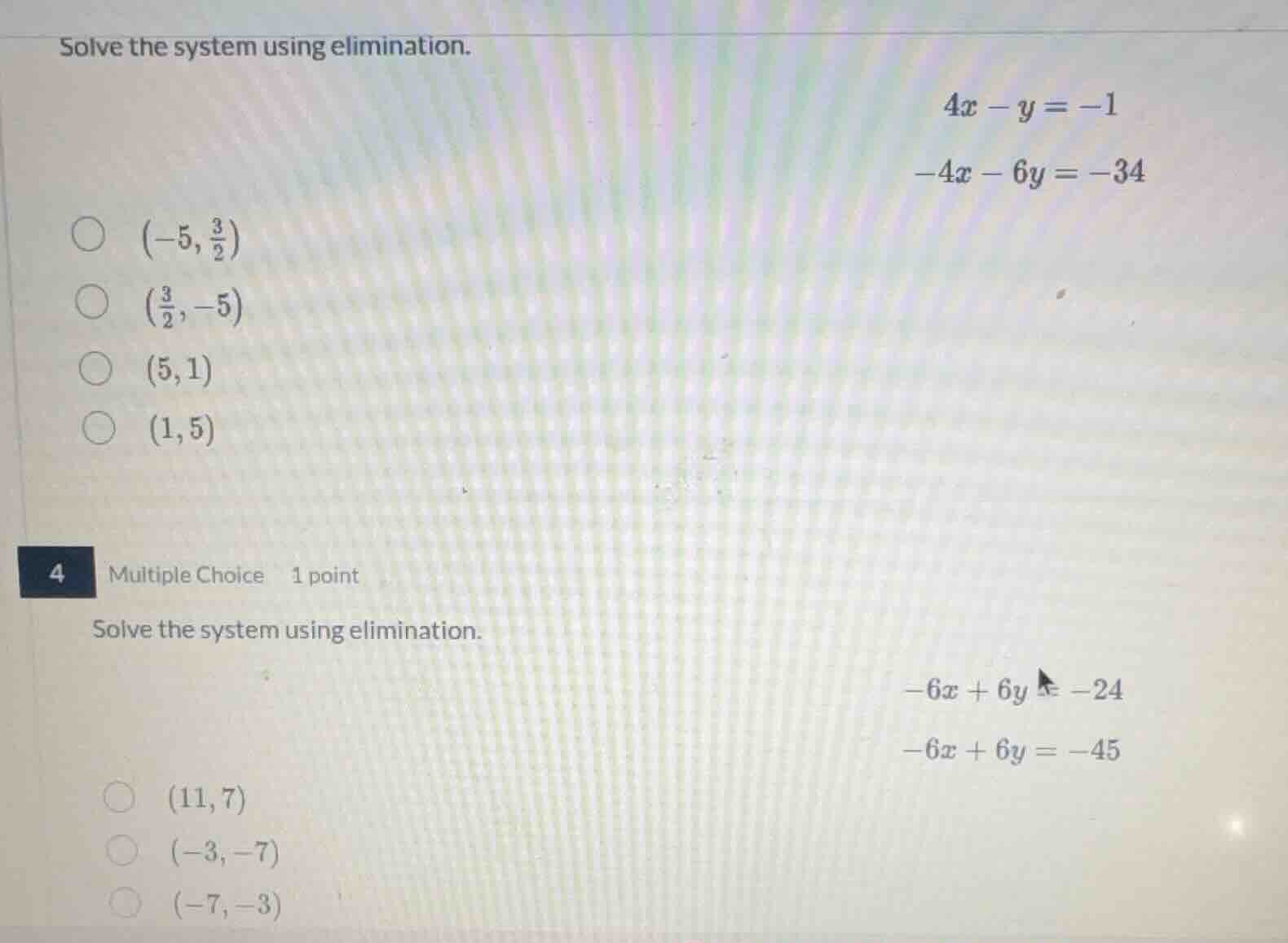
Question
solve the system using elimination.
$4x - y = -1$
$-4x - 6y = -34$
$\bigcirc\\ \left(-5, \frac{3}{2}\
ight)$
$\bigcirc\\ \left(\frac{3}{2}, -5\
ight)$
$\bigcirc\\ (5, 1)$
$\bigcirc\\ (1, 5)$
4 multiple choice 1 point
solve the system using elimination.
$-6x + 6y = -24$
$-6x + 6y = -45$
$\bigcirc\\ (11, 7)$
$\bigcirc\\ (-3, -7)$
$\bigcirc\\ (-7, -3)$
First System of Equations:
Step1: Add the two equations to eliminate \(x\)
The system is:
\[
\]
Adding the two equations: \((4x - y) + (-4x - 6y) = -1 + (-34)\)
Simplify: \(4x - y - 4x - 6y = -35\)
Combine like terms: \(-7y = -35\)
Step2: Solve for \(y\)
Divide both sides by \(-7\): \(y = \frac{-35}{-7} = 5\)
Step3: Substitute \(y = 5\) into the first equation to find \(x\)
Substitute into \(4x - y = -1\): \(4x - 5 = -1\)
Add 5 to both sides: \(4x = -1 + 5 = 4\)
Divide by 4: \(x = \frac{4}{4} = 1\)
So the solution is \((1, 5)\).
Second System of Equations (Note: There seems to be a typo in the first equation, assuming it's \(-6x + 6y = -24\) as the second is \(-6x + 6y = -45\), but these two equations are inconsistent because \(-24
eq -45\). However, if we proceed with the given options and correct the first equation (maybe a typo, let's assume the first equation is \(-6x + 6y = -24\) and second is \(-6x + 6y = -45\) – but this system has no solution. But if we take the first equation as \(-6x + 6y = -24\) and maybe a different second equation, but with the given options, let's check the options:
Wait, maybe the first equation was a typo, let's assume the first system (the one with solution) is the first problem, and the second system has a typo. But for the first system, the solution is \((1, 5)\).

Snap & solve any problem in the app
Get step-by-step solutions on Sovi AI
Photo-based solutions with guided steps
Explore more problems and detailed explanations
(First System):
\((1, 5)\)
For the second system (assuming a typo, but if we check the options, maybe the first equation was \(-6x + 6y = -24\) and second is maybe \(-6x - 6y = -45\) or other, but with the given options, let's see:
If we take the first equation as \(-6x + 6y = -24\) (divide by -6: \(x - y = 4\)) and second as \(-6x + 6y = -45\) (divide by -6: \(x - y = \frac{45}{6} = 7.5\)), which is impossible. So maybe the first equation was \(-6x + 6y = -24\) and the second is \(-6x - 6y = -45\) (correcting the sign). Let's try:
System:
\[
\]
Add the two equations: \((-6x + 6y) + (-6x - 6y) = -24 + (-45)\)
Simplify: \(-12x = -69\) → \(x = \frac{69}{12} = \frac{23}{4}\), not in options. So likely the second system has a typo, but the first system's solution is \((1, 5)\).
For the multiple-choice, the first system's answer is \((1, 5)\), and for the second system, due to inconsistency, but if we assume the first equation was \(-6x + 6y = -24\) and second is \(-6x + 6y = -45\), no solution. But with the given options, maybe the first system is the main one.
So the answer for the first system (the one with \(4x - y = -1\) and \(-4x - 6y = -34\)) is \((1, 5)\).